Showing posts with label Camera. Show all posts

Monday, 8 December 2008

I have two hands and with them I touch the world

I have two hands, and with them, I touch the world.


In the post release discussions of Far Cry 2 that I have read few others have mentioned what I think is perhaps the single most genre-innovating aspect of the game. The first person shooter’s de rigeur level of interaction is based on weapons – usually guns. Since as far back as Doom and earlier however, the ‘fist’ or ‘gauntlet’ or other hand-held melee device has been a present reminder that a person can readily do other things with their hands than simply aim and squeeze a trigger. Far Cry 2 takes note, and says ‘alright, let’s see what that means for the FPS’.


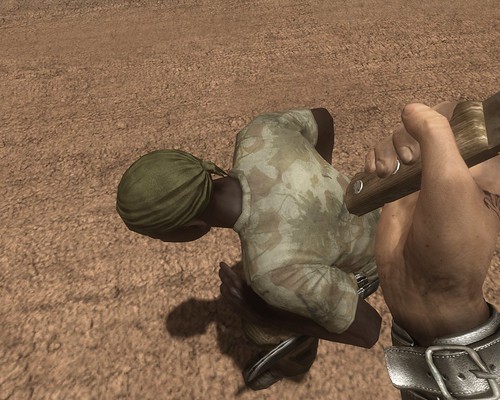
The things my hands hath wrought in Far Cry 2 are as varied as their real world counterparts – they are utilitarian, opening doors and containers, picking up objects like weapons, briefcases and diamonds. Immersion in the first person perspective is apparently paramount, and the realistic application of my hand to a door-handle is one small detail that is by no means lost on this author. The ‘procedural animation’ system makes my hand always appear to touch the object I am reaching for, twisting, collecting, opening. While it is intentionally perhaps not quite as versatile as the animation system in Spore, it doesn’t need to be. Yet it remains a significant raising of the bar for the standards of first person interaction. We will see only in time whether those standards are met, much as I suggested in my initial post on the game. If Gillen, et al. are to be believed, the Half-Life cycle of influence takes approximately two years, and I would add that the case of Halo seems to follow a similar pattern. That seems an unfortunately long time to wait for someone who, like me, is now well and truly ensnared by the Far Cry 2 immersion factor.
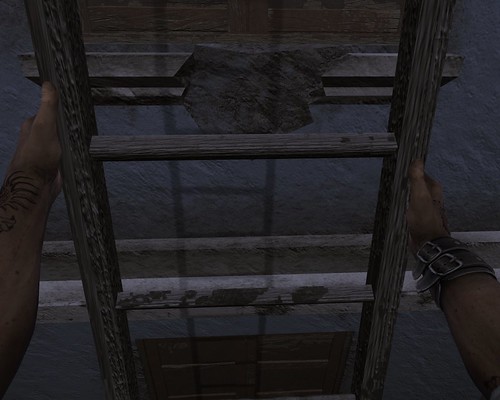


My hands are also my last saving grace when an explosion or gunshot wound renders me close to death, and given sufficient time can work their restorative magic upon the rest of my body. Indeed they themselves appear to miraculously heal from wounds that were inflicted mere moments earlier – an interesting parallel with the gradual healing of whole body wounds which we now take for granted and which are, admittedly, perhaps even sillier in concept than the somewhat arbitrary hit-point ‘n’ health pack combo paradigm they seem to universally have replaced. However I would not wish a return to those heady days of fighting Nazi’s on 5 hp as a result of an inability to find a health pack within arms reach. After all, the health pack only allows me to increase a semi arbitrary numerical value that somehow represents my ‘wellness’ and distance from death. Admittedly, auto regenerating health and body parts vastly improves game flow and rhythm – but it remains an abstraction. Still, even on that front Far Cry 2 proposes a slightly more refined version: Take too much of a beating and your health won’t regenerate beyond a certain point. That is, only until you stop to pump some more morphine into your blood stream – delivered via your hands and lower arms, of course – a novel mix of the arbitrary health pack and the auto regeneration systems.


Lastly, my hands are more than up to the task of bringing swift retribution to those who would visit violence on my own body. After all the above, this almost seems like the least interesting possibility, and I wonder whether compared to the amount of time spent holding a map in your hands or steering a vehicle, this last option does not actually plateau into a more even distribution. My hands are, after all, the most prominent manifestation of my avatar that I see through the game – and that they should spend most of their time trying to kill and maim others starts to seem oddly nihilistic. Then again, that is what the game’s about isn’t it?


Friday, 24 October 2008

Far Cry 2: Wrongs and Rights

**SPOILER ALERT: These are mostly gameplay-related spoilers, but if you are trying to steer clear of anything and everything to do with the game before it comes out then perhaps you should stop reading now.**


Like just about every videogame in history, Far Cry 2 does some things well, and some things not so well. Lets get the wrong things out of the way first.


Okay, so FC2 has some of the same ‘open world’ problems shared by GTA, Oblivion and STALKER. While browsing an internet forum, I encountered a great and humorous way to sum it up (colourful language warning!). User ‘cpd’ said:

think gta but apartheid africa. plus fucking malaria FUCK OFF FUCKING PILLS

oh and the fact that EVERY c*** wants to shoot you. EVERY SINGLE JEEP will immediately swerve into your path to shoot the living fuck out of you. get out, kill them, repair jeep, drive 100m up the road, repeat.

So it can be kind of repetitive, and frustratingly so – but I’m kind of okay with some of that. I recognize a lot of people probably won’t be, but it kind of ties into the sense of space and physicality that I'll mention later on. I am, however, a guy who has played and nearly completed Oblivion with mods to disable fast-traveling (i.e. played the whole game on horse or foot), so maybe that rules me out. FC2 is at least as large as Oblivion, so getting around can at points become a large part of the game. While there are plenty of cars and utes lying around, the problem comes with transitions to fighting – you either have to get out of your car which takes precious time, or swap to a turret if you vehicle has one leaving you stationary and exposed. Perhaps this issue will be solved later on with the addition of someone riding shotgun, I will admit to only being about 8% of the way through (after nearly 6 hours I might add).


And the good!


The ‘buddy system’ is awesome. Specifically, the fact that if you die and you have a live buddy rested and waiting, they will immediately rush to your side, in a bid to save your life. They’ll pick you up, shoot most of the nearby enemies for you, and give you some breathing room to patch yourself up. It really does solve one of the biggest and most fundamental problems with player death – lets face it, reloading from a save game isn’t exactly all that fun. So it makes sense to do away with it if you can. John Walker from Rock, Paper, Shotgun (who I quoted in my last blog post) wrote back in September about the issue. He said,


I want a high profile, big budget, mainstream action game in which the player character is invincible. I believe that the next truly great game will be the one that does this.[1]


Far Cry 2 doesn’t make you invincible, but the number of times I have accidentally ‘died’ and have just begun to reach for the quick-load button only to fall into the arms or my buddy’s saving embrace, are many.


The other thing that Far Cry 2 does extremely well (and this is the one that I think everyone will or should be talking about soon) is give you a sense of embodiment within the world. As Steven Gaynor (Fullbright) pointed out over Twitter, ‘An FPS that visualizes your hand turning doorknobs? I think I'm in love.’[2] The comparison I couldn’t help but keep making was to Bioshock which often took control of the player and their hands to perform actions, usually in its on-the-rails cutscenes. In Far Cry 2, your hands are always doing this something and they really feel (to me at least) like they are my hands. Add to this the fact that when you need to you can see your body and legs (mostly in other on-rails sections) and you can start to see the building blocks of a really interesting system for representing the player in a virtual world.


In Far Cry 2 you never change to third person, ever – and this is a really good thing! Unfold your map and you will hold in your hands a map of the African country you're stranded in, represented as just another thing in your hands. Like a gun, but for information and orientation. When driving you can open up the map and hold it in one hand, and the net effect is similar to what you would do if performing a similar action in the real world. Your eyes flit back and forth between map and windscreen, balancing path finding with map-reading. No game has ever done that to me before. Also, getting in and out of a vehicle takes time, and while I decried it earlier as being frustrating in combat, it actually further adds to a sense of embodiment. It feels like I am a real human being with a body that takes a real amount of time to move, not some super ninja that flits around at the slightest twitch of a mouse.


In conclusion, it's too early to tell if Far Cry 2 is the ‘game changer’ that I hoped it would be in my previous post. However, even if it's not, it’s certainly another great step in the right direction, in this author’s humble opinion.


Post Script: Jim Rossignol, lover of all games open and exploratory, has posted his own initial thoughts on the game on Rock, Paper, Shotgun. He's pretty much spot on with everything except the Alt+Tab thing - mine works fine.


[1] http://www.rockpapershotgun.com/2008/09/18/rps-demands-i-want-to-live-forever/

[2] http://twitter.com/fullbright/status/971289072

Wednesday, 10 September 2008

The peaks and perils of First Person Camera


Corvus Elrod and I have been going back and forth over twitter this week about camera's and camera choice in games, and he's written up a series of posts about 3rd person camera (yesterday) as well as 1st person view. And its gotten me thinking about first person perspective games a lot (mostly because they are the kind of game I tend to gravitate towards) and in particular why I think Assassins Creed was actually better for being rendered in third person and conversely why I think Mirrors Edge, while commendable for trying a whole slew of new ideas and daring to be different just generally, is possibly doomed to have some serious problems.

The essential point is the difference in camera angle - where Assassins Creed generally uses a 3rd person over the head view to depict Altair scrambling up the side of buildings, Mirrors Edge uses First Person perspective. So what's great about the first person perspective? Primarily, with a First Person Perspective you get a strong and direct connection with 'you' as the player inside the game. You're are looking out your own characters eyes, after all, and in my opinion this view (with certain caveats) seems natural and instantly relatable; it's closer to the 'normal' way that we view the world from our bodies. Additionally, it allows for very precise actions, most commonly used for aiming weapons such as guns, bows and other projectiles.

Unfortunately there are equally a number of negative aspects with the first person perspective game and which for the sake of brevity I will not attempt to list. However, one aspect I want to foreground in this discussion is highlighted once we start aiming for rather more complex control relationships with our player avatar and ourselves.

Basically I see the issue as one of embodiment in the game-space. As I hinted at in Corvus' original post I don't think that anyone has yet made a first person perspective game where the 'camera' - your embodied view of the world - is anywhere near as flexible as our real world bodily configuration.

We have a pair of eyes that move independently of our heads, and on top of that our heads can also move independently of our torso. The whole history to date of the First Person Perspective game (to the best of my knowledge) has been limited to an avatar that moves his or her eyes, head and torso as one. And this is actually fine... for certain things. It's fine particularly for (surprise, surprise) shooting games as when you aim down the sights of a real-world weapon, you don't move your head or even your eyes far from the target.

Additionally the first person perspective can only give the player so much information about their surroundings. For starters, our display screens for videogames are woefully too small to represent the whole field of vision of the average person, and as such, first person representations of games are going to lose information that the player would have in an identical real-world situation.

Take for example, your feet. Do you have to look down at your feet to know where they are? Of course not. So when Halo makes the player aim down at their feet we just know that some information about the environment is being lost. And you know, this is also fine. As Corvus says, many videogame protagonists are supposedly wearing bulky, vision impairing helmets after all. Except that when playing a game we also lose two (well three if you count taste) other senses that could be delivering information as well! We don't get to feel the world - the cool brush of a breeze on our skin or the crunch of gravel under our feet - or smell the scents in a space. So all this information which we would in reality be receiving about our surroundings, whether consciously or not, is further lost.

I was reading recently the Game Set Watch Column 'Diamond in the Rough - A body in the dark' about the healing system in the most recent Alone in the Dark. The article rightly discusses some of the innovative features of the game and how it encourages embodiment in the game-space, however when I came to this passage I had to stop, suppressing the urge to guffaw.
The effect of all of this is to ground you in the body of your protagonist. You must constantly check yourself for new cuts or bruises, sometimes eliciting a tired shrug from Edward when a visual check reveals no new blemishes.


Okay, am I the only person to think that having to visually check your body for cuts and bruises is actually dis-engaging you from your body? Since when have you ever had to stop and look yourself over only to realise that actually "Oh, I'm bleeding from the stomach".

Yes, granted there have been some times when I have experienced an adrenaline rush that has suppressed the pain of small injuries, and I have heard of people 'shrugging off' larger injuries as well, but if you've got the time to 'look yourself over' you've got the time to take a breather and start feeling the pain!

So, all this gets me to the point of saying, for all the benefits the FPS brings with it's embodied perspective, it comes with a bunch of detractors. And that's why I think Assassins Creed went the right way with 3rd person parkour action. I believe that the use of the third person perspective can partially make up for what we lose in the form of experienced, embodied information about the world.

Just one last quick quote - this time from Clint Hocking of Far Cry 2 talking about their own implementation of specific areas and even types of injury, Hocking responded saying

...a contextual animation [plays] based on the type of injury you received and the location of the injury. If you fell from a cliff, you might have a dislocated ankle that needs to be relocated. If you were shot in the leg, you might need to prise the bullet out with a knife, if you were hit by a grenade blast you might need to pull shrapnel our of your elbow… the idea is to hit the player with a visceral ‘punch’ right at the moment that the intensity is highest and his adrenalin is pumping. The combined effect is to create powerful psychosomatic bonds between the player, the avatar and consequently the world itself.


I think Hocking's got the right idea - whether it's first, third or some odd combination of the two (think Oblivion style interchanging) the aim has to be to convey enough information to the player and about the player so as to aid a sense of embodiment, which only aids in the never-ending quest for 'immersion'. If that's the goal (and the actually result) then I don't really mind which one they choose. Maybe I could even learn to love Mirrors Edge (God knows I really want to!).