Showing posts with label assassins creed. Show all posts

Sunday, 23 August 2009

Assassins Creed Official Soundtrack - A Review

If you’ve only recently joined SLRC, since the start of the Permanent Death story perhaps, you might not know that SLRC started life as a music and videogame blog. We don’t do reviews very often here at SLRC (conveniently, if you ever wish to see that change, feel free to commission me) but today sees a reprisal of an earlier trend in reviewing the music for a videogames – this time it’s Ubisoft’s 2007 title Assassins Creed that gets a thorough once-over.

As a brief aside, this will be my last post for a few weeks as I’m taking a break and dropping off the grid for a few days. I’ll probably be back in late September or early October and will hopefully be recharged and ready to take on the rest of the Permanent Death saga. Enjoy!

The album sets the tone at the opening, introducing in the first track solo voices singing in Arabic over arab-esque scales, as well as chanting monks drenched in reverb evoking cavernous Middle Ages cathedrals. Vocals are an important part of the sonic palette of the Assassins Creed soundtrack and provide a sonic element that aims to capture the unique historical period of the game.

The listener is treated to sparing splashes of flutes and piano melodies underpinned by Arabic style light drum percussion. The major feature of the track ‘Flight through Jerusalem’ is a lament sung almost operatically, and placed in a middle distance giving the sense of being heard from across a city – perhaps the singer is crying out over the rooftops at dawn or dusk. A Middle Eastern guitar-type instrument and a string section carry much of the underlying harmonic content of the song.

The following few tracks on this admittedly rather short album – totaling up to around 40 minutes of music – re-introduce more traditional orchestral instruments to contrast with their ethnic co-players; timpani, drums, tambourines, string and brass section stabs, all make appearances in the first third of the album.

The aptly named ‘Spirit of Damascus’ piece uses what sounds like a background of giant steel-works percussion and the metallic timbre works is stark contrast to the fore-grounded Middle Eastern guitar. The mix and meeting of uncommonly related instruments as heard here mirrors musically what would have been a ‘cultural melting pot’ in the particular area of the middle east Assassins Creed is set in. The meeting of Christian and Islam; West and East, would have produced both clashes and unique opportunities for art and expression. That, and a lot of fighting, obviously.

The piece trails off, and ends far too quickly for such a beautiful track, with a synth bed that evokes the monkish chants on previous tunes. The following track, ‘Trouble in Jerusalem’ (a much longer piece at 4minutes) reprises the steel-percussion of ‘Damascus’ and adds Bootmen-style stompy percussion. A synthetic almost sub-audible bass acts as a powerful counterpoint to the breathy, cloistered monk-ish whisperings in (presumably) Latin on the track ‘Acre Underworld’. The use of harsh-cuts and sample loops that remind one of a broken record at the beginning gives the track a uniquely ‘electronic’ feel, utilizing an effect that cannot be easily replicated without modern technology. It is also possibly the first most prominent artificial sound on the album, or at the least, the fist piece that leans more towards using artificial and created sounds than organic or acoustic ones.

The composer, Jesper Kyd, is a great employer of non-acoustic instrumentation, and electronic instruments and synths alternately shimmer and glisten and stutter throughout the album. The most stand-out use is on the track ‘Access the Animus’, a supremely long piece clocking in at nine minutes and which contains a plethora of razor sharp glass-like samples. Additionally, some kind of synth or sample has been manipulated to sound unnervingly like a leopard or jaguar's roar – appropriate imagery for a piece entitled ‘Access the Animus’ with its title a homonym for “Animism”, a philosophical, religious or spiritual belief common in many non-urbanised, non-westernised civilizations, often accompanied by a reverence for animals (particularly large and powerful ones such as big cats). Admittedly it’s a tenuous connection, but it’s also one I can’t help to make – it really sounds like a jaguar or other big cat to my ear. In addition to being one of the longest pieces, ‘Access the Animus’ also marks the mid-point of the album.

The short piece ‘Dunes of Death’ makes use of metallic percussion and flute or pan-pie sound-alike instruments and also brings back a few splashes of melody on the piano.

A big feature of this album is that many of the towns have specific themes or sound-palettes. For example, Jerusalem-themed tracks almost always employ monks and male choirs, appropriate imagery for the cities strong religious significance to both Christianity and Islam. Compare and contrast with the piece ‘Masyaf in Danger’ which uses none of the same vocal elements, using only a light sprinkling of female synth voices.

The third from last track, ‘Mediation Begins’, has at it’s core Arabic percussion, a steel-stringed Arabic guitar-like instrument, and a melody played on a pipe-flute instrument all sounding so much like a group of street performers. The band fades in and at first the scene could be any of a thousand street corners in the Middle East, however a bed of synth and reverb-soaked synthetic sounds soon appears to underpin the group. The effect, and it is one that is used in many of the pieces, is the juxtaposition of normal surface appearances with underlying tensions and fears – another musical metaphor perhaps for the cultural tensions of the historical period.

‘Meditation of the Assassin’ has almost no organic or instrument sounds. The return of the nearly sub-audible bass from earlier in the album along with ominous whispers and out-of-place, non-harmonic dissonant electronic noises gives the piece a strong sinister feel. The brief appearance of wind chimes is far from reassuring and only further adds to the eeriness of the piece. A quiet Arabic guitar struggles vainly against the overpowering bass towards the middle and end. The final song ‘The Bureau’ is a bit of an anti-climax for an album sprinkled with such a number of great moments.

Overall, the album hangs together quite well, however it is dominated somewhat unflattering by the 9-minute long track ‘Access the Animus’ which, despite covering a variety of rhythmic and instrumental feels throughout its duration, still feels like it drags too long. Add to this the fact that some of the more intriguing pieces are overly short and the album is left feeling lopsided and uneven. It does, thankfully, avoid the common pitfall of other videogame soundtracks and avoids any awkward song transitions or strange stops and starts.

Ultimately, however, if the listener does not have the same level of positive associations with the music generated through playing the actual game of Assassins Creed as I acknowledge I have, I think it would ultimately prove a largely unsatisfying listening experience.

The Assassins Creed Official Soundtrack, is composed by Jesper Kyd and has a running time of 40:37.

Wednesday, 15 April 2009

The Raider, The Prince and The Assassin

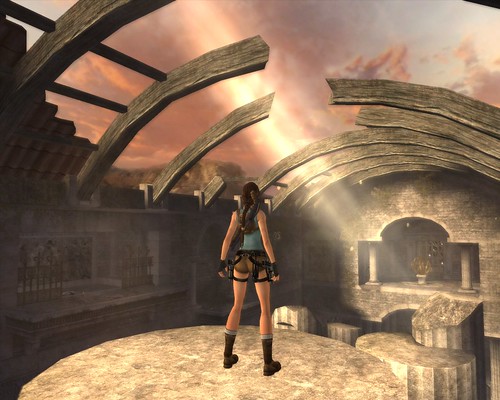
Another Steam weekend sale was the entry vehicle for my first foray into the Tomb Raider series since the third instalment on the PlayStation One in the late nineties. The series had since changed developers and I had heard whisperings the game had received a positive rebooting. Tomb Raider Anniversary had certainly changed, and indeed for the better, the controls having escaped the “forwards/backwards, turn left/turn right only” paradigm and decided to rejoin the rest of the 3D platformer fraternity in allowing for agile changes in direction more reflective of normal human movement. Strafing and the ability to move much more naturally bring the game into the 21st Century and encourage an enjoyable level of exploration and navigation of the characteristically over-complicated world.

The game stands or falls on the strength of its level design – the fun in running; jumping; climbing; swinging is what the game wants to give the player and it necessitates some rather elaborately trapped tombs and other remnants of past inhabitation in order for the player to have a flipping great time (pun intended). But these elaborate death-traps can come in a couple of forms in TRA – in the early stages they are often just minor setbacks – a bit of lost health or a missed jump that needs to be attempted again. By the time the player has reached the second chapter of the game – set in a beautiful Grecian monastery – the traps and tasks the developers for the player to traverse become decidedly binary in a kind of ‘pass/fail’ way.

One of my personal favourite game developers for talking about game design is Clint Hocking and at the recent Game Developers Conference he gave a talk about the ‘rhythm’ of his most recent game, Far Cry 2. He explained that the game was designed in such a way as to present a myriad number of small setbacks to the player at any given time, and he called this ‘analogue failure’. Examples of this are when a player’s gun unexpectedly jams in the middle of a firefight and they are caught unawares while they clear the jam. As a part of the design of the game there are a plethora of systems all working against the player to provide these minor setbacks (malaria attacks, the wounding system, procedural fire propagation, etc, etc) and the result is that the rhythm of what the player does in the game takes on a back-and-forth kind structure that Hocking illustrates like this:


Hocking notes that most games are actually not like that, particularly on that micro-level of moment-to-moment play. Instead, depending on which part of the composition/execution split they favour they will either be more puzzle-like (if they favour a long composition phase while the player figures out what they have to do) or more like a theme park ride (if they have short composition phase and long execution).

Coming back to Tomb Raider Anniversary, the the second chapter gets really frustrating for me largely because the composition/execution balance in the game, along with the cost of failure being unrelentingly binary, means that whenever I get kicked out of the execution phase I don’t usually even get to reformulate my plan. Instead I just have to try the ‘execution’ again until I get it right.

There is no room for slight slip ups in TRA. The number of times I have botched a single jump in the ‘execution’ phase, knowing full well what I wanted to do but was simply unable to execute it because of either haste with controls or lack of skill, I have lost count. Anecdotally, the first section of the second chapter has a time trial aim of 34 minutes for completion, but in the end it took me 4 hours plus spare change to finally manage to do everything the designers were asking of me.


So this idea of ‘analogue failure’ is an important one – what Hocking points out in most games happens in TRA. When we fail in execution, we are usually faced with a load screen and gets stuck replaying the (increasingly tedious via repetition) execution phase. As Hocking said in the presentation, it’s like the developers are training us to jump through hoops, and both he and I find it personally unfulfilling.

An aggravating factor in the above scenario is the length of the execution phase – when the player fails it can take a good several minutes to get back to just the same spot in order to try again and if we were to measure the cost of failure in time (As suggested by videogame academic Jesper Juul’s GDC talk about balancing difficulty) we can see from my own 4x the recommended time that I was being severely punished.

One answer to this problem is the Prince of Persia solution, and you can take either ‘Sands of Time’ or the newer reboot. Both titles reset the player (or give them the opportunity to reset via rewinding time) to the point just prior to the ‘failure’ that would otherwise have ended their game. Thus, the execution phase is stopped from becoming the bloated, frustrating time-waste that it so easily becomes in Tomb Raider Anniversary. Still, whenever the player fails in execution, all that exists is re-execution. There is usually no re-composition involved.

Lastly, we can look at Assassins Creed for another example. Say what you will about the main game, the fact remains that the developers got the act of moving and navigating a crowded cityspace so right. Whenever you fall from a rooftop, whether you either failed in your planned execution or you are knocked off by a pursuing guard, you rarely die in Assassins Creed. Instead of being thrown back to a load screen, Altair experiences an amount of ‘analogue failure’ as the game pushed back against the player. Ultimately, the player picks himself up, dusts himself off and starts to recompose a route through the city again. You don’t even get to retry your execution unless you specifically go back to the point you failed from. In fact, there’s also little reason to since the failure is not binary, and less strictly win/lose than in Tomb Raider Anniversary or Prince of Persia. It only so much resembles the player being kicked out of execution phase and being placed back into the composition phase, much like Hocking described in Far Cry 2.

Now if you’ll excuse me, I think I have another game obsession to cultivate.

Wednesday, 10 September 2008

The peaks and perils of First Person Camera


Corvus Elrod and I have been going back and forth over twitter this week about camera's and camera choice in games, and he's written up a series of posts about 3rd person camera (yesterday) as well as 1st person view. And its gotten me thinking about first person perspective games a lot (mostly because they are the kind of game I tend to gravitate towards) and in particular why I think Assassins Creed was actually better for being rendered in third person and conversely why I think Mirrors Edge, while commendable for trying a whole slew of new ideas and daring to be different just generally, is possibly doomed to have some serious problems.

The essential point is the difference in camera angle - where Assassins Creed generally uses a 3rd person over the head view to depict Altair scrambling up the side of buildings, Mirrors Edge uses First Person perspective. So what's great about the first person perspective? Primarily, with a First Person Perspective you get a strong and direct connection with 'you' as the player inside the game. You're are looking out your own characters eyes, after all, and in my opinion this view (with certain caveats) seems natural and instantly relatable; it's closer to the 'normal' way that we view the world from our bodies. Additionally, it allows for very precise actions, most commonly used for aiming weapons such as guns, bows and other projectiles.

Unfortunately there are equally a number of negative aspects with the first person perspective game and which for the sake of brevity I will not attempt to list. However, one aspect I want to foreground in this discussion is highlighted once we start aiming for rather more complex control relationships with our player avatar and ourselves.

Basically I see the issue as one of embodiment in the game-space. As I hinted at in Corvus' original post I don't think that anyone has yet made a first person perspective game where the 'camera' - your embodied view of the world - is anywhere near as flexible as our real world bodily configuration.

We have a pair of eyes that move independently of our heads, and on top of that our heads can also move independently of our torso. The whole history to date of the First Person Perspective game (to the best of my knowledge) has been limited to an avatar that moves his or her eyes, head and torso as one. And this is actually fine... for certain things. It's fine particularly for (surprise, surprise) shooting games as when you aim down the sights of a real-world weapon, you don't move your head or even your eyes far from the target.

Additionally the first person perspective can only give the player so much information about their surroundings. For starters, our display screens for videogames are woefully too small to represent the whole field of vision of the average person, and as such, first person representations of games are going to lose information that the player would have in an identical real-world situation.

Take for example, your feet. Do you have to look down at your feet to know where they are? Of course not. So when Halo makes the player aim down at their feet we just know that some information about the environment is being lost. And you know, this is also fine. As Corvus says, many videogame protagonists are supposedly wearing bulky, vision impairing helmets after all. Except that when playing a game we also lose two (well three if you count taste) other senses that could be delivering information as well! We don't get to feel the world - the cool brush of a breeze on our skin or the crunch of gravel under our feet - or smell the scents in a space. So all this information which we would in reality be receiving about our surroundings, whether consciously or not, is further lost.

I was reading recently the Game Set Watch Column 'Diamond in the Rough - A body in the dark' about the healing system in the most recent Alone in the Dark. The article rightly discusses some of the innovative features of the game and how it encourages embodiment in the game-space, however when I came to this passage I had to stop, suppressing the urge to guffaw.
The effect of all of this is to ground you in the body of your protagonist. You must constantly check yourself for new cuts or bruises, sometimes eliciting a tired shrug from Edward when a visual check reveals no new blemishes.


Okay, am I the only person to think that having to visually check your body for cuts and bruises is actually dis-engaging you from your body? Since when have you ever had to stop and look yourself over only to realise that actually "Oh, I'm bleeding from the stomach".

Yes, granted there have been some times when I have experienced an adrenaline rush that has suppressed the pain of small injuries, and I have heard of people 'shrugging off' larger injuries as well, but if you've got the time to 'look yourself over' you've got the time to take a breather and start feeling the pain!

So, all this gets me to the point of saying, for all the benefits the FPS brings with it's embodied perspective, it comes with a bunch of detractors. And that's why I think Assassins Creed went the right way with 3rd person parkour action. I believe that the use of the third person perspective can partially make up for what we lose in the form of experienced, embodied information about the world.

Just one last quick quote - this time from Clint Hocking of Far Cry 2 talking about their own implementation of specific areas and even types of injury, Hocking responded saying

...a contextual animation [plays] based on the type of injury you received and the location of the injury. If you fell from a cliff, you might have a dislocated ankle that needs to be relocated. If you were shot in the leg, you might need to prise the bullet out with a knife, if you were hit by a grenade blast you might need to pull shrapnel our of your elbow… the idea is to hit the player with a visceral ‘punch’ right at the moment that the intensity is highest and his adrenalin is pumping. The combined effect is to create powerful psychosomatic bonds between the player, the avatar and consequently the world itself.


I think Hocking's got the right idea - whether it's first, third or some odd combination of the two (think Oblivion style interchanging) the aim has to be to convey enough information to the player and about the player so as to aid a sense of embodiment, which only aids in the never-ending quest for 'immersion'. If that's the goal (and the actually result) then I don't really mind which one they choose. Maybe I could even learn to love Mirrors Edge (God knows I really want to!).