Showing posts with label indie games. Show all posts

Friday, 30 January 2009

Jan 09 Round Table: The New Testament for Windows, Mac OS and Linux


Jan 09 Round Table - Putting the Game Before the Book: What would your favorite piece of literature look like if it had been created as a game first? …rather than challenge you to imagine the conversion of your favorite literature into games, I challenge you to supersede the source literature and imagine a game that might have tried to communicate the same themes, the same message, to its audience.


Now I know the New Testament of the Bible is not strictly speaking one book, it’s made up of a bunch of them and they’re written by a number of different authors, however many Christians like to think of the Bible as expressing a single idea – or rather more specifically, the single voice of God. There are, as you may or may not know, many different views, perspectives and beliefs on how to read the Bible – all too many to count and list here in fact. So I will instead explain how and why I read the Bible in my own fallibility and imperfection and then get onto the interesting business of imagining how “The New Testament: The Videogame” (for Windows, Mac & Linux) would play and what it would be like if it were originally authored as a videogame.


I read the Bible because I do believe that it really is some kind of ‘designer’s handbook’ for life and living. And I believe in the central figure of the story – you know, that Jesus guy. Yeah he’s alright with me. However, I’m not altogether convinced at the moment that the Bible is as infallible as the institution often portrays and I similarly struggle to believe that it’s entirely reflective of exactly and specifically the intent of the author (talking about God as the author in this case not the human writers) but there are still plenty of people that do. And there are also plenty of people that think Braid is exactly authored the way Jonathan Blow wanted it to be. (Admittedly, that is rather a reduction of their arguments and points about the games, but an overarching theme of much of the discussion has been ‘what Blow was doing’ with the game and it’s hardly been studied in from the modernistic perspective as an independent work, studied in a vacuum if you will, with one notable exception.)


So let’s pretend that God sent his son Jesus to earth not in the first century but in the twenty-first instead. Two points make The New Testament for Windows, Mac OS and Linux a convincing possibility. Firstly, knowing that Jesus was a pretty contemporary dude for his time, it makes sense that he’d encourage his followers to be down with the ways and the means of the time. The 12 apostles would probably have held wicked awesome Halo LAN parties and frag each other late into the night, trash talking about who was greatest in the kingdom of Halo and all that. It would probably get a bit out of hand when Judas started TK-ing and the other disciples left Jesus to fight by himself, but somehow the peace would always be kept and a good time would be had by all. Jesus being the prince of peace and all that.


Also, as someone who was dedicated to speaking to people in a way that they could understand, using parables and stories to communicate his message, it seems rather credible that his followers would be just as dedicated, and want to tell people about him via the medium that they are both well versed in and which is rapidly emerging as the newest medium for human expression.


Obviously throughout the short history of games there have been a bunch of limp wristed, patently pathetic Bible based videogames and I’ve only (thankfully) been witness to a few of them. The most high profile of recent bible games would have to be the Left Behind game, based on the popular ‘Left Behind’ series and which plays as a spiritual focused RTS. No game, as far as I know has tried to be the Bible, even if many have tried to re-tell the Bible. So how would the Bible authors make The New Testament: The Game?


While the gospels in the New Testament are about telling the story of Jesus, the point of the gospels is not found within in the narrative, that is, by reading, studying and learning the order of events. Instead it’s about character and characters, people that are both saintly and flawed. The important things to take away from the Bible are not names and places and dates, but implications and ideas. Let’s take a small look at one idea that this Jesus fellow wanted to get across – this short passage is from The Message version of the Bible, which has deliberately been paraphrased from the original Greek so as to (hopefully) speak in a contemporary vernacular much as it would have for readers in the first century.


(This is Jesus speaking)

“Be wary of false preachers who smile a lot, dripping with practiced sincerity. Chances are they are out to rip you off in some way or other. Don’t be impressed with charisma; look for character. Who preachers are is the main thing, not what they say. A genuine leader will never exploit your emotions or your pocketbook. These diseased trees and their bad apples are going to be chopped down and burned.”

The passage is from Matthew, Chapter 7, verses 15-20 (for those so inclined to go look it up) and the point Jesus is making could be told in any number of ways through a videogame.


Maybe the videogame of The Gospel of Matthew is a tile based top down RPG, where you play as a follower of Jesus or even play through a series of Galileans, Judeans, Pharisees and Sadducees in a kind of fractured narrative style game a bit like the Call of Duty games and their three-way US/British/Russian story splits. The ‘game’ could even be a series of fully fledged proto-games, like a harvest moon clone where, in one of a number of vignettes, you’re a poor fisherman performing your daily chores only to hear of a visitor in town promising to make your sick daughter well. However the trade off is that if you don’t catch enough fish then you’ll go hungry tonight and your daughter will only get worse. Do you investigate or ignore this stranger? Maybe he hangs around for a few days, with each day your daughter getting progressively sicker until she either dies or you decide you’re getting desperate and what could it hurt to just go and see? Simulating the conditions for a random encounter with Jesus could be a method of showing something about Jesus’ life to people – he was around for only so long before he had to be elsewhere and if he’s truly as important as we say he is then you’d better go see!


After a bit of play testing however, maybe Matthew decides that, as the currently game works it’s making people think that the message of the game is “Go see Jesus or your daughter will die” which is pretty extreme and not exactly what Matthew wants. So he goes back to the drawing board and for a second version creates an interesting dynamic story where your daughter’s chance of survival is a mix of random chance and how well you care for her, with story options for what Jesus would do when he heard she died, if she recovered on her own, etc, etc… Like the real world, in The New Testament: The Videogame sad and terrible things happen and they’re often out of our own control.


But just because Matthew is an indie dev of shmups and RPG’s in this scenario doesn’t mean that the disciple Luke will be – maybe he’s much more into the FPS. In his gospel, the focus is less on the experience of meeting Jesus and more about remediating the ideas that he espoused and personally represented. So to express something like the passage above – that charisma is less important than character – perhaps Luke designs a mod for an existing game, like Half-Life 2.


In The Gospel of Luke, a mod for Half-Life 2, he codes and makes changes to the levels, giving you the player the ability to divine the real nature of a character, and see past the facade. It’s probably a bit more of a ‘proof of concept’ demo than full mod because it only works on that first level after you get off the train and until you reach the building where you get chased by the combine. But in the first area of the game, it works by letting you touch a human or combine NPC to see a short flashback from an earlier moment in that person’s life – with each example being something the person has done that has contributed to making them the person that they really are. Maybe one of the flashbacks shows a person surrendering to the combine and turning collaborator, naming their friends as members of the resistance. A flashback for a particular Metrocop could show quick, rapidly cut scenes of the combine transformation process – how they were afraid before it happened, and how that fear turned to terror as their personality was destroyed and replaced with machine.


Why do you have this mechanic? There’s no in-story reason for it, but it’s a nice experiment as part of The New Testament for Windows, Mac OS and Linux. The point of the mod is to show that appearances can be deceiving and while there’s no ‘practical application’ involved with seeing these flashbacks it would probably change the way we perceive the particular NPC’s. Imagine if you could do the same thing in the real world – think of all the things you would rather keep hidden from random strangers, all the things you’ve ever done you’re not proud of.


So I’ll leave the rest of the imagining up to you – these are just a few ideas I half-baked in my noggin, I’m sure the real version would be way better and have much higher production values anyway. I mean, have you seen how much money is in Christian lifestyle books these days? Then again, maybe the early Christian’s would have been edgy and cool and gone pure indie – 8bit all the way. Yeah, I think that’s it. Solid.




Saturday, 20 December 2008

Audiosurf - Breakfast of Champions

I’ve been playing Audiosurf recently, and it struck me that buried deep within my thesis was a nice little bit of theorising about the game. So I've chosen to reprint it here, slightly edited, for the convenience of anyone who can’t be arsed to wade through my multiple thousands-of-words thesis and pick out the good bits (probably most people).

____________________________________________________________________


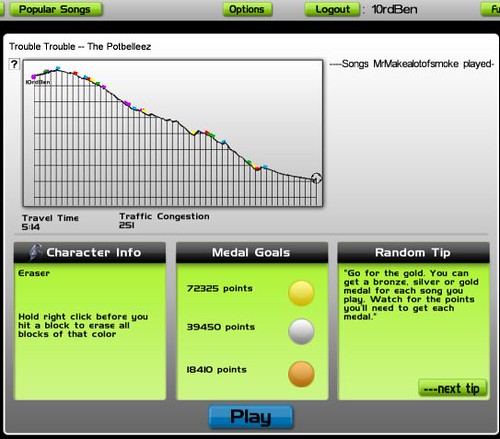
Audiosurf was the work of primarily by one person, Dylan Fitterer, and was released on the Steam digital distribution platform in February 2008. Audiosurf requires music to play – it takes your music collection, and creates a 3D track based upon features of the music which is then navigated by the player who, depending on the game-mode, collects coloured blocks that visually correspond to the music. The game ostensibly provides a way to ‘ride your music’ as the game’s tag-line suggests[1] - a feat of musical gameplay that is operating on a rather different level to a game like Guitar Hero. It’s also a great step towards overcoming some of the widely acknowledged problems with games like Guitar Hero - many critics have noted that the strength of a music game is largely subject to how good its track listings are[2]. Alec Meer says,

…we were all playing Guitar Hero and wishing we could stick our favourite music into it. Audiosurf says “fuck it, why not?” and provides the scaffolding of a game around it[3]


Audiosurf’s particular implementation of representing and performing music in a game does however come with a number of its own disadvantages. Firstly, the way the three dimensional track is generated by the program is fixed and determined by a set algorithm[4]. In an interview with Ars Technica, the developer Dylan Fitterer commented on the way that the algorithm turns the song into a three dimensional track, saying;

…when the music is at its most intense, that's when you're on a really steep downward slope, like you're flying down a rollercoaster in a tunnel. When the music is calmer, that's when you're chugging your way up the hill, watching that peak in the distance you're going to reach.[5]


The experience of playing the game itself is where I personally find the major innovations of Audiosurf as well as its major problems. When surfing a song the game’s analysis algorithm has pre-determined the majority of the course’s parameters from the musical elements contained within the recording. Some aspects of the course are determined from relatively transparent musical parameters – the track’s length corresponds directly to the length of the song and the contours of the course are derived from reasonably straightforward aspects such as volume and dynamics. In music with a strong steady beat, the track will often appear to undulate along beneath the player’s ship character in time with the rhythm of the song. The comprehensible translation of the music into visuals, or lack thereof, is where I encounter the main problem of Audiosurf.


In the examples outlined above, the relationship between music and the visuals (the track environment) is clear and direct, making sense to the player and allowing for a pleasurable and organic merging of knowledge of the song with knowledge of the corresponding Audiosurf track. This is a significant aspect of the appeal of the game as much community discussion goes on about the suitability of tracks for surfing[6]. Indeed the process works effectively on the macro structural scale, however a core component of Audiosurf is a ‘match 3’ type block collection game, where the block placement – called ‘traffic’ by the game – is generated from the rather more musically ambiguous parameter of “volume spikes”. The developer, Dylan Fitterer, describes the process saying

…whenever there's a spike in the music, the intensity of that spike determines the block's color. So the most distinct spikes, like a snare drum, that would tend to be a red block, a really hot block. If something is a little more subtle, like a quiet high hat, that would be a purple block, which is worth less points.[7]

This kind of relationship between music and visuals or environment becomes, musically at least, increasingly murky on this micro level as a sheer ‘spike’ in volume is no guarantee that a listener would make the corresponding connection to what they are hearing. Indeed the issue of what a listener actually perceives about a song when listening to it is much, much more complicated. Albert S. Bregman, author of the comprehensive text ‘Auditory Scene Analysis: The perceptual organisation of sound’ coined the term “stream” for what he identified as an audible cognitive process which was lacking adequate terminology. Bregman’s research noted a significant distinction between the cognitive process of the grouping of sounds that ‘go together’[8] from what might be distinguished as pure ‘sounds’. He notes that, ‘A series of footsteps, for instance, can form a single experienced event, despite the fact that each footstep is a separate sound.’ He also makes a musical comparison, saying that,

A soprano singing with a piano accompaniment is also heard as a coherent happening, despite being composed of distinct sounds (notes). Furthermore, the singer and piano together form a perceptual entity – the “performance” – that is distinct from other sounds that are occurring.[9]

Kieron Gillen writing for Rock, Paper, Shotgun says that

The problem with Audiosurf is that the concentration you take to really make the block game work is entirely the opposite of what you need to do to feel the music. The two parts of the game can tug at each other a little...On one hand, a zone game. On the other, a high-speed sorting puzzle.[10]

What I believe that Gillen has identified here is the inherent disjunction between what the musical listener focuses on when listening to the song, and what the game makes the player focus on. I suggest that this phenomenon is somewhat analogous to Ian Bogost’s term ‘simulation fever’. The concentration Gillen identifies as being necessary for successful play means that the player is acutely aware of block placement, largely determined by the volume spikes mentioned earlier.


I would argue that simply focussing on volume spikes is not adequately representative of the music to withstand the scrutiny that a player applies to it. I propose that, in a situation of high concentration on music, a more complex system is needed, one which addresses the issue of how a listener perceives a song. Admittedly, this is a daunting prospect and one inevitably encounters certain apparently insurmountable barriers to rendering onscreen what any one particular person is most likely to concentrate on within a song at any one time, needing as it would to take into account personal differences and background as well as individual musical training. However, the fact remains that this process is undertaken by humans themselves leads me to believe that a more accurate model is possible. When listening we can (and do) lock onto a number of particular elements of a song – the melody, a catchy lead rhythm or hook – and this is not always represented visually on screen. While Audiosurf often wonderfully represents the underlying kick-drum rhythm, especially if it is prominent, it will rarely pick up and single out an element like the aforementioned melody or hook unless it stands out in a particular way – namely through sheer volume.


Guitar Hero, in contrast, sidesteps some of these problems through both its position as a guitar game (with the player’s concentration largely limited to being focussed on the guitar) and by having a human pre-define the on screen actions the player has to undertake to ‘perform’ the song. However it does not yet allow for any meaningful input of a players own music library, and for that I am continually thankful for Audiosurf’s existence – imperfect though it may be.

____________________________________________________________________

[1] Wikipedia contributors, "Audiosurf," Wikipedia, The Free Encyclopedia, http://en.wikipedia.org/w/index.php?title=Audiosurf&oldid=241996378, accessed October 7, 2008.

[2] See for example, Mitch Krpata, ‘Rock Band 2: Why now?’, Insult Swordfighting, http://insultswordfighting.blogspot.com/2008/07/rock-band-2-why-now.html, accessed October 7th, 2008.

[3] Alec Meer in ‘The RPS Verdict: Audiosurf’, Rock, Paper, Shotgun, http://www.rockpapershotgun.com/2008/03/03/the-rps-verdict-audiosurf/, accessed March 3, 2008.

[4] Thomas Wilburn, ‘Catching Waveforms: Audiosurf Creator Dylan Fitterer speaks’, Ars Technica, http://arstechnica.com/journals/thumbs.ars/2008/03/11/catching-waveforms-audiosurf-creator-dylan-speaks, accessed

[5] Dylan Fitterer in Thomas Wilburn, ‘Catching Waveforms: Audiosurf Creator Dylan Fitterer speaks’.

[6] See the comments section of any Rock, Paper, Shotgun Post tagged ‘Audiosurf’ – every single one involves readers suggesting songs that others should try: http://www.rockpapershotgun.com/tag/audiosurf/

[7] Dylan Fitterer in Wilburn, ‘Catching Waveforms: Audiosurf Creator Dylan Fitterer speaks’.

[8] Albert S Bregman, Auditory Scene Analysis : The Perceptual Organization of Sound, 2nd MIT Press paperback ed., Cambridge, Mass.: MIT Press, 1999, p.9

[9] Ibid, p.10

[10] Kieron Gillen in ‘‘The RPS Verdict: Audiosurf’, Rock, Paper, Shotgun, http://www.rockpapershotgun.com/2008/03/03/the-rps-verdict-audiosurf/, accessed March 3, 2008.

Monday, 29 September 2008

A retrospective of 'ZZT', part Deux

In this post I am having a long-form discussing about a particular videogame with a childhood friend of mine and fellow blogger, Bibliosimius. In this 2 parter we discuss our mutual affection for the game ZZT and it's profound impact on our underdeveloped teenage minds. Part Un, in which we discuss the influence of the aesthetic of ZZT and more, can be found here.


B'simius adds his $.o2:

That's given me another thought. We learn visual art, creative writing, mathematics, "citizenship", all compulsorily in school. What about programming? One could argue that it'd make a good addition to the basic curriculum to give kids a general introduction to the very basic basics of how it all works. Using computer programs is increasingly becoming a part of schooling these days, but what about understanding how they're made? Not so much.


Ben:

Wow, that's such a brilliant idea! I think that kids would also really be into it - I know I would have been. But then again, I was a massive nerd, so... I'm sure there'd need to be classes tailored to skill levels much like the maths and sciences.

You're right that knowing how to use them is about 100 times more important than knowing stuff like how a Hard Disk Drive works (hey, I was under the mistaken impression that there was no magnetism involved until just recently, and I'm OK), so maybe school computer classes should be teaching fundamentals of programming. It also makes sense, because students are currently being taught stuff like how to use specific software packages like Microsoft office and Photoshop, etc, which all go out of date within a year or so. The ideas behind being able to understand programming are so much longer lasting though.


B'Simius:

Absolutely. It comes down to whether we want kids to grow up as good little mechanoids in the social machine or to be informed individuals who actually know how stuff works, and not just how to work it. We want new generations to avoid hardware problems which could be resolved with the dual typicals "Have you tried turning it off and on again?" and "Are you sure it's plugged in?" Understanding basic programming principles could alleviate similarly ridiculous problems with software.

I haven't thought about it from this perspective before, but understanding the basic ZZT-OOP programming paramaters and commands has probably helped me understand a fairly diverse range of electronic applications. I'd be interested in any kind of study into whether understanding the basics makes the complexities more intuitive. I'd more than tentatively guess that it does.


Ben:

Mmm, good points. I don't think it's just an age thing either. My nana in her 80's got her first ever mobile phone recently, although I guess that is more an extension of an existing older technology, but my other grandmother is getting a laptop too, so she can get on the internet.

So, to segue into a neat conclusion - what's the single best thing about ZZT? The Aesthetic? Teaching Programming? Creative Potential? Or even the community of programmers and storytellers that grew up around it?

B'simius:

I'd say that the single best thing about ZZT is all the good times it gave us - it was fun; fun to learn how to use it, fun to collaborate, fun to work individually, fun to share... but that's a matter of opinion. There's a lot in ZZT for a lot of different types.

Single best feature in your opinion?


Ben:

For me probably the creative outlet aspect. I really need to have something like that and ZZT was the first ever thing where I could just be creative without being constrained by lack of skill or talent or equipment or something =P

It's not like there weren't constraints on ZZT (in fact there were lots) but it was the first real "medium" or toolset I ever managed to come to grips with enough to get to the stage of being able to make something that was meaningful to me.

And on that note, thanks for taking a stroll down memory lane with me, B'simius! Feel free to blog about the experience and how librarians can use Facebook threaded conversations, etc on your own blog. And dear readers, may I also encourage you to check out Bibliosimus sometime in the future too.

-------------

That's all for my two part discussion with B'simius, however if people find this format at all interesting (and I quite like it myself) then look out for more posts in a similar vein. If you're looking for Part Un, in which we discuss the influence of the aesthetic of ZZT and more, it can be found here.


Random ZZT Linkdump:

ZZT @ YTMND.com
ZZT In retrovision article at Gay Gamer
Official Wikipedia article on ZZT

Thursday, 25 September 2008

A retrospective of 'ZZT', part Un


In this post I am having a long-form discussing about a particular videogame with a childhood friend of mine and fellow blogger, Bibliosimius. In this 2 parter we discuss our mutual affection for the game ZZT and it's profound impact on our underdeveloped teenage minds.


Ben fires his opening volley:

So in this blog post I'm discussing with my long time friend B'simius a game that is part of both of our shared gaming heritage, and has probably had the single biggest impact on my tastes when it comes to games. I am of course talking about the 1991 classic videogame ZZT!

ZZT was a game by Tim Sweeny, later founder of Epic games, who went on to make both the Gears of War and Unreal Tournament series. What is probably most notable about the game is that it's not quite your ordinary PC game - in large part ZZT was just a level editor for making your own games. B'simius, would you also agree that a large part of the attraction to ZZT was the fact that it was really just a cleverly disguised game creation tool?


B'Simius replies:

As far as I'm concerned, the editor was ZZT's primary point of appeal. I probably spent more time programming Objects and drawing giant sandwiches using nothing but ASCII than I did playing the games, even though some of them were pretty amazing feats, especially given the limitations inherent to the program.

In retrospect my many attempts at crafting masterpieces of ZZT-OOP were generally fairly shoddy, but I couldn't get enough of trying, and trying, and trying again because of that ever-present sense that I made this, this is mine; a sense that's generally out of reach to the common gamer. A bit of a melodramatic assessment, I must admit, but there is truly a warm, snuggly spot in my heart reserved for this game.


Ben:

You're totally right about the feeling you get of owning your creations. I remember I once spent a good six hours scripting an EPICintro cut scene to a game that I never made more than a single screen for. It was fantastic!

Do you get the same sensation of ownership from Spore? I know you have been playing that game like a bit of an addict, does it reflect a similar attraction? I've been formulating this weird theory recently that ZZT (and the semi-sequel Megazeux) have been more of an influence on my gaming tastes than anything since.

I mean, how else do I explain why my favourite game ever is the batshit insane Randy Balma: Municipal Abortionist? I can only guess that the surreal games of ZZT (I'm looking at you Bernard the Bard & That Game With B-Fly Ptarmigan in it. For readers unfamiliar with this particular ZZT game, B-Fly was a Ptarmigan God who spewed up the universe).


B'simius:

Spore has a similar feel, although it pales in comparison to the scope and scale of ZZT. You can only go so far with creating Spores; eventually you have to set them loose in the universe, which is where the majority of the game really takes place. In ZZT, though, it's not just the majority but the entirety of the game that's forged in the editor's fires.

A thought's occurred to me. ZZT may have influenced your taste in games as far as the surreal and loopy content goes, but do you think your early exposure to ZZT has influenced the way you think about games as games - that is, the structure, outlay, design, etc. of games?


Ben:

ha ha! I was actually hoping this topic would come up, because, yes, I think ZZT has totally influenced the way I think about and appreciate games. And not just games too - I think the 'ZZTOOPS' system of scripting burrowed deep into my impressionable mind as a child and is influencing the way I make music.

When we started working with a music program called Max/MSP in Digital Musics back in 2nd year Uni, I was one of those insane few people who actually got it. Although I wasn't super great at making cool stuff with it, I understood the underlying principle of the visual patcher environment as a programming language and that gave me a huge advantage over just about everyone else in the class.

When it comes to games, I think I also have that same rule based approach, hence my attraction towards the work of Ian Bogost & Gonzalo Frasca who both talk about games qua simulations or computations. It's all rules and instructions baby!

And thus concludes part I of our ZZT retrospective.

Sunday, 27 July 2008

Of Indie Games and Children


A few weeks back I was babysitting a family of four kids all under the age of 11 for the whole day, 9-5. It was fun, as they're all great kids and all I've gotta do to keep them entertained for a while is put on a Star Wars DVD and let em go nuts with the movie. By go nuts I mean be incredibly absorbed for multiple hours.

Anyway, as the day dragged on and they got progressively less interested in the movie (I think we were up to episode 6 by then) I decided to show them a couple of cool things on the PC. They showed me a few fun mini clip games that they enjoyed, and it got me thinking about sharing a few of the Indie games I was rather into at the time with the kids. I downloaded the cult classic Death Worm (which I've mentioned before in my 10 indie games to be playing while not working on your thesis post) and prepped the kiddies on how to gobble up lions and elephants and people like a good Death Worm should.

They got stuck into it like professional gamers. They loved it, and I quickly downloaded the two player version of the game, which delighted them even more, as there are 4 of them and in their family there's always someone wanting to do whatever another one is. Two players means one less person to be left out. Coincidentally, they were actually better at the game than me I'm mildly ashamed to say. It seems to me that kids are getting better and better at games, and at younger and younger ages too. I've got no chance these days.

Anyway, their parents get home about an hour or so later and I suddenly realised that... well... maybe Death Worm was a little bit of a mature game to be letting a bunch of (remember max age) 11 year olds play. Worries aside, their parents are super-cool and were totally fine with them playing it (I wish my parents were that understanding!) and that was that. Did I mention how awesome I think their parents are yet - both generally and specifically about games? Oh I did. Oh well, can't really stress it enough.

But it got me thinking... there are Indie games out there, for instance Randy Balma: Municipal Abortionist, which while not explicitly depicting abortion, at least hints at the act and is quite a mature kind of experience. Oh, and by the way, it's not at all rated by any classification system, because it's free to download. As far as I know, no idie game that is free to download comes with any kind of classification, offical or not!

I know, I know, Caveat Emptor and all that goes without saying on Teh Intertubes, but it's a bit of an interesting situation we're in whereby politicians are shouting left right and centre "WON'T SOMEBODY THINK OF TEH CHILDREN!!!" whenever any game aimed at a mature audience comes out (For a recent local Australian TRAVESTY of an incident, see this video in which an audience member asks a panel of politicians and journo's why Australia can't have an R18+ classification for videogames and in which Fallout 3 is described as being 'all about killing people'. Incidentally what I want to know is why the FRAK did the question asker, apparently a writer for an Aussie online gaming portal, answered 'basically, yes' to that description... GAH!). Additionally, these same politicians are choosing to ignore current information, statistics even, that says the average Australian gamer is aged 28, and that there are games being made without classification being targeted at this same age bracket (indeed like Randy Balma and Death Worm).

So anyway, the lesson to be learned this is;
Don't forget when showing friends your Indie games to think about age appropriateness, because chances are if you're like me, you've probably never even given it a second (or first!) thought before.

Or maybe you have and I'm an idiot for giving Death Worm to a bunch of tiddlewinks. Either or.