Showing posts with label Honours. Show all posts

Saturday, 20 December 2008

Audiosurf - Breakfast of Champions

I’ve been playing Audiosurf recently, and it struck me that buried deep within my thesis was a nice little bit of theorising about the game. So I've chosen to reprint it here, slightly edited, for the convenience of anyone who can’t be arsed to wade through my multiple thousands-of-words thesis and pick out the good bits (probably most people).

____________________________________________________________________


Audiosurf was the work of primarily by one person, Dylan Fitterer, and was released on the Steam digital distribution platform in February 2008. Audiosurf requires music to play – it takes your music collection, and creates a 3D track based upon features of the music which is then navigated by the player who, depending on the game-mode, collects coloured blocks that visually correspond to the music. The game ostensibly provides a way to ‘ride your music’ as the game’s tag-line suggests[1] - a feat of musical gameplay that is operating on a rather different level to a game like Guitar Hero. It’s also a great step towards overcoming some of the widely acknowledged problems with games like Guitar Hero - many critics have noted that the strength of a music game is largely subject to how good its track listings are[2]. Alec Meer says,

…we were all playing Guitar Hero and wishing we could stick our favourite music into it. Audiosurf says “fuck it, why not?” and provides the scaffolding of a game around it[3]


Audiosurf’s particular implementation of representing and performing music in a game does however come with a number of its own disadvantages. Firstly, the way the three dimensional track is generated by the program is fixed and determined by a set algorithm[4]. In an interview with Ars Technica, the developer Dylan Fitterer commented on the way that the algorithm turns the song into a three dimensional track, saying;

…when the music is at its most intense, that's when you're on a really steep downward slope, like you're flying down a rollercoaster in a tunnel. When the music is calmer, that's when you're chugging your way up the hill, watching that peak in the distance you're going to reach.[5]
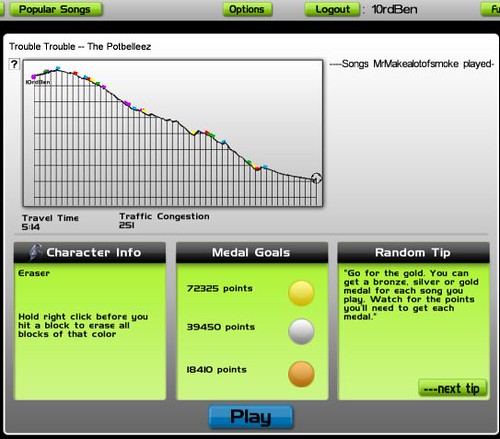


The experience of playing the game itself is where I personally find the major innovations of Audiosurf as well as its major problems. When surfing a song the game’s analysis algorithm has pre-determined the majority of the course’s parameters from the musical elements contained within the recording. Some aspects of the course are determined from relatively transparent musical parameters – the track’s length corresponds directly to the length of the song and the contours of the course are derived from reasonably straightforward aspects such as volume and dynamics. In music with a strong steady beat, the track will often appear to undulate along beneath the player’s ship character in time with the rhythm of the song. The comprehensible translation of the music into visuals, or lack thereof, is where I encounter the main problem of Audiosurf.


In the examples outlined above, the relationship between music and the visuals (the track environment) is clear and direct, making sense to the player and allowing for a pleasurable and organic merging of knowledge of the song with knowledge of the corresponding Audiosurf track. This is a significant aspect of the appeal of the game as much community discussion goes on about the suitability of tracks for surfing[6]. Indeed the process works effectively on the macro structural scale, however a core component of Audiosurf is a ‘match 3’ type block collection game, where the block placement – called ‘traffic’ by the game – is generated from the rather more musically ambiguous parameter of “volume spikes”. The developer, Dylan Fitterer, describes the process saying

…whenever there's a spike in the music, the intensity of that spike determines the block's color. So the most distinct spikes, like a snare drum, that would tend to be a red block, a really hot block. If something is a little more subtle, like a quiet high hat, that would be a purple block, which is worth less points.[7]

This kind of relationship between music and visuals or environment becomes, musically at least, increasingly murky on this micro level as a sheer ‘spike’ in volume is no guarantee that a listener would make the corresponding connection to what they are hearing. Indeed the issue of what a listener actually perceives about a song when listening to it is much, much more complicated. Albert S. Bregman, author of the comprehensive text ‘Auditory Scene Analysis: The perceptual organisation of sound’ coined the term “stream” for what he identified as an audible cognitive process which was lacking adequate terminology. Bregman’s research noted a significant distinction between the cognitive process of the grouping of sounds that ‘go together’[8] from what might be distinguished as pure ‘sounds’. He notes that, ‘A series of footsteps, for instance, can form a single experienced event, despite the fact that each footstep is a separate sound.’ He also makes a musical comparison, saying that,

A soprano singing with a piano accompaniment is also heard as a coherent happening, despite being composed of distinct sounds (notes). Furthermore, the singer and piano together form a perceptual entity – the “performance” – that is distinct from other sounds that are occurring.[9]

Kieron Gillen writing for Rock, Paper, Shotgun says that

The problem with Audiosurf is that the concentration you take to really make the block game work is entirely the opposite of what you need to do to feel the music. The two parts of the game can tug at each other a little...On one hand, a zone game. On the other, a high-speed sorting puzzle.[10]

What I believe that Gillen has identified here is the inherent disjunction between what the musical listener focuses on when listening to the song, and what the game makes the player focus on. I suggest that this phenomenon is somewhat analogous to Ian Bogost’s term ‘simulation fever’. The concentration Gillen identifies as being necessary for successful play means that the player is acutely aware of block placement, largely determined by the volume spikes mentioned earlier.


I would argue that simply focussing on volume spikes is not adequately representative of the music to withstand the scrutiny that a player applies to it. I propose that, in a situation of high concentration on music, a more complex system is needed, one which addresses the issue of how a listener perceives a song. Admittedly, this is a daunting prospect and one inevitably encounters certain apparently insurmountable barriers to rendering onscreen what any one particular person is most likely to concentrate on within a song at any one time, needing as it would to take into account personal differences and background as well as individual musical training. However, the fact remains that this process is undertaken by humans themselves leads me to believe that a more accurate model is possible. When listening we can (and do) lock onto a number of particular elements of a song – the melody, a catchy lead rhythm or hook – and this is not always represented visually on screen. While Audiosurf often wonderfully represents the underlying kick-drum rhythm, especially if it is prominent, it will rarely pick up and single out an element like the aforementioned melody or hook unless it stands out in a particular way – namely through sheer volume.


Guitar Hero, in contrast, sidesteps some of these problems through both its position as a guitar game (with the player’s concentration largely limited to being focussed on the guitar) and by having a human pre-define the on screen actions the player has to undertake to ‘perform’ the song. However it does not yet allow for any meaningful input of a players own music library, and for that I am continually thankful for Audiosurf’s existence – imperfect though it may be.

____________________________________________________________________

[1] Wikipedia contributors, "Audiosurf," Wikipedia, The Free Encyclopedia, http://en.wikipedia.org/w/index.php?title=Audiosurf&oldid=241996378, accessed October 7, 2008.

[2] See for example, Mitch Krpata, ‘Rock Band 2: Why now?’, Insult Swordfighting, http://insultswordfighting.blogspot.com/2008/07/rock-band-2-why-now.html, accessed October 7th, 2008.

[3] Alec Meer in ‘The RPS Verdict: Audiosurf’, Rock, Paper, Shotgun, http://www.rockpapershotgun.com/2008/03/03/the-rps-verdict-audiosurf/, accessed March 3, 2008.

[4] Thomas Wilburn, ‘Catching Waveforms: Audiosurf Creator Dylan Fitterer speaks’, Ars Technica, http://arstechnica.com/journals/thumbs.ars/2008/03/11/catching-waveforms-audiosurf-creator-dylan-speaks, accessed

[5] Dylan Fitterer in Thomas Wilburn, ‘Catching Waveforms: Audiosurf Creator Dylan Fitterer speaks’.

[6] See the comments section of any Rock, Paper, Shotgun Post tagged ‘Audiosurf’ – every single one involves readers suggesting songs that others should try: http://www.rockpapershotgun.com/tag/audiosurf/

[7] Dylan Fitterer in Wilburn, ‘Catching Waveforms: Audiosurf Creator Dylan Fitterer speaks’.

[8] Albert S Bregman, Auditory Scene Analysis : The Perceptual Organization of Sound, 2nd MIT Press paperback ed., Cambridge, Mass.: MIT Press, 1999, p.9

[9] Ibid, p.10

[10] Kieron Gillen in ‘‘The RPS Verdict: Audiosurf’, Rock, Paper, Shotgun, http://www.rockpapershotgun.com/2008/03/03/the-rps-verdict-audiosurf/, accessed March 3, 2008.
Tuesday, 16 December 2008

Marty O'Donnell in Interview - Part 1


Marty O’Donnell is a man on the bleeding edge, being responsible for the music and audio vision for the stratospheric Halo trilogy from Bungie studios. I wanted to try and find out what this leader in the field of music and sound for games had to say about the subject and get some input for my then to be completed thesis. Around August of this year I embarked on a campaign of multiple emails to multiple addresses to somehow get in contact with Marty for an interview. After what seemed like a longer period than it probably was, finally in October a scant week before I had to hand in my thesis I spoke to the man himself via phone. Even though I approached him essentially out of the blue, Marty held no qualms about chewing my ear off for close to 90 minutes, to my own delight of course, and it is clear that music for videogames is a subject about which he is fiercely passionate.


In this, the first of a series which will include nearly the full transcript of our interview, I ask Marty about a few things to do with my thesis. Namely, what I identify as the inherent musicality of the sound effects of Halo 2, whether or not his unique role as audio director uniquely enabled that process to occur, and Marty elaborates on his own personal philosophy for music in games.


Ben: I’m doing a music degree, in my 4th year (honours), and writing a thesis that combines my love of music with my passion for videogames. So I wanted to look into what makes videogames unique and specifically the new ways that videogames can use music.

So, coming to the music of Halo, I started with this hunch that Halo did a bunch of interesting things with music, but I had no idea what it was… And while doing my analysis I came to realize that if I think about the music of Halo 2 as broader than just the composed music… I started noticing all this musicality within the ambient sound and the composed sound effects. That relationship between the music and sound effects is really interesting. It seems to me like there’s so much cross pollination between the music and the sound effects. The first thing that came to mind, or that inspired me to think about this was the covenant carbine & it’s scope zoom. It’s got this sort of low synthy, resonant note. And I though, hang on I can kinda pitch that, and it sounded like an interval of a perfect fourth going in and out. So do you think this is an accurate kind of assessment? Can you see the musicality in the sound effects?


Marty: The most general thing that we do is we try to make the basically human vehicles and weapons sounds actually sound close to what real world sounds might be and we tend to take the alien sounds and try to give them a little more… I guess you could say they were a bit more synthetic. We used more of our musical instruments to create the sounds of the aliens so that… that whole suite of sounds sits in a different place from the human sounds.


B: I think that’s really, really cool. So you just mentioned that was intentional, do you think that was helped by the fact that you were a composer and musician yourself, as well as the head guy in charge of sound? Do you think that would have happened if it was just some sound engineer in charge of the sound effects?


M: That’s an interesting question. I had a long career in music and sound design for movies and television & commercials so I was used to dealing with all those areas but when I was able to get into the game business it was much more wide open. I could be an audio director, which means I was able to say, ‘look, there should be nothing that ever comes out of speakers in these games that I didn’t approve or create’… that’s something you don’t necessarily get to do when you’re part of a team making a film or a commercial or a TV show or something… you’re a composer or sound designer or you’re a sound effects editor or a re-recording mixer – you have a lot of different roles and sometimes there’s no singular audio vision for the whole project and I was always hoping that was something I could do, and games gave me the opportunity to do that.


B: Is that a unique thing to games?


M: If you look for the term audio director in any movie you won’t find it… so it’s unique to games. And I am happy to say, I am probably a pioneer in that area.


B: I’d definitely agree with that assessment, yeah.


M: I mean I actually sorta insisted. I kinda made up the term and said ‘No I’m audio director’ and I told those young guys ‘here’s what that means: It means anything to do with audio comes through me’.


B: Sounds like a good approach, it’s definitely working.


M: Well thanks. *laughs*


B: If you were, say, trying to make a game like the Call of Duty games where they’re aiming for realism and that strict attention to detail do you think that you would be a bit more constricted?


M: In videogames and especially in the Halo audio engine…content is probably only half of what is important; the other half is how all the music and sound effects are manipulated in real time. So you can record the sound of a realistic engine but that doesn’t help make it seem real when someone’s actually driving it in a virtual world. You have to have a lot of different parameters you control to make it feel like the engine, or the sound of the suspension on the warthog, or the tyres or the gravel getting kicked up… all of those things can’t just be pre-rendered. You want to have good content to begin with but it has to be manipulated in real time. We’re using all sorts of real time parameter controls and digital signal processing that is controlled in real time to make it feel that it’s actually happening.

You have a little more latitude with weapons and vehicles that are alien because you’re not starting from something that you’re trying to recreate… like, the way a jeep sounds when it’s driving over sand. …The way an alien hovercraft sounds when it speeds past you – no one knows what that sounds like, you can make it up as you go along. And you can probably be a little more crazy with how the real time parameter controls actually manipulate the audio when it’s an alien weapon, or vehicle or sound effect. You can be a little more adventurous.


B: I found it really interesting reading a piece by Jim Rossignol that recently got reprinted recently on Rock, Paper, Shotgun. In it he mentioned the Multiwinia developers Introversion and how they were working on some animations that at first seemed somewhat so-so, but when they put sounds to it, it made the actual animations look better as well.


M: Right. And that’s one of the other things that’s actually interesting about games, and for the most part especially the Halo games, everything is virtual so we have no source to begin with… there’s not live action that we shot [to] listen to what we recorded and implement, everything is virtual. Character models, weapons, vehicles and you name it are all completely virtual so they have absolutely no sound. It’s like animation, there’s no sound at all, so in order to bring these things to life we have to do it in real-time.


B: There’s a guy who wrote a book called The Acoustic Ecology of the First Person Shooter, and he talks about how sound effects and the in game sounds that the player hears form an ecology, but he kind of writes off music from that relationship. Do you think the music, the linear compositions of music, can contribute to the ecology of sounds?


M: It’s probably somewhat difficult to disassemble [the music of] Halo just by playing it, but if you play sections over and over again… I would suggest actually recording the music you hear when you’re playing it, and then comparing the performance of the music back to each other, especially the in-game music. The reason I would suggest doing that, is ...I think you’ll be surprised at how much non linear-music is actually happening in Halo 2.


B: I guess the impression that you get if you just go straight through, and listen to all the CD’s you go “Oh yeah, it’s that song, it’s that song” and it’s sorta hard to pick out where it does change more than you think.


M: Just so you know, my own philosophy of how music works in games is that’s actually my ideal. I want people to play through a level or play through a game or play through a section or whatever and actually think that somehow the music just happened to be scored for their experience. And what they had was a linear experience because that is all you have – When you play a game you are having a linear experience, you’re playing for 10m you have a 10m experience. But if you play that 10m over again, believe it or not, the music will not play back the same way.

And that is all on purpose…I don’t want people to be aware that the music is actually adapting or interacting with their interaction, I want people to think that it’s just a linear piece of music that seemed to somehow fit what they were doing and they had a good experience. If they are aware that they are changing the music then I think I’ve failed.


B: Right. So you want to avoid what happens in some games, where you know you’re being attacked because the battle music has started.


M: Yeah, right. But it’s not just that… even when a piece of music starts, there are sections where the linear pieces of music that I basically reassemble in order to make a CD soundtrack out of it, but these things are not just disassembled and have stems… you know, you have a rhythm track or a pad and these things cross-fade or whatever, I actually have different sections of music that randomly fit together with each other and give you a different linear experience based on some random chance elements that happen. And I can weight the chance so that section D has only a 10% chance of playing. So you have at least a random playback of what is happening; then there will be more intense sections, or less intense sections, or things that overlay that only happen because of actions that you are doing. If you decide to speed through an area you’ll get a completely different piece of music that basically feels linear from beginning to end, but if you linger and do something different you’ll have a completely different musical experience. That’s actually something that I think is fun to do and to try to find those sections, and try to analyse how many different things are you hearing that are changing up.


In the next post our discussion moves onto granular music approaches in videogame music, why Marty has not been one to advocate a granular approach to videogame music, and what his own alternative approach is.

An investigation of new musical potential in videogames; A Thesis


So the day has finally arrived and the chickens can now be counted. First the raw mark:


For my thesis, which I spent all year writing, I received a mark of 86 which is safely within the High Distinction band. Accordingly, the full text of my thesis is now available here. Go read it, print it, bind it, critique it, lambast it, or just put it on your coffee table and let it look pretty.


So here's the inside scoop on what to expect:


- Chapter 1 is me raving, perhaps somewhat inadvisably, about a loony Indie game for 1000 of my 17,000 word limit before getting around to talking about music and what I'm going to say in this wordy monstrosity.


- Chapter 2 is my literature review (highly skippable if you aren't interested in either a) Ian Bogost or b) Gonzalo Frasca)


- Chapter 3 is all about how I think the current musical paradigm in videogames is, erm... how you say? COMPLETELY RUBBISH (okay, not quite, but almost) and then I talk about games like Guitar Hero, Audiosurf and Everyday Shooter and how wicked awesoe they are....


- Chapter 4 is the thesis, really, and it's where I interview the awesome Marty O'Donnell in an attempt to glean some insights about music for videogames from him. If you only read one chapter, it should really be this one.


Which also reminds me that I've got the full text of the interview ready to put up, so I'll kick start that series later in the week - keep an eye out for it. I think Marty has some genuinely interesting and important things to say about sound and music in games - and about game design more generally.


What are you still doing here? Go download it already!


Also: props to my man in Melbourne, Dan Golding, who recently posted his own thesis for which he got an even better mark (90) so go download and read his when you're done with mine.


Edit: Matthew Gallant from The Quixotic Engineer has graciously provided hosting for my thesis so I don't have to use Mediafire. Isn't he lovely? =)


Tuesday, 14 October 2008

Thesis is complete!


And thus ends another chapter of my life; that of being an undergraduate student. I printed, bound and submitted my thesis last Friday and I have been Walking on a Dream since.

I plan to turn the more compelling parts of it into a blog series, either here or elsewhere, and elaborate a bit on my findings. I'll also make it publicly available at the same time, which should be around mid-November when I get it back from being marked. In the intervening time, you can read the abstract of my Thesis:

Abstract

Unlike traditional artistic endeavours such as literature, painting or sculpture, videogames and their creation, according to Janet Murray, are still in an incunabular period. Various efforts have been made to view videogames in light of other media such as film and narrative while few have yet to address, specifically, ways in which videogames present unique opportunities for expression. This thesis draws upon a number of authors to identify areas unique to videogames, and examines the implications for the employment of music within them. After examining the case for videogame uniqueness, the thesis looks to the current musical paradigm within videogames and, finding it somewhat lacking, offers a critique of the paradigm. A number of games that do, however, break from tradition and utilise music in exceptional ways are then discussed and their potential for adoption in future games is assessed. The final component of the thesis is an investigation into the use of music within the Xbox videogame Halo 2 (2004) through discussion with the composer, Martin O’Donnell, and an analysis of the music and sound of the game. In the process I discover that the game uses music in a way similar to the dominant paradigm, while also exhibiting a musicality within the in-game sound effects and level ambience. The result is a ‘soundscape’ style approach well suited to attaining both the emotive power of linear compositions as well as a closer relationship between music and visuals, seemingly a ‘best of both worlds’ videogame musical approach.

Thursday, 14 August 2008

Thesis Update

[The guy on the far left is me :D]


It's been a while since I last posted and although apologising for not posting more frequently smacks of disingenuousness (if you were really worried about it, you'd do something about it) I'm going to do so anyway. To anyone who cares, Sorry- but I've been busy writing my thesis.

Yes, that's right I'm actually up to the writing stage, despite the fact that I have 8 weeks and 3 days to go. Also I've just passed the rough 10,000 word mark which is pretty spiffy if I do say so myself, as it's a milestone on the way to completion and an order of magnitude larger than anything I've ever written on one subject before.

I would really like to share some parts of it with my readers, but I'm also aware that I maybe shouldn't, as potentially my final marker could end up reading it and getting the wrong impression. It will probably undergo some serious revision before it reaches its final incarnation.

Suffice to say, I've been writing about the games Guitar Hero, Audiosurf and Everyday Shooter which are all must-play games for people interested in what the future of music in videogames looks like. [Or could look like it everyone reads my thesis ;)]

So I'll leave it at that for a while and hope it satisfies the hunger of those desperately desiring an update on my work.

Cheerio!

Monday, 19 May 2008

Becoming Gamer; or "My last ever log out."

I hearthed to Shattrath, at the request of a very good friend of mine. She had something to show me, she said, and I had a good idea of what exactly that was. I had, after all, 'twinked' her with 1,000 gold a few weeks prior and, as it turned out, it was her snowy gryphon mount that she had purchased with my parting gift, that she wanted to share with me. I felt like a big brother to a little sister - I had never met her in the 'real 'world. She hugged me, made a *sniff emote and said with lots of exclamation marks that she'd miss me. I was going to miss her too.

Recently, after a particularly bad experience with an overly controlling and somewhat arrogant guild leader, I was left without a World of Warcraft guild that I called home. I wanted to 'progress' and to see (and beat) new content but finding a new raiding guild to start building relationships within was just not something I was prepared to do again. University was also starting to heat up, with an increasing amount of work having to go into assessment tasks and my major thesis, when my job, which that suited me and my study timetable perfectly, sadly dried up. Without a steady income, and having to still pay the bills (not many, but a few) I decided that, well, after a good run of a year and 6 months with the World of Warcaft, maybe it had become time to hang up the gauntlets and retire gracefully.

So I did. And it's probably one of the best things I could have done. Now, I'm not saying that wow is the devil or anything knee-jerkingly reactionist like that (although I *do* have some serious issues with some elements of it: the grind, only having one somewhat flawed model of guild leadership, etc, etc). But instead, much like Mr Brainy Gamer himself, Michael Abbott, said - it means that I can play other games again. I mean, in all honesty, how many people who play wow seriously do you think also play other games seriously and critically on a regular basis? I'd wager not many.

I make no secret of the fact that I want to work in the games industry. I am working towards that with my degree and with my thesis, and also, now, so with this. I can't just play WoW all the time and call myself a gamer. I honestly have no desire to work in any other field. I recognise that I probably will, but I hope that eventually I will be able to work for a living on what I am so most passionate about. My passion is for gaming, and that's really what this experience has been all about. I've left WoW and all of the amazing wonderful (and some horrible) people that I met on the Alliance side of the Dath'Remmar Oceanic Realm, and yeah, I'll miss them too. But I'm not a really a WoW-er. Not anymore. I'm a GAME-er.

Saturday, 15 March 2008

Project Update

HOLY HOLE IN THE GROUND, BATMAN! IT'S A VERBOSE UPDATE OF MY HONOURS PROJECT - POSSIBLY THE MOST IMPORTANT WORK ON VIDEOGAME MUSIC OF OUR TIMES! (Sorry Caps).

Follows:

In my project I propose to examine the role that music plays in the genre of videogames known as First Person Shooters (FPS). Specifically I will examine in detail the score of the Xbox game Halo 2, published by Microsoft Game Studios, and the complex relationships with other elements of the game. The Halo series of games are the Videogame equivalent of the Hollywood Blockbuster – they have some of the highest production values of the current generation of games and spend more time under development than their filmic counterparts.


Videogame analysis and critique, being a burgeoning field, has been developing a vocabulary and methodology with which to approach Videogames and their methods of creating meaning and story. Most analyses and critiques can be placed in one of two camps; those that study a Videogames efforts at inscribing a narrative in a game, identified as ‘Narratology’, often drawing on methods of analysis for other media, such as films, literature and especially hypertext and new media. The alternative, calling their study of games as systems unrelated to story ‘Ludology’, is exactly that, to treat Videogames as systems and representations, examining the rules and laws that govern the simulation.


My analysis of Halo and the music of the series involves a number of key elements. I will apply traditional musical analysis techniques to the music of Halo 2, looking at the function played by musical devices such as ‘Leitmotif’, as well as examining the effect of style and genre connotations. I will also apply a method of analysis that quantifiably examines the music in terms of ‘what plays when’ and try to find some motivation as to ‘why’ it does so. I wish to also apply an examination of the evolution of the music across the series, including key musical motifs and pieces, and view it as not only a development of the composers ‘voice’ but also as a representation of the progression of the themes of the games.


In a non traditional vein, I wish to also attempt to identify important salient features of the relationship between the music and other non-musical aspects of the game. For example, I wish to analyse specific levels of the game by using concepts such as ‘level flow’, ‘progression’ and ‘optimal paths or strategies’, in an attempt to uncover meaningful relationships to the music. One tool I will use to do this is a world famous video recording of a ‘Speed Run’ in which the player, an American film student and Halo player, completes the game on the hardest difficulty setting (called ‘Legendary difficulty’) and never once dies, providing an insight into the importance of elements of the structure and layout of the levels, as well as combat techniques. The most reduced and implicit form of feedback that the player receives from the game is information about the player’s state; either the player is still alive and can continue on ‘progressing’ through the game to its conclusion, or the player is dead and must try again. This information reveals inarticulate or tacit aspects of the game that the designers intentionally and unintentionally included in the game, and which I believe are a vital aspect of the ‘meaning’ created by the game. The crux of the rationale for this approach is a belief that Halo 2 locates much of its created meaning (in a largely non-narrative sense) outside of traditional narrative structures and devices such as dialogue, narration and cinematic direction. In this way, I believe that I will see a parallel to meanings and ideas created by and revealed in the music.


I will also apply semi-filmic analyses, adapting concepts such as Mimesis and Diegesis, along with analyses of such things as the effects of geography, art direction and the Videogame equivalent of camera angles to specific levels and sections of the game. Throughout I will apply Ian Bogost’ theory of ‘unit operations’ as an approach to Videogame criticism, as well as his idea of ‘simulation fever’, especially in regards to the ideas of Mimesis and Diegesis in Videogames – whether videogames ‘tell’ the story to the player (Diegesis) or ‘show’ the story to the player by mimicking actions (Mimesis). To explain the relevance of this distinction, I quote Wikipedia’s entry on Diegesis:

When we come to a modern consideration of the cinema, it may appear that the medium is a straight-forward example of mimetic storytelling--but it is not. In terms of classical poetics, the cinema is an epic form that utilizes dramatic elements; this is determined by the technologies of the camera and editing. Even in a spatially and temporally continuous scene (mimicking the theatrical situation, as it were), the camera chooses where to look for us. In a similar way, editing causes us to jump from one place (and time sometimes) to another, whether it be somewhere else in the room, or across town. This jump is a form of narration; it is as if a narrator whispers to us: "meanwhile, on the other side of the forest".


By this definition it would seem at first glance that First Person Shooter games (and Halo in particular) are generally ‘Diegetic’ with only a short amount of ‘cut scenes’ at the beginning and end of levels determining what the player has to look at. However, if we consider Bogost’s notion of simulation fever, which says that, while we generally view simulations, and Halo could be considered as such, as ‘objective’ representations of what we are simulating, they are in actual fact necessarily ‘subjective’ by virtue of their nature as reductive. Even when a simulation renders every physical aspect of an environment or situation in detail, it still does not include such things as concepts of value, such as the value of human life, which Bogost says by referencing a military simulation of a sarin nerve gas cloud modelling simulation. While it arguable simulates accurately the progression of the gas on a University campus and how to evacuate quickest, it does not represent such things as who to prioritise for evacuation; the Nobel prize winning Professors or the students with years of possible contribution in their lives still left unrealised. In this way, by choosing what Halo includes and excludes in its ‘simulation’, Halo 2 could certainly be considered also Mimetic, and this seemingly contradictory state will be explored.


To sum up my project, I am looking at the music of Halo 2 and placing an emphasis on identifying other aspects of meaning creation in the non-musical elements of the game, applying current theories and concepts of videogame criticism as well as a number of adapted methods from other mediums. I wish to outline the relationships between the music and these other elements and hopefully persuade the reader that a Videogame about a super-human soldier in the future whose task it is to save the world is a work worthy of investigation and which locates its meaning and value in places non typical to media such as films and novels.


*******

Word! Did you read it all? If so, give yourself a pat on the back for getting through over 1,000 of the finest words on Teh Interwebs without exploding. Feel free to comment / flame / ignore this post.


Oh, and the thing about Heiddeger I mentioned last week? That's so last week. It's MIMESIS now.

- Ben.