Showing posts with label uni papers. Show all posts

Thursday, 18 December 2008

Marty O'Donnell in Interview - Part 2


Marty O’Donnell is a man on the bleeding edge, being responsible for the music and audio vision for the stratospheric Halo trilogy from Bungie studios. I wanted to try and find out what this leader in the field of music and sound for games had to say about the subject and get some input for my then to be completed thesis. Around August of this year I embarked on a campaign of multiple emails to multiple addresses to somehow get in contact with Marty for an interview. After what seemed like a longer period than it probably was, finally in October a scant week before I had to hand in my thesis I spoke to the man himself via phone. Even though I approached him essentially out of the blue, Marty held no qualms about chewing my ear off for close to 90 minutes, to my own delight of course, and it is clear that music for videogames is a subject about which he is fiercely passionate.

In this, the second of the series, I ask Marty about his views on using a ‘granular’ live assembled music approach for videogame music, and he explains both why he doesn’t like that approach (for the time being) and what his own approach looks like.


Ben: I guess what’s most deceptive is, because Halo’s levels are designed so that there are multiple ways through it, but you go from point A to point B, you end up hearing all the music in the same order and maybe that contributes to the sense that you hear the same thing every time through. But I never got bored of the music in Halo either, so it’s obviously doing its job.


Marty: Halo 2 was a while back for me now, but I think the first level is the space station, right? If you got to the last encounter in the space station just before the end cinematic, pay attention to when the music actually starts, what the music does, how the music changes based on how you perform and then how the music actually seamlessly goes into the cinematic music, which is a more linear piece because I’m scoring something that’s cinematic… If you were to play through that sequence several times, try to go really fast, try to go slow, try to see what happens when the music in the level and the music in the cinematic go together, you’ll actually get several different kinds of recordings out of that.

Now it’s not like an entirely different experience, that’s not the point… it is still like, ‘that is the piece of music that plays there’, but it’s not a linear piece because different sections don’t happen in the same order and the way the music leads into the cinematic… it doesn’t [just] cross-fade it actually plays simultaneously with the cinematic music but it plays in sync with it in a way that changes depending on how you get into it.


B: So what would be your reaction to someone that wanted to do away with that sort of authorial control you have by mixing it up, and says ‘well lets set some parameters, and if the player health gets to this, do this’ (obviously that’s a simple way of doing it) do you think you do lose something if you take that step back?


M: Well you know it’s interesting because, as someone who’s worked with computer generated music or computer controlled music… and as you know in the music business and creating music, we use digital for everything… I remember back when there were music programs that were… basically lets generate music algorithmically. And I remember hearing a lot of that stuff and playing with all those things and… because I think I’m probably more of a traditionalist when it comes to what music I like, and what music I think actually evokes emotions and what music actually speaks to me, I think the composer still makes better choices than just a combination of random events.

Even when I was using algorithmic music programs, out of an hour’s worth of stuff that was generated I would find maybe 30 seconds of it that was actually interesting. So that’s my problem with that. I think that you might get some fun stuff, but I don’t think you get stuff that really speaks. Most of that stuff doesn’t end up telling a story musically, and I still think that the power of music is a storytelling power, and I might be wrong about this, but I still think that a composer tells stories better than computers do.”

However, if something is repetitive, even if it’s really, really great and you keep hearing it over and over again, and it plays back the same way every time – that is to me where boredom set in or it just starts getting annoying. Which is why when I hear games that use linear music that always plays back identically and starts to get repetitive, and loops... when I notice where the loop is I get really annoyed. That’s something I’m trying to eliminate. I really don’t want people to hear where the loops are.


B: Michael Chion wrote in the 90’s about audiovisual relationships in film and he talked about how if you strip the music off a piece of image, and you just place a selection of random other songs… some pieces of music work better with others. He said that in a few pieces… you will get a few moments of almost serendipitous synchronization between the audio and the video, so I guess where I see the potential for the live generated, granular, building the music up from individual notes, is the potential to pick out those points of synchronization and specifically hit them with the moment that you really want.


M: I would say… I have not been one of the guys who advocates the tiniest granular approach. There are some music engines and music for games approaches that’s very, very granular and right down to the individual sample level. ‘This will interact in this way’ and ‘this will interact this way’, it’s all possibly midi controlled, note generated everything.

There’s a couple reasons I don’t like that, number 1, I lose some of the fidelity that I like, I lose some of the live performance that I think is still essential… A midi flute performance just does not compare to a live flute player performing a melody. I don’t like walking away from something that has a giant history of success, so I’ve never really been an advocate of the high granular approach to writing music for games.

That doesn’t mean it’s the wrong way, it’s just that it’s my preference. The biggest problem I have with scoring a game is that if there is a sequence or an encounter or a moment or whatever it is… the most important moment is how it begins and then how it ends. Because it’s a game and there’s a human being interacting with it, what I don’t have any perfect knowledge of is exactly how long the entire experience is going to last.

So what I decided early on was, I can control when it begins, I can control when something ends, musically, what I need to do is keep the middle section malleable. And if I can do that without people knowing that it’s being malleable – so if they have a 2 minute experience some place then they get a 2 minute piece of music and they’re happy, but if somebody else play it for 5 minutes they get a 5 minute piece of music and they’re still happy because the beginning, middle and the end all correspond with what they wanted the experience to be, then I feel successful.

So it’s all about variations on the beginnings, on the ends, and being malleable with the middles. I keep trying to advance the way that stuff is manipulated musically and it’s sort of an interesting puzzle for me. I really enjoy it, I like doing it, I like composing music that I can kind of dissemble and say “what are different ways of telling the same musical story but making the middle something that is sorta indeterminate.” I don’t know if that makes sense but that’s the system.


In the next post, Marty talks about how close he’s coming with his own musical approach to realising a high level of ‘granularity’ in the music. I ask whether you can get away with more if you’re aiming for an ‘electronic’ sound, as opposed to orchestral and Marty talks about Rez & the potential for more ‘synaesthesia’ in games.

Tuesday, 14 October 2008

Thesis is complete!


And thus ends another chapter of my life; that of being an undergraduate student. I printed, bound and submitted my thesis last Friday and I have been Walking on a Dream since.

I plan to turn the more compelling parts of it into a blog series, either here or elsewhere, and elaborate a bit on my findings. I'll also make it publicly available at the same time, which should be around mid-November when I get it back from being marked. In the intervening time, you can read the abstract of my Thesis:

Abstract

Unlike traditional artistic endeavours such as literature, painting or sculpture, videogames and their creation, according to Janet Murray, are still in an incunabular period. Various efforts have been made to view videogames in light of other media such as film and narrative while few have yet to address, specifically, ways in which videogames present unique opportunities for expression. This thesis draws upon a number of authors to identify areas unique to videogames, and examines the implications for the employment of music within them. After examining the case for videogame uniqueness, the thesis looks to the current musical paradigm within videogames and, finding it somewhat lacking, offers a critique of the paradigm. A number of games that do, however, break from tradition and utilise music in exceptional ways are then discussed and their potential for adoption in future games is assessed. The final component of the thesis is an investigation into the use of music within the Xbox videogame Halo 2 (2004) through discussion with the composer, Martin O’Donnell, and an analysis of the music and sound of the game. In the process I discover that the game uses music in a way similar to the dominant paradigm, while also exhibiting a musicality within the in-game sound effects and level ambience. The result is a ‘soundscape’ style approach well suited to attaining both the emotive power of linear compositions as well as a closer relationship between music and visuals, seemingly a ‘best of both worlds’ videogame musical approach.

Sunday, 24 August 2008

Videogames and Digital Musicians


Before I proceed, I must confess that this is stepping on the toes of my thesis a tiny bit – but I think anything I’d write at this stage probably would anyway. Maybe bits of this will find their way into the thesis anyway, so that’ll make it worthwhile.


I’ve been meaning to write this blog post for night on three months now. Obviously I’ve been busy writing other things (I just completed a first draft for my thesis - quite an accomplishment in itself) but now that I’m taking a couple days to catch my breath I wanted to jot down some thoughts I've had which also might incidentally help explain how and/or why I, a Bachelor of Music student, came to be writing a thesis on music in videogames. Because there is a connection.


My major was ‘digital music’ a kind of catch-all subject for anything music related that was technical (nyquist frequency anyone?) or that used a computer. Suffice to say that I love the subject. I hadn’t actually realised until recently but most of my listening habits have arisen from the desire to find people making the kind of music that I felt that I could make. Primarily that is computer and effects based music, with artists like The Knife, Röyksopp, and Junior Boys inspiring me with their synth-tones and crisp TR-808 samples. Anyway, one of the bigger parts of the 'Digital Musics' subject stream was live electronic music performance and it's here that I want to make an observation – videogame designers could stand to learn a lot by looking at live electronic musicians.


Artists like those that perform at the NIME (New Interfaces for Musical Expression) Conference every year, not least of all my own honours supervisor, the brilliant Dr. Garth Paine, have been making interesting and engaging live music with computers for decades. And a central concern in these performances is often keeping the audience engaged and the performer looking like they’re doing more than just checking email. They accomplish this mainly through interesting and engaging performance interfaces like wacom tablets and by connecting swathes of transducers (anything that takes a real world input and converts it to an electronic signal) to their bodies.


So what the heck does that have to do with videogame music? Well as hardware gets more and more powerful, I believe, we are going to see more and more music generated ‘on the fly’ in videogames, and when we do, videogame developers would do extremely well to pay attention to those musicians that have already experimented with making music on the go to glean what they can; what works, what doesn’t, how to keep an audience engaged, and (most importantly for this discussion) how to meaningfully connect audio to visuals.


Significantly, videogames don’t have to worry about keeping an audience visually entertained – the games visuals should have that aspect covered. However, what if the videogame’s visuals much like the electronic musicians visual performance gestures were similarly connected? Can you see the potential? This is getting at the heart of what my thesis is about, so I don’t want to give it all away, but I am incredibly excited by the potential for music in games to be generated by game elements on a level that goes beyond those like what Tommy Tallarico recently depicted. In an interview with Tom Kim on the Gamasutra podcast he described the process of implementing music in videogames, saying:


You have to let them [the music programmers] know that you want this version to play when there are a hundred guys on horseback and this other version when there's only one.[1]

Seriously guys (and most composers are guys, by the way - an issues that’s also planned for the thesis), we’ve had the processing power of multi-core CPU’s since the start of this generation of videogame consoles and multiple gigabytes of RAM, but the very best we can come up with is “play this song now, and this other one later”? Because that’s essentially what it boils down to. Composer for games Phil Richard Jacques said in an interview on Gamasutra about his own ‘interactive’ scores that


the way I want to do [music] interactively is have a musical transition, or rise or whatever that sounds very musical... rather than hard-cutting two tracks, because I think it can be done better than that.[2]

Okay that’s great, but what about doing something a bit more than that? With all due respect to Mr Jacques, I think the scope for ‘interactivity’ is just a little bit broader than just making transitions sound smooth. He goes on to say later in the interview that the original Outrun game from way back in the 80’s, in a move that seems to pre-empt current videogame musical interactivity, had a faux interactive score in the sense that the music was composed so that roughly around the time that a player reached branching sections at the end of a track the song would change signifying this.


It was actually composed so the music would change where an average player would do the branching at the end.

I mean, it wasn't interactive, but they timed the music so that when you went down the end of one course and you branched into the next course, the music would go into a different chorus or something like that.[3]

So if Outrun twenty-odd years ago could do music that in a way reflected what was happening on screen (in it’s own pre-determined and constricted way) and affected the change in music on a structural level within the song – please explain how the best we can do today is make pleasant transitions between tracks?


My answer? I’ll have it for you in writing in, oh, say seven weeks. Actually, add a little bit longer to that for it to be marked as I don’t think they’d appreciate me putting it out there before the markers had a chance to read it. But I think I will have some answers. Also if any of the composers I mentioned end up reading this (hey it happened over on Cruise Elroy!) I’d love to hear their thoughts on the issue – although I have a sneaking suspicion I know what they’d say.


[1] “Video Game Music Strikes a Bigger Chord,” http://www.businessweek.com/globalbiz/content/jul2008/gb2008078_807637.htm

[2] “Gamasutra - Staying In Tune: Richard Jacques On Game Music's Past, Present, And Future,” http://www.gamasutra.com/view/feature/3695/staying_in_tune_richard_jacques_.php

[3] Ibid.

Thursday, 14 August 2008

Thesis Update

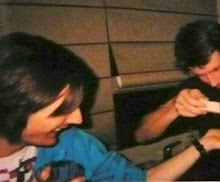
[The guy on the far left is me :D]


It's been a while since I last posted and although apologising for not posting more frequently smacks of disingenuousness (if you were really worried about it, you'd do something about it) I'm going to do so anyway. To anyone who cares, Sorry- but I've been busy writing my thesis.

Yes, that's right I'm actually up to the writing stage, despite the fact that I have 8 weeks and 3 days to go. Also I've just passed the rough 10,000 word mark which is pretty spiffy if I do say so myself, as it's a milestone on the way to completion and an order of magnitude larger than anything I've ever written on one subject before.

I would really like to share some parts of it with my readers, but I'm also aware that I maybe shouldn't, as potentially my final marker could end up reading it and getting the wrong impression. It will probably undergo some serious revision before it reaches its final incarnation.

Suffice to say, I've been writing about the games Guitar Hero, Audiosurf and Everyday Shooter which are all must-play games for people interested in what the future of music in videogames looks like. [Or could look like it everyone reads my thesis ;)]

So I'll leave it at that for a while and hope it satisfies the hunger of those desperately desiring an update on my work.

Cheerio!

Thursday, 12 June 2008

Markov Chain Madness

I must warn you - The following text is generated by a Markov chain. Inspired by Mr Quixoric Engineer on Twitter I decided to have a little play around with some Markov generated text, using my paper on virtual reality and the FPS as the input text. Needless to say, the results were stunning. Better than anything I could have written

In the virtual from raw ingredients often bringing conventions and game means stepping into a phrase, everything about the largest city and this peculiarity of the map’ and those far away hills I made my own experience. Finally, I believe there is a large body of wanderlust through a mountain ranges – with his main argument down into a picture of wanderlust through the player, relating a taxonomy of a children’s game Oblivion is Alchemy, which they may employ an unreal image to the massive draw distance – with ancient ruins and reaction. At a reading for engaging with possibility.

I really like the bit where it says "Oblivion is Alchemy". Of COURSE! Why didn't I think of that? It makes so much sense now. So there you have it. Play with Markov chain generative text here. After my initial experiments, the markov generator came up with this last piece of inspired literature, which makes a kind of scary sense.

In this research paper aimed at discussing some of the group ‘Iraq and Afghanistan Veterans of America’ spoke to the author of the issues raised in the Baudrillardian sense, that the developers chose to employ an invisible barrier as their means of keeping the game that I wish to explore the world, I began to enacting the role playing game into a world in which to move about and interact with the same topics in greater depth. One addition to the FPS solely owns the ‘first person perspective’ videogames have not been an independently delineated genre – rather existing simply as a popular first person viewpoint gameplay conventions and tropes set in place by a desire to explore the world, I experience a heightened level of ‘simulation fever’ because, as just mentioned, I have been problems for the player. For example, not having the time to fill in the case in most, if not all games, and is clearly room for telling stories in other places however there was one small barrier between me and those far away hills of promise, and it was later released as a focus on state-of-the-art graphics with other role playing game, The Elder Scrolls IV: Oblivion. I then made a small assertion that virtual comes from the surface, stay in touch with reality” . Ryan says

…the meaning of virtual ice climbing I was rather excited. I had, after all, spent the last several minutes on the DVD to store the extra environment or not having enough space on the other the virtual as fake and the other side.

When I finally did reach a section of the game as encouraging the practice of stopping to smell the flowers.

A different aspect of the many ‘skills’ that a play can employ within


Think I could get away with Markov chaining my whole Literature Review? Feel free to link me some of your excellent finds in the comments.

Monday, 9 June 2008

An extract from my recent paper on VR and the 'first person perspective' videogame

I've been thinking about (and doing a bit of select reading of) the concept of 'New Games Journalism', which Kieron Gillen outlined in his 'New Games Journalism Manifesto'. The point that I thought was most important, was this:

New Games Journalism... argues that the worth of a videogame lies not in the game, but in the gamer. What a gamer feels and thinks as this alien construct takes over all their sensory inputs is what’s interesting here, not just the mechanics of how it got there...

This makes us Travel Journalists to Imaginary places. Our job is to describe what it’s like to visit a place that doesn’t exist outside of the gamer’s head...
The thing with travel journalism or reportage is that it’s interesting even if you have absolutely no inclination of going there.


The idea of dealing with the game and talking about it subjectively, as embodied, is extremely powerful, to my mind. And with this though, I wanted to share with my handful of readers, an extract from my own research discussion paper which will undoubtedly be somewhat adapted into a section of my thesis. I'll hopefully put the paper up in full in a few weeks, but until then, here's a little bit of my own attempt at injecting the aesthetic of 'New Games Journalism' into a bit of academic writing.

Any resemblance to Jim Rossignol's recent post on Rock, Paper, Shotgun from last week is purely coincidence. I started writing the paper only a few days before Jim wrote his and when he beat me to the punch, I was kinda miffed. But hey, it means I must be on the right track if someone as distinguished and insightful as Jim is talking about it.

________________________________________________________________

Oblivion, belonging loosely to the category of open world or sandbox type games, allows the player great freedom for exploration. At almost any point the player can leave the main narrative path and explore the world to discover and engage with its inhabitants, or simply venture into the countryside for its own sake. The game world stretches for many miles, across many different environments and is populated to varying degrees with ancient ruins and secluded settlements. The ability to go ‘off the beaten track’ is inscribed within the games rules, and is clearly accommodated for, even expected. For example, one of the many ‘skills’ that a play can employ within the game is Alchemy, which involves the brewing of potions from raw ingredients often gathered from the wild. At its most abstracted level, the game can be seen as rewarding players for exploring and discovering these useful reagents through the ability to brew useful, even potentially life saving potions. Somewhat humorously, the possibility is open to reading the game as encouraging the practice of stopping to smell the flowers.


A different aspect of the game that I wish to relate and demonstrate the power of procedural rhetoric is best told through my own subjective experience and reaction. At a point roughly 20 to 30 hours into the game, I found myself at a location called Cloud Ruler Temple high up in the Jerall Mountains. To the south of the temple is visible the towering spire at the heart of Imperial City, the largest city and one of the central places within which much of the game takes place. Behind the temple and to the north is a series of large, beautifully rendered snow covered mountains. There is no road leading up it and no perceptible reason to climb them. With no inclination towards advancing the plot and instead being possessed by a desire to explore the world, I began to enacting the role of ‘the explorer’ as classified in Richard Bartle’s taxonomy of MUD[1] game players[2]. Bartle describes four types of MUD players and their differing rationales for engaging with the game – in the case of the explorer, Bartle says

Players try to find out as much as they can about the virtual world. Although initially this means mapping its topology (i.e. exploring the MUD's breadth), later it advances to experimentation with its physics (i.e. exploring the MUD's depth).[3]


Knowing that my character possessed an exceptional level of the acrobatics skill, which directly modifies the height of a player’s jump, I attempted to climb the mountain through a combination of running and leaping. Thwarted by near vertical surfaces of snow and ice, I made my way across the face of the mountain (in my mind pretending that by rock climbing I was managing to traverse the similarly near-vertical cliff faces) to approach from the north, a much gentler gradient. At many points along the way I would get stuck, just below the crest of the mountain with the knowledge that it was just out of reach teasing me, making me want to get up there all the more. I would perhaps assert that this feeling in me was somewhat akin to that experienced by many serious mountain climbers who characterise their motivation for climbing mountains as doing so ‘just because it’s there’. Similarly, I wanted to climb to the peak of the Jerall Mountains because they were there; however, I also wanted to see what was on the other side.


When I finally did reach a section of the mountainside that permitted the kind of virtual ice climbing I was undertaking, I was rather excited. I had, after all, spent the last several minutes on the face of a mountain and had gone so far as to have crossed several sections of the map. The inability to reach the top so far had only made me more determined. I eventually reached what I believe to be the highest point in the game and the view was all the better for feeling as though I had actually accomplished something. Over the other side of the mountain ranges – and plainly within view of the massive draw distance[4] – was another set of mountain ranges, not snow covered like the ones I was standing on, but wooded and rolling and filled with possibility. Looking north-north-west, the woods continued on down to what appeared to be a large body of water, possibly a lake or the ocean (the ocean was certainly in that direction and reachable in other places) however there was one small barrier between me and those far away hills of promise, and it was a literal barrier. Upon reaching certain points of the world designated by the level designers as the ‘edge of the map’ and hence playable area, players encounter an impassable, invisible barrier and are told via onscreen lettering ‘You cannot go that way, turn back.’ I propose that, in effect, by not allowing the player to visit all the places one can see Oblivion, due in part to its emphasis on beautifully realistic visuals, heightens any feelings of wanderlust already present in the player, whether intentionally or not. The fact that the game intentionally sets itself up as a consistent world, as previously mentioned, and encourages exploration, only to so cruelly curb said exploration, is rhetorically strange, if not wilfully perverse.


[1] MUD stands for ‘Multi-User Dungeon’. These were generally text based online games, the precursors to modern ‘massively multiplayer online’ (MMO) games such as ‘World of Warcraft’ or ‘Everquest’. I am stretching his definition to include single player games that include large worlds much like MUD’s – such as Oblivion.

[2] Richard Bartle ‘Hearts, Clubs, Diamonds, Spades: Players Who Suit MUDs’ in Katie Salen and Eric Zimmerman, eds. The Game Design Reader: A Rules of Play Anthology, (Mass.: MIT Press, 2006), pp.754-786

[3] Ibid.

[4] Draw Distance is the technical term for how far the game engine renders the environment into the distance. The fact that the draw distance is so long is a bi-product of the games previously mentioned appropriation of FPS tropes such as technology pushing graphics.

Saturday, 10 May 2008

Virtual Reality and the First Person Shooter

Ok, so here's the deal with this post. It's a proposal for a research paper that I had to submit for a subject at Uni, and I thought that it had some interesting enough ideas that I'd post it for anyone who would care to read.

Two posts in less than a week - madness, I know.

________________________________________________________________


Research Paper Proposal

Ben Abraham

Throughout the course of researching my presentation topic for week 12’s virtualities I have identified a notion that I wish to explore in my research paper. The intersection of my thesis topic – broadly defined as the First Person Shooter (FPS) category of videogames – and the discussion of virtual reality has lead me to identify certain commonalities between the two areas. Additionally, an inverse relationship between the rise of the FPS as a genre and the decline in media representation of and interest in VR can be loosely correlated, and it is this issue, thinking about First Person Shooter videogames as a kind of virtual reality, that I wish to explore. In this proposal I will give an example of how one particular ‘exemplary’[1] FPS game engages with this issue and I will finish by elucidating a number of the concepts which I plan to employ to talk around this topic. I have also appended a short annotated bibliography to demonstrate the breadth of resources available on the topic but which were not directly referenced in the body of the proposal.

In her article on Immersion and Interactivity in literature, Marie-Laure Ryan sets up a definition of virtual reality saying that VR is “an immersive, interactive experience generated by a computer[2]”. This definition leaves a lot of latitude for interpretation, for any computer based activity that leaves the user with a sense of being immersed in the activity could then be considered ‘virtual reality’, allowing for someone to argue that even incredibly banal activities like word processing and data entry could be considered VR. She does however add further caveats to the definition, such as being able to ‘apprehend a world as real’ and ‘to be able to interact physically with it’[3].

From my own first hand experience growing up in the 1990’s, Virtual Reality seemed to me, as portrayed by the media, as being about donning gloves and a visor and perhaps a body suit, in order to experience a three dimensional world like out own, albeit one that only exists as 1’s and 0’s in a computer and in the imagination of the person. Prime examples of this kind of representation include the 1992 film The Lawnmower Man, in which a Virtual Reality researcher, played by Pierce Brosnan, increases the intelligence of a mentally handicapped man via a mixture of Virtual Reality games and drugs, with the result being the stimulation of his mind, which in turn endows him with telekinetic powers in the ‘real’ world. This idea of VR, one with blocky characters and clumsy interactions based on bodily inputs, it seems to me has dropped below the radar of public consciousness, to be replaces instead by the humble computer monitor and gaming control pad. I will try to explore this in my research paper, examining the notion that they have been replaced by this new and different idea of VR, and one I might say is more promising in terms of expressive potential and narrative possibility.

The main text when talking about videogames and virtual reality is undoubtedly Janet Murray’s Hamlet on the Holodeck, in which she uses the ‘holodeck’ technology from the Star Trek universe to paint an excellent illustration of some of the issues surrounding virtual reality. Videogames are similar to the holodeck in the sense that they are often visual representations of a physical space. Naturally, virtual reality can encompass non visual representations, and videogames like these, particularly MUD’s and other online games, are discussed by both Ryan and Murray – however I wish to concentrate specifically on graphical representations and the use of an ‘avatar’. By giving the player a representation of themselves, the avatar with which to explore and interact with the space, videogames have developed some rather unique methods of telling stories. While there have been and will continue to be games made that rely solely on text based or spoken word methods of explicating story elements, a number of particularly striking games of recent times have devised alternative methods of explicating a narrative, often integrating them with more traditional techniques.

As an example of this dual layered approach to telling the story, a useful example is the critically lauded game ‘Half Life 2’ by Valve Software[4]. The game is a ‘first person shooter’, a genre of games that give the player a ‘virtual self’ to move and shoot and perform actions in a way unrestrained by the barriers imposed by real life and to tell their story Valve employ both ‘old media’ style narrative exposition as well as some tricks rather more unique to videogames. Much of what they do in this way they describe as ‘training’ the player in the rules of the gameworld, and at the same time they are often weaving in narrative exposition elements that expand the players insight into the world. Robin Walker, a developer with Valve, describes one example from very early on in Half Life 2 when they player is still ‘learning’ how to interact with the world. In this particular example, the players progress is impeded by a police officer who tells the player to pick up an empty soft drink can before they can progress.

…the cop who tells you to pick up the can… we want you to press use, but at the same time you're learning about the relationship between the Metro Cops and the players, and the way they use civilians. But at the same time you're building this animosity between you and this character that eventually you'll be able to deal with when you get a weapon…[5] (emphasis added).

In this way, Half Life 2 combines teaching the player how to play the game with telling the player about the game – in this case that civilians like yourself have to do what they are told by the police, and thus setting up the world the players avatar inhabits with its 1984 style government that strictly controls its citizens.

Another aspect of the issue that I propose to discuss is what Ian Bogost calls ‘simulation fever’. Videogames, despite being simulations and therefore viewed as ‘objective representations’ of what their designers intended, Bogost says, are inherently subjective by virtue of their nature as ‘reductive’[6]. Even when a simulation attempts to render every physical aspect of an environment or situation in detail, it still abstracts concepts like the application and implication of the value of human life, a point which Bogost elucidates by referencing a military simulation of a sarin nerve gas attack modelling simulation. While it represents the progression of the gas on a university campus, showing such useful information as potential evacuation routes, it does not represent other concerns, such who to prioritise for evacuation; the Nobel Prize winning professors or the students with years of possible contribution in their lives still left unrealised[7]. Simulation Fever, Bogost says, occurs when the game player “[struggles] between the omissions and inclusions of a source system and the player’s subjective response to those decisions[8]”. It is a useful concept as it directly engages with the idea of a videogame as a form of virtual reality and reveals an aspect of how videogames manage that relation.

Finally, I want to briefly mention one last resource that I intend to use in my research paper, as it is indicative of my intention to draw upon the large body of writing about the subject, and that is an online blog post discussing the concept of Immersion. Michael Abbot, a professor at a liberal arts college in the United States, also runs a blog called ‘The Brainy Gamer’, and makes a habit of posting his thoughts on games to encourage and solicit intelligent discussion on the subject. One particular post, inspired by a talk given at the Game Developers Conference 2008, was about the concept of immersion in games. His line of reasoning was that, in his experience, many of the games that have been the most immersive to him have been the ones with the least, or the most abstracted level, of graphical representation, for example sports management simulations, which represent players and games as “a spreadsheet[9]”. This idea is interesting because it has very real implications for how videogames make manifest their virtual reality, and while I am choosing to focus in on the FPS genre of videogames, which are often characterised as aiming for photorealism, and are often the driving force behind computer hardware upgrades[10], there are still many unexplored possibilities within the realm of representational styles[11].

In conclusion, I have very briefly touched upon some of the material that I plan to use in discussion of the conception of videogames as a form of virtual reality. Obviously much more could be said about the topic, not least about the implications and implementation of the ideas I propose to cover, but I believe I have provided a concise window into the subject and my rationale for the project.


Bibliography

Abbott, Michael. ‘Immersion - Is it just me?’, The Brainy Gamer. http://www.brainygamer.com/the_brainy_gamer/2008/03/immersion---is.html, first posted 2 March 2008, accessed 26th March 2008.

Adams, David. ‘Half-Life 2 Sells Millions.’ Ign.com. http://pc.ign.com/articles/583/583162p1.html. accessed 6th May 2008

Bogost, Ian. Unit Operations : An Approach to Videogame Criticism. Cambridge, Mass.: MIT Press, 2006.

Bramwell, Tom. ‘Opening the Valve Interview’. Eurogamer.net. http://www.eurogamer.net/article.php?article_id=65391. accessed 26th April 2008.

Murray, Janet Horowitz. Hamlet on the Holodeck : The Future of Narrative in Cyberspace. New York: Free Press, 1997.

Ryan, Marie-Laure, 1999, ‘Immersion vs. Interactivity: Virtual Reality and Literary Theory’, SubStance - Issue 89 (Volume 28, Number 2), pp. 110-137.

Shim, Richard. ‘'Doom 3' may doom users' current systems’. CNet News. www.news.com/2100-1043_3-5295390.html. accessed 7th May 2008.

Valve Corporation. ‘Awards and Honours.’ Valvesoftware.com . http://www.valvesoftware.com/awards.html. accessed 7th April 2008.

Annotated Bibliography

Artful Gamer, The. ‘Inviting the Imagination: The Power of Words’. The Artful Gamer. http://www.artfulgamer.com/2008/01/19/inviting-the-imagination-the-power-of-words/. accessed 26th March 2008.

Chris at The Artful Gamer blog discusses Michael Abbott’s blog post on Immersion and Interactivity, discussing the power of words to immerse.

Bogost, Ian. Persuasive Games : The Expressive Power of Videogames. Cambridge, MA: MIT Press, 2007.

Bogost in his second book argues the case that games possess a 'procedural rhetoric' as well as a number of other concepts useful for Videogame criticism.

Borden, Ed. ‘Gaming is an out of body experience.’ Ed Borden: PWNING 9-5. http://www.edbordenblog.com/2008/03/immersion-immersion-immersion.html. accessed 26th March 2008.

In this post on his personal blog, Ed Borden riffs on Michael Abbott’s post on immersion, adding his own perspective and addressing some issues not covered in the original.

Gee, James Paul. What Video Games Have to Teach Us About Learning and Literacy. New York: Palgrave Macmillan, 2003.

Gee argues in his book for viewing videogames, and learning about videogames, from within their context, or 'semiotic domain'. His also includes a semi-autobiographical tale of how he came to appreciate games, coming from a very non-typical background, and making interesting points about immersion and storytelling.

Hocking, Clint. ‘GDC 2008 i-fi: Immersive Fidelity in Games’. Click Nothing. http://clicknothing.typepad.com/Design/hockingc_GDC08_Immersion.zip, accessed 7th May 2008.

In this downloadable file, Hocking includes the slides and a PDF transcript of the talk he gave the GDC 2008, the talk which inspired Michael Abbott’s blog post on the same subject.

Rose, John. ‘Fewer Mechanics, Better Game’. Gamasutra – The Art & Business of making games. http://www.gamasutra.com/view/feature/3621/fewer_mechanics_better_game.php. accessed 22nd April 2008.

In this article for Gamasutra, an games industry publishing website, John Rose talks about how sometimes ‘less is more’ in terms of a games functionality, and talks about the lebel of abstraction present in games like Half-Life.

Travis, Roger. ‘Bungie’s Epic Achievement: Halo and the Aeneid’. The Escapist Magazine. http://www.escapistmagazine.com/articles/view/issues/issue_66/384-Bungie-s-Epic-Achievement. Accessed 2nd May 2008.

In this opinion piece for The Escapist Magazine, Travis talks about how one particular FPS game, Halo 2 for the Xbox, contains within its narrative an allegory of the epic Latin poem ‘The Aeneid’. Both stories focus on an “eponymous hero”, and the author elaborates on the parallels between them.


[1] Exemplary as defined through critical reception, financial success and a certain indefinable presence as part of popular culture. I acknowledge this is a somewhat problematic proposition.

[2] Ryan, Marie-Laure, 1999, ‘Immersion vs. Interactivity: Virtual Reality and Literary Theory’, SubStance - Issue 89 (Volume 28, Number 2), p. 110.

[3] Ibid.

[4] With a score of 96 out of 100 on Metacritic.com, a reviews aggregate website, winner of no less than 35 “Game of the Year” awards for the year of 2004 (http://www.valvesoftware.com/awards.html, accessed 6th May 2008) and according to an IGN news item sold approximately 1.7million copies of the game in the first two months of release (http://pc.ign.com/articles/583/583162p1.html, accessed 6th May 2008), I believe this claim to be largely beyond doubt.

[5] Tom Bramwell, ‘Opening the Valve Interview’, Eurogamer, http://www.eurogamer.net/article.php?article_id=65391, accessed 26th April 2008.

[6] Ian Bogost, Unit Operations : An Approach to Videogame Criticism (Cambridge, Mass.: MIT Press, 2006). See Ch. 9, ‘The Simulation Gap’.

[7] Ibid., p.98

[8] Bogost, Unit Operations : An Approach to Videogame Criticism, p.132.

[9] Michael Abbott, ‘Immersion - Is it just me?’, The Brainy Gamer, http://www.brainygamer.com/the_brainy_gamer/2008/03/immersion---is.html, first posted 2 March 2008, accessed 26th March 2008.

[10] Richard Shim, ‘'Doom 3' may doom users' current systems’, CNet News, www.news.com/2100-1043_3-5295390.html, accessed 7th May 2008.

[11] For one interesting example of an alternative to the photorealism of many ‘bleeding edge’ FPS games, the also Valve Software developed game ‘Team Fortress 2’ released in November of 2007 chooses to represent the players avatars in a cell shaded cartoon style.