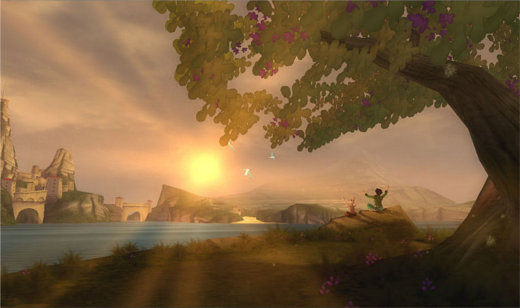
We don’t do reviews very often here at SLRC, and naturally this ‘review’ is probably only part review, with a bit of musical analysis throw in for good measure. I started listening through the Beyond Good and Evil soundtrack in conjunction with the Vintage Game Club’s play through of the game and couldn’t resist taking a few notes. I should preface by saying that it is one of the most impressive soundtracks for any game I have ever heard. Stylistically, the music on this album is amazing – the diversity of sound is a testament to the composer’s ability to create an incredible range of music, and even with the sheer amount of it present there are no pieces that sound like the standard licensed fare you get in many games (even many ‘AAA titles’). It’s impressive in that it manages a cohesive sound while including pieces that evoke calypso, ambient, jazz and funk feels.
While there is an official soundtrack, just as popular it seems is an ‘unofficial version’ which is straight rips of the music from the game (obtained from the PC version, I assume) – and while that’s kind of cool in it’s own way, I’m preternaturally attracted to the OST because of my love for the album form. The majority of my music listening is accomplished by putting on an album and letting it play through while engaged in some other activity and outside of my iPod, I rarely at best use the shuffle function in iTunes. The direct rips are also problematic for me because they often contain ‘unfinished’ tracks that end abruptly where a song would loop and start again, with the game applying fadeouts and transitions wherever appropriate.
I eventually discovered and downloaded the free official soundtrack, with the expectation that it was an album, which it is. However just as nothing is as it first appears in the city of
The album opens and closes with iconic pieces of music form the game, over which are played a selection of the in-game dialogue and sound effects in a way that builds up a rather complete aural picture of that moment in the game. I’m quite a fan of this technique as it can evoke some very specific moments in films and games particularly well. It really works well when the aim of your album is to re-tell the audio story of the film or game especially, and it works here.
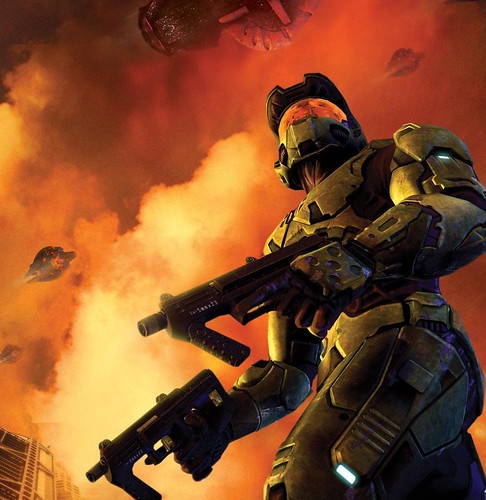
So let’s cut to the chase and talk about the album as a whole. My initial comparisons were to the Halo series’ soundtracks which similarly capture the feel of ‘all the songs you hear when playing the game’ in their approximate order, but the comparison is not entirely beneficial to BG&E. While the Halo album releases definitely feel like complete album each, and can be listened to on their own repeatedly, BG&E ends up wearing a bit thin after a few listens.
Firstly, it seems to me that there is not enough variation to maintain interest in the more ‘ambient’ background pieces that in the game play while exploring dungeons. This criticism is perhaps a bit of a cheap one to level at the album, since the music obviously works in game, however it’s inclusion on the album strikes me as a somewhat thoughtless choice. The decision to include all or as much of the music from the game as possible, and in roughly the order it gets heard, has subordinated the need for the album to exist and be listenable as a work in itself. Don’t get me wrong, attention has definitely been paid to making the album, but maybe not quite enough.
The first hiccup in the album comes with the tracks ‘Mineshaft Madness’ and ‘Say cheese, fellas’ (tracks 7 & 8) which both drag on for just a bit too long. The latter piece uses a bit of in-game audio again at the start (omitting spoken word however) to remind listeners that this is the music from the first boss battle. Again, while both these tracks hold up well in the game their inclusion on the album is a bit questionable, especially since there is enough quality on this album to avoid using any filler tracks.
This would be a good point to talk about the uneven pacing of the album, which I think is the result of wanting to put the music in the order the player of the game encounters it. Conventional wisdom regarding pop records is that you generally try to give your album a ‘flow’ by arranging tracks so that you get a pleasing and natural progression between songs and also a particular kind of dynamic to the album. Think, for a moment, of how many albums you know that open with their best song, add a few in the middle (usually none of which are perhaps catchy enough for release as a single but which can still often be quite good) and in the last 1/3 of the album bring out all the stops, lifting the album to it’s crescendo. It tends to follow roughly that same curve that is used to describe a good narrative – with the

If I could draw a similar graph of the dynamic of Beyond Good and Evil’s soundtrack, it would be a series of tiny humps. All the stand-out tracks are separated by 2 to 3 songs that either feel like filler or feel out of place. Consequently, the album never really gets off the ground and can’t escape the feeling of ‘a collection of semi-related tracks’. Not helping this problem is the fact that, like the music in the direct rips I mentioned earlier, a number of tracks stop abruptly, where adding a simple fadeout would have worked wonders. One last issue – the song ‘propaganda’, the most iconic and memorable song from the game, is frustratingly mixed quieter than the rest of the album detracting from what should have been one of the highlights of the album.
I was originally planning on doing some musical analysis in this post as well, however this review has run on long enough as it is. If there is a lesson to take away from the album it’s that for any release to stands on it’s own, attention needs to be paid to conventions and expectations of the medium. As videogame music it succeeds flawlessly, however as an album, for me at least, it critically fails. Hopefully before long I’ll be back with some less critical things to point out about the music of BG&E and elaborate on just how good it is as 'music', rather than album.