Showing posts with label review. Show all posts

Sunday, 23 August 2009

Assassins Creed Official Soundtrack - A Review

If you’ve only recently joined SLRC, since the start of the Permanent Death story perhaps, you might not know that SLRC started life as a music and videogame blog. We don’t do reviews very often here at SLRC (conveniently, if you ever wish to see that change, feel free to commission me) but today sees a reprisal of an earlier trend in reviewing the music for a videogames – this time it’s Ubisoft’s 2007 title Assassins Creed that gets a thorough once-over.

As a brief aside, this will be my last post for a few weeks as I’m taking a break and dropping off the grid for a few days. I’ll probably be back in late September or early October and will hopefully be recharged and ready to take on the rest of the Permanent Death saga. Enjoy!

The album sets the tone at the opening, introducing in the first track solo voices singing in Arabic over arab-esque scales, as well as chanting monks drenched in reverb evoking cavernous Middle Ages cathedrals. Vocals are an important part of the sonic palette of the Assassins Creed soundtrack and provide a sonic element that aims to capture the unique historical period of the game.

The listener is treated to sparing splashes of flutes and piano melodies underpinned by Arabic style light drum percussion. The major feature of the track ‘Flight through Jerusalem’ is a lament sung almost operatically, and placed in a middle distance giving the sense of being heard from across a city – perhaps the singer is crying out over the rooftops at dawn or dusk. A Middle Eastern guitar-type instrument and a string section carry much of the underlying harmonic content of the song.

The following few tracks on this admittedly rather short album – totaling up to around 40 minutes of music – re-introduce more traditional orchestral instruments to contrast with their ethnic co-players; timpani, drums, tambourines, string and brass section stabs, all make appearances in the first third of the album.

The aptly named ‘Spirit of Damascus’ piece uses what sounds like a background of giant steel-works percussion and the metallic timbre works is stark contrast to the fore-grounded Middle Eastern guitar. The mix and meeting of uncommonly related instruments as heard here mirrors musically what would have been a ‘cultural melting pot’ in the particular area of the middle east Assassins Creed is set in. The meeting of Christian and Islam; West and East, would have produced both clashes and unique opportunities for art and expression. That, and a lot of fighting, obviously.

The piece trails off, and ends far too quickly for such a beautiful track, with a synth bed that evokes the monkish chants on previous tunes. The following track, ‘Trouble in Jerusalem’ (a much longer piece at 4minutes) reprises the steel-percussion of ‘Damascus’ and adds Bootmen-style stompy percussion. A synthetic almost sub-audible bass acts as a powerful counterpoint to the breathy, cloistered monk-ish whisperings in (presumably) Latin on the track ‘Acre Underworld’. The use of harsh-cuts and sample loops that remind one of a broken record at the beginning gives the track a uniquely ‘electronic’ feel, utilizing an effect that cannot be easily replicated without modern technology. It is also possibly the first most prominent artificial sound on the album, or at the least, the fist piece that leans more towards using artificial and created sounds than organic or acoustic ones.

The composer, Jesper Kyd, is a great employer of non-acoustic instrumentation, and electronic instruments and synths alternately shimmer and glisten and stutter throughout the album. The most stand-out use is on the track ‘Access the Animus’, a supremely long piece clocking in at nine minutes and which contains a plethora of razor sharp glass-like samples. Additionally, some kind of synth or sample has been manipulated to sound unnervingly like a leopard or jaguar's roar – appropriate imagery for a piece entitled ‘Access the Animus’ with its title a homonym for “Animism”, a philosophical, religious or spiritual belief common in many non-urbanised, non-westernised civilizations, often accompanied by a reverence for animals (particularly large and powerful ones such as big cats). Admittedly it’s a tenuous connection, but it’s also one I can’t help to make – it really sounds like a jaguar or other big cat to my ear. In addition to being one of the longest pieces, ‘Access the Animus’ also marks the mid-point of the album.

The short piece ‘Dunes of Death’ makes use of metallic percussion and flute or pan-pie sound-alike instruments and also brings back a few splashes of melody on the piano.

A big feature of this album is that many of the towns have specific themes or sound-palettes. For example, Jerusalem-themed tracks almost always employ monks and male choirs, appropriate imagery for the cities strong religious significance to both Christianity and Islam. Compare and contrast with the piece ‘Masyaf in Danger’ which uses none of the same vocal elements, using only a light sprinkling of female synth voices.

The third from last track, ‘Mediation Begins’, has at it’s core Arabic percussion, a steel-stringed Arabic guitar-like instrument, and a melody played on a pipe-flute instrument all sounding so much like a group of street performers. The band fades in and at first the scene could be any of a thousand street corners in the Middle East, however a bed of synth and reverb-soaked synthetic sounds soon appears to underpin the group. The effect, and it is one that is used in many of the pieces, is the juxtaposition of normal surface appearances with underlying tensions and fears – another musical metaphor perhaps for the cultural tensions of the historical period.

‘Meditation of the Assassin’ has almost no organic or instrument sounds. The return of the nearly sub-audible bass from earlier in the album along with ominous whispers and out-of-place, non-harmonic dissonant electronic noises gives the piece a strong sinister feel. The brief appearance of wind chimes is far from reassuring and only further adds to the eeriness of the piece. A quiet Arabic guitar struggles vainly against the overpowering bass towards the middle and end. The final song ‘The Bureau’ is a bit of an anti-climax for an album sprinkled with such a number of great moments.

Overall, the album hangs together quite well, however it is dominated somewhat unflattering by the 9-minute long track ‘Access the Animus’ which, despite covering a variety of rhythmic and instrumental feels throughout its duration, still feels like it drags too long. Add to this the fact that some of the more intriguing pieces are overly short and the album is left feeling lopsided and uneven. It does, thankfully, avoid the common pitfall of other videogame soundtracks and avoids any awkward song transitions or strange stops and starts.

Ultimately, however, if the listener does not have the same level of positive associations with the music generated through playing the actual game of Assassins Creed as I acknowledge I have, I think it would ultimately prove a largely unsatisfying listening experience.

The Assassins Creed Official Soundtrack, is composed by Jesper Kyd and has a running time of 40:37.

Monday, 27 April 2009

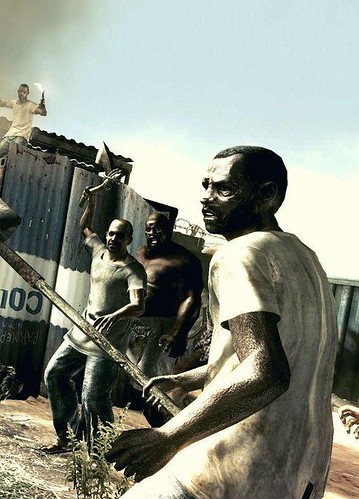
In case you missed it: My Resident Evil 5 review


In case you missed my linking to it on twitter late last week, here's another link to the full 1600-odd words I had to say in review of Resident Evil 5. I have a lovely relationship with the people at GamingSA and I hope they keep sending me games to review occasionally.

I was pretty critical of the game overall, but I was otherwise quite happy with how the review came together. It starts like this,

Here’s a quick test to decide whether or not you will find Resident Evil 5 (RE5) enjoyable – what reaction do you have to the following image: “Chris Redfield punching a car sized boulder into boiling lava”. Do you find the image a) awesome and exciting, b) silly and clichéd, c) brain-offendingly stupid? Depending on your choice, you will have a radically different experience with RE5. That image is representative of the kind of Guano crazy logic this game uses to tell a story with more twists, turns and convolutions than 6 volumes of The Law Society Journal. At the end of this review, I’ll reveal which option I picked. See if you can guess by the end.

And carries on like that for a good few paragraphs.
I'm really not going to miss playing this game now that I've completed my review.

Sunday, 15 February 2009

Beyond Good and Evil Official Soundtrack - A Review

We don’t do reviews very often here at SLRC, and naturally this ‘review’ is probably only part review, with a bit of musical analysis throw in for good measure. I started listening through the Beyond Good and Evil soundtrack in conjunction with the Vintage Game Club’s play through of the game and couldn’t resist taking a few notes. I should preface by saying that it is one of the most impressive soundtracks for any game I have ever heard. Stylistically, the music on this album is amazing – the diversity of sound is a testament to the composer’s ability to create an incredible range of music, and even with the sheer amount of it present there are no pieces that sound like the standard licensed fare you get in many games (even many ‘AAA titles’). It’s impressive in that it manages a cohesive sound while including pieces that evoke calypso, ambient, jazz and funk feels.


While there is an official soundtrack, just as popular it seems is an ‘unofficial version’ which is straight rips of the music from the game (obtained from the PC version, I assume) – and while that’s kind of cool in it’s own way, I’m preternaturally attracted to the OST because of my love for the album form. The majority of my music listening is accomplished by putting on an album and letting it play through while engaged in some other activity and outside of my iPod, I rarely at best use the shuffle function in iTunes. The direct rips are also problematic for me because they often contain ‘unfinished’ tracks that end abruptly where a song would loop and start again, with the game applying fadeouts and transitions wherever appropriate.


I eventually discovered and downloaded the free official soundtrack, with the expectation that it was an album, which it is. However just as nothing is as it first appears in the city of Hillys the same holds true for this album, and in this post I’m going to try and outline why.


The album opens and closes with iconic pieces of music form the game, over which are played a selection of the in-game dialogue and sound effects in a way that builds up a rather complete aural picture of that moment in the game. I’m quite a fan of this technique as it can evoke some very specific moments in films and games particularly well. It really works well when the aim of your album is to re-tell the audio story of the film or game especially, and it works here.


So let’s cut to the chase and talk about the album as a whole. My initial comparisons were to the Halo series’ soundtracks which similarly capture the feel of ‘all the songs you hear when playing the game’ in their approximate order, but the comparison is not entirely beneficial to BG&E. While the Halo album releases definitely feel like complete album each, and can be listened to on their own repeatedly, BG&E ends up wearing a bit thin after a few listens.


Firstly, it seems to me that there is not enough variation to maintain interest in the more ‘ambient’ background pieces that in the game play while exploring dungeons. This criticism is perhaps a bit of a cheap one to level at the album, since the music obviously works in game, however it’s inclusion on the album strikes me as a somewhat thoughtless choice. The decision to include all or as much of the music from the game as possible, and in roughly the order it gets heard, has subordinated the need for the album to exist and be listenable as a work in itself. Don’t get me wrong, attention has definitely been paid to making the album, but maybe not quite enough.


The first hiccup in the album comes with the tracks ‘Mineshaft Madness’ and ‘Say cheese, fellas’ (tracks 7 & 8) which both drag on for just a bit too long. The latter piece uses a bit of in-game audio again at the start (omitting spoken word however) to remind listeners that this is the music from the first boss battle. Again, while both these tracks hold up well in the game their inclusion on the album is a bit questionable, especially since there is enough quality on this album to avoid using any filler tracks.


This would be a good point to talk about the uneven pacing of the album, which I think is the result of wanting to put the music in the order the player of the game encounters it. Conventional wisdom regarding pop records is that you generally try to give your album a ‘flow’ by arranging tracks so that you get a pleasing and natural progression between songs and also a particular kind of dynamic to the album. Think, for a moment, of how many albums you know that open with their best song, add a few in the middle (usually none of which are perhaps catchy enough for release as a single but which can still often be quite good) and in the last 1/3 of the album bring out all the stops, lifting the album to it’s crescendo. It tends to follow roughly that same curve that is used to describe a good narrative – with the high point somewhere around the 2/3rds mark, or roughly the point of the Golden Mean.


If I could draw a similar graph of the dynamic of Beyond Good and Evil’s soundtrack, it would be a series of tiny humps. All the stand-out tracks are separated by 2 to 3 songs that either feel like filler or feel out of place. Consequently, the album never really gets off the ground and can’t escape the feeling of ‘a collection of semi-related tracks’. Not helping this problem is the fact that, like the music in the direct rips I mentioned earlier, a number of tracks stop abruptly, where adding a simple fadeout would have worked wonders. One last issue – the song ‘propaganda’, the most iconic and memorable song from the game, is frustratingly mixed quieter than the rest of the album detracting from what should have been one of the highlights of the album.


I was originally planning on doing some musical analysis in this post as well, however this review has run on long enough as it is. If there is a lesson to take away from the album it’s that for any release to stands on it’s own, attention needs to be paid to conventions and expectations of the medium. As videogame music it succeeds flawlessly, however as an album, for me at least, it critically fails. Hopefully before long I’ll be back with some less critical things to point out about the music of BG&E and elaborate on just how good it is as 'music', rather than album.

Wednesday, 31 December 2008

From Go to Woe - Only The Best of SLRC in '08


Two Thousand and Eight in the year of our Lord was the year SLRC really entered its stride. While the URL of ‘drgamelove.blogspot.com’ was officially claimed in October of Oh-Seven, the first real piece of writing on the blog that says anything worth reading was the April ‘08 Round Table entry ‘Starcraft and the power of 3’s’. Off to a slightly shaky start, the piece was roughly shoe-horned into the round table topic of the month but was ostensibly targeting the potential within asynchronous gameplay.


Actually, there was a small piece buried in the earlier fluff that pointed towards the future direction of the blog – a post about how System Shock 2 is a bit skewed towards the hacker/navy career path. I think that I was actually wrong in saying that though (even if I didn’t exactly test the alternatives in practice), but I’d be interested in hearing other tales from SS2 players, if only because it’s such a classic (and dare I say canonical?) game. Its influence on the hallowed Bioshock is deeply profound and obvious to any veteran of the earlier ‘Shock game.


In May, while researching my thesis I attended the “first ever academic conference held in World of Warcraft” and then promptly cancelled my subscription. I never did go back for Wrath. Also in May, I presented to my honours class, a seminar on immersion in videogames and took an Xbox with me to show them all Call of Duty 4. Immersion is an interesting topic, and the class members were most familiar with literary comparisons – an interesting counterpoint to my own reliance on CLINT HOCKING and Chris Crawford for theories of videogame immersion.


In June I created the ‘Things-to-do-while-you-should be working on your thesis’ tag, which was first applied to one of my most enduringly popular posts ‘10 Free Indie Games to play while not working on your thesis’, although… it seems I never applied that tag to that actual post. Nevertheless, it fits, and it has been consistently a popular search result on Google for ‘Free Indie Games’. Also in June, I blogged what is possibly my longest post ever, ‘A post for Xenia: Simulation and an apologetic explanation of Super Columbine Massacre RPG’. Which was probably the first post of mine to gain some real traction in the blog-o-sphere, going purely on comments. L.B. Jeffries managed to succinctly sum up my argument saying,

If I'm reading you right...the basic idea is that instead of making a bunch of events to experience the creator should instead be creating a bunch of reactions to the player.


Which would have only been so much easier if I had just said that, but then it might not have been as persuasive? Who’s to know. It was also an important landmark for SLRC because it really hints at the focus of most of my analysis and player/experience centric-criticism for the rest of the year. These are the things that ‘I’m Quite Interested In’.


July was almost a non-starter, busy as I was with thesis coursework, but I managed to squeeze out a post asking the question ‘Should we aim for some sort of rating system for indie games?’ after I introduced DEATH WORM to a bunch of 6-10 year olds to general hilarity.


In August, I wrote up what eventually became the motivating question for my thesis – why do game developers think a linear medium like music can just be shoved into a nonlinear videogame? – in the post ‘Videogames and Digital Musicians’.


September opened with the cracking ‘What speaks to me the most’, a post all about my inclination towards the ‘tourist’ player type in Mitch Krpata’s New Taxonomy of Gamers, the spiritual successor to Richard Bartle’s earlier ‘taxonomy of MUD players’. Expanding on that idea and partially in response to a post by Corvus Elrod adressing player preference for first person or third person camera, I wrote ‘The peaks and perils of first person camera’. An interesting foreshadowing of things to come – in it I mentioned a Game Set Watch column which pointed out how ‘innovative’ the latest Alone in the Dark game’s mechanic of forcing you to check your body for injuries was. Almost in answer to my criticism of AitD (Why would you need to know where to heal yourself if you are actually in this body?), Far Cry 2 would later in the year present a similar focus on embodiment minus the need to ‘discover’ where you were injured. In the rest of the month of September, I wrote about ‘The Affect Discussion’ which still hasn’t really been addressed adequately by videogame critics or proponents, and did a back-and-forth retrospective with an old friend of mine in a retrospective on the classic computergame-making-game ZZT.


If April was SLRC’s beginning, October was the month in which we could finally say ‘SLRC has arrived’. The big announcement in it was the completion of my thesis, but it was quickly overshadowed by, first, my second ever contribution to the Blogs of the Round Table ‘Playing Halo with my Mother’ and later by my initial burst of enthusiasm for Far Cry 2. The initial pre-game discussion in ‘Why I’m so Fracking excited about Far Cry 2’ was quickly followed by ‘Far Cry 2: Wrongs and Rights’ in which I had my first encounter with a game designer In The Wild when CLINT HOCKING stopped by the blog to thank me for the attention paid to his game. I then tried to pry myself away from Far Cry 2 to play Fable 2 with a rather scathing result, and at around which point SLRC celebrated its technical First Birthday. October rocketed home with ‘War Stories from Mosate Soleo’ leading the charge, followed up close behind by a quick photo-journey through Far Cry 2 (which has sadly since been broken by my flickr reorganisation). Finally October culminated in the Magnum Opus ‘Hocking’s Masterpiece’ which has been rather widely linked to as an excellent example of SMART fanboyishness.


Ah, November, what a month. If I had to pinpoint the onset of The Madness it would be somewhere in November. Two Posts about Valve’s Left 4 Dead added a distinctly metallic taste to the month and with the additional arrival of Fallout 3 it became a bit of a clusterfrak. Far Cry 2 had well and truly ruined me for any and all future games with Fallout 3 not surviving the comparison with honour intact. However, with the posting of this rather vitriolic diatribe against its rather flaccid ending (which was supposed to be more entertainingly ironic than I think the post it ended up) I think I needed to straighten-up and fly right by criticizing a rather less easy target. And perhaps a little more coherently. Which I did when I got annoyed by the vapid portrayal of ‘the moustache twirling evil doer’ character, Mister Burke and pointed out how he should have been more Heath Ledger and less Jack Nicholson. And there’s was a photo of a scorpion stuck on a fence! Giggle!


Which leads into December, wherein The Madness reaches a head – starting with ‘Frank Bilders is Dead’, a first person perspective piece. Look ma’, I’m in a vidjagame! Erm… I also posted a review for a game that came out two months prior, and with which I was right pleased (the review, not the game: that as pretty dumb) – here’s to more videogame review gigs! Then I wrote what I felt was perhaps a slightly overlooked piece on Far Cry 2I have two hands and with them I touch the world’, which (I thought at least) was Pretty Smashing Actually and all about the difference having hands as the central embodiment of the avatar made over traditional FPS gun-centrism. Around that time the whole ‘Games Journalism Journalism’ trend fired up again (lead by Mister Snappy Gamer and his Angry Internet Man impersonations) and I had to have a go myself – writing to criticize the trend of talking about games and mechanics as though it was more maths than art. Yes that touched a bit of a nerve, but the cool was kept. I’m just much more into the experience and the subjective (done well) – and this could not be made plainer than by my ‘Going Gonzo’ piece. In December I also finally got my thesis marks (86 – High Distinction, just) and posted the full text for all and sundry. With that, I started posting the (exceptionally long, but terribly worthwhile) transcript of my interview with Marty O’Donnell – composer and Audio Director of the Halo series. It’s going to run to about 7 or 8 parts, but I promise, it’s totally worth a read. Shortly thereafter (and just to fill in a posting gap, I might add) I re-posted a lightly edited excerpt from my honours thesis, ‘Audiosurf – Breakfast of Champions’ which swiftly got picked up by Kieron Gillen of Rock Paper Shotgun in linked to in The Sunday Papers. The result was no less than 700 pageloads in the space of a few days. Just going off my own habits, I click through maybe one or two items in RPS’ Sunday Papers weekly, so if I’m at all indicative, their readership is probably quite easily in the 5,000-10,000 reader’s mark. And that’s just their more intellectual and less busy weekend post! Phwoar!


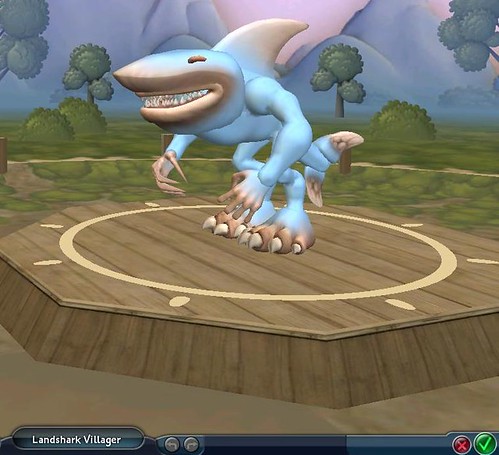
A number that big requires a brand new paragraph to get over, so lets finish the last part of December by mentioning that I was (to my own child like delight) included in Michael Abbott’s wonderful end of year gamers confab epic podcast of legendary proportions. That was an absolute blast to be on and a huge honour to be considered alongside some truly respectable bloggers. Not content to finish the year on such a self-congratulatory note, I then went and followed up with a second Gonzo journalism piece “Gonzo Pt 2 – Return of the Shark”, which was either brilliant or a spectacular failure. And, that’s the only way I’d want it. Look for more of same in early Oh-Nine. Toot-Toot! Last but not least and barely sneaking into 08, I finally got around to playing some more Spore and discussing (if ever so disdainfully) the procedural music in the game, with "Spore 'n' Eno".


Thanks for reading (or even glancing over), all you readers out there. You know who you are and I don’t (but apparently Feed Burner say’s there’s now 60+ of you! Where’d you all come from?!) so you’ll just have to give yourselves a pat on the back for discovering SLRC ‘before it jumped the Shark’. Onwards!, to Twenty-Oh-Nine with nary a backward glance and a slight ringing in the ears. Enjoy the New Year and please drink responsibly.


Friday, 5 December 2008

In which I post my first ever review: Saints Row 2


So this is the first ever review I've done for any outlet, ever. It's not been published yet (will it? who can say.) so I thought I'd share it with my readers if for no reason other than this game is Batshit Effing Insane... if you want to employ Ben for a game review (will accept food or games as payment) feel free to contact me via email or blog comment.

Edit: This review is now live in it's final form here.

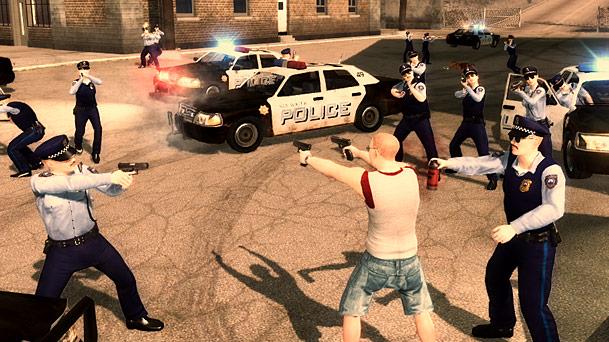
Saints Row 2 is set in a parallel universe from our own, in which gun fights and massive explosions are so commonplace as to become everyday for the inhabitants of Stilwater. The police bat nary an eyelid at your antics as you mow down pedestrians in a bulldozer, doing little to stop the brazen killings and wanton destruction. Choose your weapon of mass demolition. Feelin’ gangsta? Dual wield some Desert Eagle types. Feeling a bit in the mood for some Yakuza-style samurai executions? Borrow a sword from a friendly Ronin on a passing motorbike. He’s not a member of the Saints, so it’s okay to murder him. It’s apparently cool.


“What did you expect?”, quips my middle-aged, ‘west coast Latino’ accented protagonist after another kill. Having not played the original Saints Row, I didn’t really know what to expect. I wanted to create some kind of rationale for my female lead character, however, I wanted some pretense of a credible history to help explain why this middle aged woman had gone mad with rage and no longer seemed to identify other human as worthy of receiving their basic human rights. Let’s pretend that her kids were killed and, now that she has nothing to live for, decided to become a gang leader as a 30-something – your standard revenge story, yeah? So anyway, the start of my experience with Saints’ wasn’t a good sign that the rest of the game was going to be ‘all there’, nicely polished to perfection. After exiting the somewhat hit-and-miss character creator at the very start of the game, I was treated to an intro cut-scene with (surprise, fool!) no voice track. Ah, well played Volition - this must be some kind of trick to make it difficult for me because I’m just such a Pro. When it came time to bust out of jail by beating up a single doctor and a few guards, followed I might add by what has to be the worlds easiest/slowest jail-break ever, I didn’t really have any idea what in the world I was doing.


But that turned out to be actually rather okay.


This review is probably in danger of becoming a ‘how I learned to stop worrying about inconsistencies and start loving Saints Row’ review, so allow me to explain. If one were to focus on all of the strange goings on within the world of Saints Row you would have to conclude that, more often than not, it just doesn’t make sense. As in, none at all. Mow down ten to fifteen rival gang members on one street corner and then, inexplicably, there’s another bunch just round the corner, all fresh and ready to have a cap busted in their collective asses. The AI is pretty whacky at times too; I had some pursuers charge blindly off-road after me, only to promptly fall into and get trapped in an empty swimming pool. I’ve also seen retiree’s sitting on their lawns typing on their laptops, while two more laptops protrude at right angles from their thighs. Hmm. Pimps, casually strolling down the street with Yankee-doodle style feathers in their caps (and heavy jackets, in ‘the heat’ no less) turn on passing police cars and beat down their occupants like they were owed money. Double hmm. At a million points throughout this game I could barely restrain fits of hysterical laughter at the strange absurdity of one or other situation. And no one else seems to notice.


So, perhaps inevitably, neither do you. And when you start to accept the inanity of this world, you start to realize that Volition have actually made a really, really decent GTA clone. Granted, it is just a GTA clone – you’ll find little that’s ground-breaking or genre expanding in Saints 2 – however it still manages to be quite fun, even intentionally humorous at times. Much of the situations and dialogue skate the thin line between taking the piss and treating the slaughter of (literally) hundreds of rival gang members somewhat seriously. When one of your Saint brethren, upon seeing a stripper, remarks “Damn those are nice boots!” it’s genuinely quite a funny moment. It’s also hard to tell whether the developers fully appreciated the irony of setting a mission during a funeral – by that point so many others have been slaughtered in your ambitious gang-advancing rampage that caring about the funeral of just one person seems incredibly nihilistic. It’s like mourning the death of a Nazi prison camp guard in the middle of the holocaust – yes they were indeed a person too, but remind me again what the difference was of this person from all the nameless masses that went before, and why you don’t care about any of them? I assume it was supposed to instill some dramatic tension, however it once again comes over as just another ‘WTF???!’ moment, for better or worse. Maybe by this point you’ll be like me and stuck somewhere between genuine horror, and laughing at how hilariously B-grade it has all become. Well actually, who am I kidding, it’s probably deliberately B-grade, and I guess that’s part of its charm. Again, take it too seriously and the flaws really start to show; switch off your brain for a bit and it’s quite passable as fun.


Key to the joy of Saints is that it runs almost constantly at the full 60 frames per second, or near enough to not notice. Even when the police-car you’ve hijacked smashes into some pursuing officers and explodes in a flurry of sparks and the High Def propagation of super-advanced particle systems, the Xbox 360 keeps chugging along. A note should be made about the quality of the world that has been created by Volition – there’s no loading between city sections and generally it presents an adequate level of detail.


Difficulty is rarely an issue. For some select occasions you are given infinite ammunition for your weapons in the interest of being able to kill all those pesky Brotherhood gang-bangers from up town without having to pop into a corner store and buy some more bullets. In the end it hardly matters that there is always more of them than you as generally nothing short of an RPG to the head will kill you. Try standing on a grenade, and watch as the hilarious, Havok powered rag-doll physics kick in. Get blown high into the air, and tumble to the ground. Pick yourself up, dust yourself off and keep on keeping on, like some kind of insane Duracell bunny for videogames. There’s also some pretty neat full-screen effects similar to what you get in Call of Duty 4 when a grenade goes off in your face – it will make your vision and hearing go all dull and fuzzy. Alternatively, get sprayed by a cop with a bottle of mace and watch as your eyes water, distorting the screen into waves. May I suggest you remedy the situation with a prompt shotgun to the face? The guy had it coming, by the way, apparently all the cops in Saints are crooked. There’s a story here about a big corporation having the city in their pocket, etc, etc, nothing particularly experimental is going on, but if you want to ‘stick it to them man’ Saints Row 2 certainly gives you plenty of opportunities to say ‘Fuck You’ to the establishment. One side mission sees you spending some time spraying feces from a septic truck around an area of the city inhabited by corporate high-fliers. Not my favorite mission-type; that spot is reserved for ‘trail blazing’ in which you drive around on a quad-bike, while on fire, blowing up conveniently placed barrels of gasoline, car, people. Yes that really is the type of game this is.


One last thing of note, and actually one of the better aspects of Saints, is the in-game radio (again, unconcernedly riffing on the whole GTA series) which has a bunch of fantastic songs from some genuinely big-name bands. Hot Chip, MGMT, Does it offend you, Yeah? and Panic at the Disco are all on the radio and there’s a bunch more from other styles of music on the reggae, rock and 80’s stations. Quite a surprisingly solid selection however Volition have clearly chosen quality over quantity for Saints, as there’s only about 8 or 10 songs for each station.


Let me sum up the game by using the character creator as an example – it’s really, really great for some things (pimps, ho’s and awesome cornrows) but it is also quite, er, average when it comes to others – specifically any non-black Gangsta that you can make. The Asian fellow that my younger brother sculpted is rather so-so, and my own Latino momma… well let’s just say she doesn’t look much like a momma. So why did they bother including the creator then? I think Volition would have been better served to stick with the GTA style single type of protagonist approach (think Tommy Vercetti in Vice City) or narrow down the choices to a small number of more appropriate characters. Thankfully, like the rest of the game, it gets better and via the magic of in-game plastic surgery you can change anything and everything you didn’t like about your character.


One last addendum: the game is, how shall I put it, “buggy as all hell”. I have heard story after story of glitched up missions, weird behavior generally and a couple of more serious crash bugs. Still, my verdict stands – if you don’t mind some brainless mayhem, Saints might be a game you could learn to love.