Sunday, 24 August 2008

Videogames and Digital Musicians


Before I proceed, I must confess that this is stepping on the toes of my thesis a tiny bit – but I think anything I’d write at this stage probably would anyway. Maybe bits of this will find their way into the thesis anyway, so that’ll make it worthwhile.


I’ve been meaning to write this blog post for night on three months now. Obviously I’ve been busy writing other things (I just completed a first draft for my thesis - quite an accomplishment in itself) but now that I’m taking a couple days to catch my breath I wanted to jot down some thoughts I've had which also might incidentally help explain how and/or why I, a Bachelor of Music student, came to be writing a thesis on music in videogames. Because there is a connection.


My major was ‘digital music’ a kind of catch-all subject for anything music related that was technical (nyquist frequency anyone?) or that used a computer. Suffice to say that I love the subject. I hadn’t actually realised until recently but most of my listening habits have arisen from the desire to find people making the kind of music that I felt that I could make. Primarily that is computer and effects based music, with artists like The Knife, Röyksopp, and Junior Boys inspiring me with their synth-tones and crisp TR-808 samples. Anyway, one of the bigger parts of the 'Digital Musics' subject stream was live electronic music performance and it's here that I want to make an observation – videogame designers could stand to learn a lot by looking at live electronic musicians.


Artists like those that perform at the NIME (New Interfaces for Musical Expression) Conference every year, not least of all my own honours supervisor, the brilliant Dr. Garth Paine, have been making interesting and engaging live music with computers for decades. And a central concern in these performances is often keeping the audience engaged and the performer looking like they’re doing more than just checking email. They accomplish this mainly through interesting and engaging performance interfaces like wacom tablets and by connecting swathes of transducers (anything that takes a real world input and converts it to an electronic signal) to their bodies.


So what the heck does that have to do with videogame music? Well as hardware gets more and more powerful, I believe, we are going to see more and more music generated ‘on the fly’ in videogames, and when we do, videogame developers would do extremely well to pay attention to those musicians that have already experimented with making music on the go to glean what they can; what works, what doesn’t, how to keep an audience engaged, and (most importantly for this discussion) how to meaningfully connect audio to visuals.


Significantly, videogames don’t have to worry about keeping an audience visually entertained – the games visuals should have that aspect covered. However, what if the videogame’s visuals much like the electronic musicians visual performance gestures were similarly connected? Can you see the potential? This is getting at the heart of what my thesis is about, so I don’t want to give it all away, but I am incredibly excited by the potential for music in games to be generated by game elements on a level that goes beyond those like what Tommy Tallarico recently depicted. In an interview with Tom Kim on the Gamasutra podcast he described the process of implementing music in videogames, saying:


You have to let them [the music programmers] know that you want this version to play when there are a hundred guys on horseback and this other version when there's only one.[1]

Seriously guys (and most composers are guys, by the way - an issues that’s also planned for the thesis), we’ve had the processing power of multi-core CPU’s since the start of this generation of videogame consoles and multiple gigabytes of RAM, but the very best we can come up with is “play this song now, and this other one later”? Because that’s essentially what it boils down to. Composer for games Phil Richard Jacques said in an interview on Gamasutra about his own ‘interactive’ scores that


the way I want to do [music] interactively is have a musical transition, or rise or whatever that sounds very musical... rather than hard-cutting two tracks, because I think it can be done better than that.[2]

Okay that’s great, but what about doing something a bit more than that? With all due respect to Mr Jacques, I think the scope for ‘interactivity’ is just a little bit broader than just making transitions sound smooth. He goes on to say later in the interview that the original Outrun game from way back in the 80’s, in a move that seems to pre-empt current videogame musical interactivity, had a faux interactive score in the sense that the music was composed so that roughly around the time that a player reached branching sections at the end of a track the song would change signifying this.


It was actually composed so the music would change where an average player would do the branching at the end.

I mean, it wasn't interactive, but they timed the music so that when you went down the end of one course and you branched into the next course, the music would go into a different chorus or something like that.[3]

So if Outrun twenty-odd years ago could do music that in a way reflected what was happening on screen (in it’s own pre-determined and constricted way) and affected the change in music on a structural level within the song – please explain how the best we can do today is make pleasant transitions between tracks?


My answer? I’ll have it for you in writing in, oh, say seven weeks. Actually, add a little bit longer to that for it to be marked as I don’t think they’d appreciate me putting it out there before the markers had a chance to read it. But I think I will have some answers. Also if any of the composers I mentioned end up reading this (hey it happened over on Cruise Elroy!) I’d love to hear their thoughts on the issue – although I have a sneaking suspicion I know what they’d say.


[1] “Video Game Music Strikes a Bigger Chord,” http://www.businessweek.com/globalbiz/content/jul2008/gb2008078_807637.htm

[2] “Gamasutra - Staying In Tune: Richard Jacques On Game Music's Past, Present, And Future,” http://www.gamasutra.com/view/feature/3695/staying_in_tune_richard_jacques_.php

[3] Ibid.

Thursday, 14 August 2008

Thesis Update

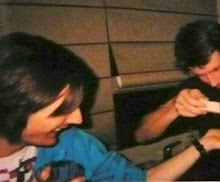
[The guy on the far left is me :D]


It's been a while since I last posted and although apologising for not posting more frequently smacks of disingenuousness (if you were really worried about it, you'd do something about it) I'm going to do so anyway. To anyone who cares, Sorry- but I've been busy writing my thesis.

Yes, that's right I'm actually up to the writing stage, despite the fact that I have 8 weeks and 3 days to go. Also I've just passed the rough 10,000 word mark which is pretty spiffy if I do say so myself, as it's a milestone on the way to completion and an order of magnitude larger than anything I've ever written on one subject before.

I would really like to share some parts of it with my readers, but I'm also aware that I maybe shouldn't, as potentially my final marker could end up reading it and getting the wrong impression. It will probably undergo some serious revision before it reaches its final incarnation.

Suffice to say, I've been writing about the games Guitar Hero, Audiosurf and Everyday Shooter which are all must-play games for people interested in what the future of music in videogames looks like. [Or could look like it everyone reads my thesis ;)]

So I'll leave it at that for a while and hope it satisfies the hunger of those desperately desiring an update on my work.

Cheerio!

Monday, 4 August 2008

Kountry Gentleman


This song has been in my head for the better part of four days and I just can't seem to get it out.

Maybe sharing it with you will help get it out. Pity about the compressed quality of the sound, oh well, that's YouTube for ya.

And if you didn't like that one, this one is possibly even better.


Too much? Naw...

Monday, 28 July 2008

In a previous life I was...


...a mashup artist.

So here's a link to my critically acclaimed* mashup album, Demon Says...A Mashup Album.

A little bit of background on the album, all done in an attractive, bullet point style:
  • > I made it for a 20 credit point unit at Uni (It was half of a semesters load worth of study)
  • > It was made in around 4 months
  • > It is a thematic song-by-song remixing/reworking/mashing-up of the entire Gorillaz album 'Demon Days' (hence Demon Says... Geddit? like Simon Says... okay you're right it wasn't all that clever but it stuck.)
  • > It features other such prominent artists such as: Coldplay, Fergie, Will Smith, Radiohead, Rhianna, Lady Sovereign, Justin Timberlake and plenty of other unwitting victims.
  • > It got me a distinction. Nuff said surely.
  • > Oh yeah, it's free cause if I tried to make money from it I'd be hunted down and killed.
  • > Please try and listen to the whole album - there's supposed to be a thematic continuity and I think some of that idea survived the process. The ending songs do get a bit weird, but I like weird, and so do you - go on, admit it.
  • > Some song titles are appropriaely nerdy (e.g. the final tracks' title 'Exits are north south, east and Dennis'. If you don't get it, I'm not explaining it to you)
  • > I really enjoyed making it, and some of it remains some of my best work. I hope you like at least some of it too.

Go nuts people, but don't tell the authorities on me, K?

*by critically acclaimed I mean that I, speaking critically, am full of accolades for it.

Sunday, 27 July 2008

Of Indie Games and Children


A few weeks back I was babysitting a family of four kids all under the age of 11 for the whole day, 9-5. It was fun, as they're all great kids and all I've gotta do to keep them entertained for a while is put on a Star Wars DVD and let em go nuts with the movie. By go nuts I mean be incredibly absorbed for multiple hours.

Anyway, as the day dragged on and they got progressively less interested in the movie (I think we were up to episode 6 by then) I decided to show them a couple of cool things on the PC. They showed me a few fun mini clip games that they enjoyed, and it got me thinking about sharing a few of the Indie games I was rather into at the time with the kids. I downloaded the cult classic Death Worm (which I've mentioned before in my 10 indie games to be playing while not working on your thesis post) and prepped the kiddies on how to gobble up lions and elephants and people like a good Death Worm should.

They got stuck into it like professional gamers. They loved it, and I quickly downloaded the two player version of the game, which delighted them even more, as there are 4 of them and in their family there's always someone wanting to do whatever another one is. Two players means one less person to be left out. Coincidentally, they were actually better at the game than me I'm mildly ashamed to say. It seems to me that kids are getting better and better at games, and at younger and younger ages too. I've got no chance these days.

Anyway, their parents get home about an hour or so later and I suddenly realised that... well... maybe Death Worm was a little bit of a mature game to be letting a bunch of (remember max age) 11 year olds play. Worries aside, their parents are super-cool and were totally fine with them playing it (I wish my parents were that understanding!) and that was that. Did I mention how awesome I think their parents are yet - both generally and specifically about games? Oh I did. Oh well, can't really stress it enough.

But it got me thinking... there are Indie games out there, for instance Randy Balma: Municipal Abortionist, which while not explicitly depicting abortion, at least hints at the act and is quite a mature kind of experience. Oh, and by the way, it's not at all rated by any classification system, because it's free to download. As far as I know, no idie game that is free to download comes with any kind of classification, offical or not!

I know, I know, Caveat Emptor and all that goes without saying on Teh Intertubes, but it's a bit of an interesting situation we're in whereby politicians are shouting left right and centre "WON'T SOMEBODY THINK OF TEH CHILDREN!!!" whenever any game aimed at a mature audience comes out (For a recent local Australian TRAVESTY of an incident, see this video in which an audience member asks a panel of politicians and journo's why Australia can't have an R18+ classification for videogames and in which Fallout 3 is described as being 'all about killing people'. Incidentally what I want to know is why the FRAK did the question asker, apparently a writer for an Aussie online gaming portal, answered 'basically, yes' to that description... GAH!). Additionally, these same politicians are choosing to ignore current information, statistics even, that says the average Australian gamer is aged 28, and that there are games being made without classification being targeted at this same age bracket (indeed like Randy Balma and Death Worm).

So anyway, the lesson to be learned this is;
Don't forget when showing friends your Indie games to think about age appropriateness, because chances are if you're like me, you've probably never even given it a second (or first!) thought before.

Or maybe you have and I'm an idiot for giving Death Worm to a bunch of tiddlewinks. Either or.

Friday, 11 July 2008

The attraction to collaboration

I haven't posted in a while, mostly because I'm on holidays and I'm lazy, but also because I've been playing lots of Oblivion on PC. I bought a new graphics card last week (a Gigabyte 8800GT 512mb) which is awesome and makes PC games fun again. Hooray for generous tax returns to poor students! Anyway, what I wanted to quickly mention was something entirely unrelated. I've been thinking about it for a while and I just wanted to jot down some thoughts about it and ask the audience.

Collaboration. From Miriam-Webster online:
1 : to work jointly with others or together especially in an intellectual endeavor
2
: to cooperate with or willingly assist an enemy of one's country and especially an occupying force
3
: to cooperate with an agency or instrumentality with which one is not immediately connected

Yes, that's the sound of this post heading in a completely unexpected direction. Collaboration is everywhere. It's in Music (any band who ever played together), it's in Writing (any writer and their editor/s), its in Videogames (in any multi-person development or mod team) and it can be in blogging (like RPS, etc).

I'm bored of doing stuff by myself - for starters, its never as good as when I work with someone else as what always seems happen is we end up inspiring each other and produce something better as a result. In my second year at Uni we had a subject called Collaborative Project in which we formed inter-disciplinary groups of artists from music, drama, electronic arts and fine arts to put on a short 20 minute work at the end of the semester. The groups were as big as 15-20 people, and easily became unwieldy, with decision making being done mostly on a basis of whoever actually bothered to turn up to the class (which was about 5-10 of us regularly =P). Anyway, it was a great time and one of the best things about such a large group was that you could do something very specialised within the group. My contribution, other than often helping facilitate discussions, was a piece of musical improvisation that used live digital signal processing to make lovely ethereal sounds.

A screenshot of my Max/MSP patcher - a visual programming environment made for digital signal processing, and my first musical love. The bottom box was used to 'draw' a spectral filter that was applied to white noise, resulting in some awesome sounds.

I've uploaded a short sample of a very early version of what it sounded like, just for fun, here. (1.9mb, 4:10) The final performance was... OK - and our supervisory lecturer really enjoyed it, so we obviously did something right. Good marks too.

The point that I wanted to to get to was that I want to collaborate more. The Internet is possibly the most powerful communication enhancing tool out there and can facilitate some great works... so where are they all? Have you got a great idea you want to collaborate on? A Mod idea? A musical work you want to do? Something you want to write about that you want input from others on? If so, tell me about it! Collaborate with me, people! I want to give you my time!

So in conclusion, consider this an official invitation to sequester me for all sorts of strange collaborations. Got an idea, drop it in the comments or send me an email and we'll talk! I'd love to hear from anyone and everyone, and I'd also love to hear your success/horror stories of collaborations. If they've turned you off them, why? They can be ever so much fun.

Friday, 27 June 2008

More proof of the versatility of 'Obilivion'


The main point of this post is to link to Christopher Livingston's highly entertaining travel-blogue which is based around creating a character and role playing him as an NPC in the world. The travel-blogue is called 'Living Oblivion' and he uses a bunch of mods to starts his character Nondrik in the port town of Anvil (somewhat reminiscent of Morrowind) and roleplaying as an NPC, Livingston refuses to run to destinations or to use the quick travel feature, resulting in what must be a very leisurely pace at times.

An extract from 'Day 19 & 20' of the Travel-blogue:

I’ll be honest — walking everywhere and never fast-traveling isn’t… easy. The click of my mouse could instantly transport me to any city in the game. Sprinting would decimate my lengthy travel time. There are long stretches, like today, where I’m not attacked, there are few ingredients to pick, and not much of anything interesting to look at, and I think, man, why the hell am I playing like this?


But at moments like this it somehow feels worth it. In other playings of this game I’ve spent days, weeks even, in Imperial City. I know it inside and out. I barely even look at the city, I just zip there, run to the merchants, unload my junk, and dematerialize to my next location. But playing as Nondrick has restored a good deal of majesty and mystery on Imperial City, and catching a glimpse of it through the trees, seeing it grow closer and larger each time, is a bit of a thrill.


Oh, also, for a little bit of contextualisation, Chris Livingston is the guy who wrote, posed and print-screened 'Concerned: The Half-Life and Death of Gordon Frohman' which is a must read for anyone interested in the Half-Life universe.

Also, just wanted to give a heads-up for a post I'm working on "What Videogames have can learn from Digital Musicians" which is hopefully going to explain how I went from a Digital Musics major to a videogame theoretician (if I can even really call myself that...). I've got some interesting ideas, so I hope people will come back for that next week. Until then!