Showing posts with label narrative. Show all posts

Friday, 14 August 2009

Permanent Death, Episode 7: A Mysterious Packet


CIA Special Analyst Perry Gerling was part of the African Attaché, and as such regularly received reports from a number of field operatives. One particular operative was late in reporting and he grew anxious waiting.

After several days of silence, he was about to consider reporting the field agent as missing when a package arrived on his desk in a yellowed envelope. It looked like it had travelled half-way round the world in someone’s back pocket. Inside was a long telegram (2 pages) from his field agent and a series of surveillance photographs.

Gerling pulled out the surveillance photographs and leafed through them.

It was clear that Singh was regularly getting his hands dirty, but as to whether he was still on-the-job was another matter. He grabbed a pen and a pad from his top drawer and scribbled a note for a return message. "Maintain distance and surveillance. END OF TELEGRAM." He wondered whether Washington would notice the expenses being racked up by his special surveillance project but he Gerling thought it was worth the risk. Washington still didn't know that Singh had - potentially, he was quick to add to no one in particular - gone rogue. He looked over a few more of the photos.

Yes it was going to be worth the extra hassle of justifying the diverted resources if it mean he could give a definitive answer to Washington. Singh would show his hand sooner or later, he knew that much from experience.

"This just won't do." He said, tossing aside the photographs and rocking back in his chair. At this rate, he considered, he was likely to get a posting back Stateside some time around the turn of the next decade.

At least one agent was still taking orders.

Thursday, 12 March 2009

Getting My Immersion Fix


There is a certain type of game that I gravitate towards and that always seems to end up being the ones I keep coming back to, spending far and away the most time with. These games delight me with tiny pockets of ‘emergent narrative’ – parts of the game that for whatever reason ‘just happen’ as a result of the fact that the world around me is alive with people and things. The stories that most stand out in my memory are the ones that pop up without explicit authorial intent, the ones that just happen to coalesce into some strange and surprising mini story.

When I play The Elder Scrolls IV: Oblivion my regular habit is to walk everywhere to get around. I like to avoid the use of ‘quick travel’ because it doesn’t make logical sense to me that I should be able to instantly teleport around the world. The ‘quick travel’ method that is present in both Oblivion and Fallout 3 pulls me out of the game because literally nothing happens to the player while travelling. I want things to happen to me; after all, it’s why I’m playing a game.

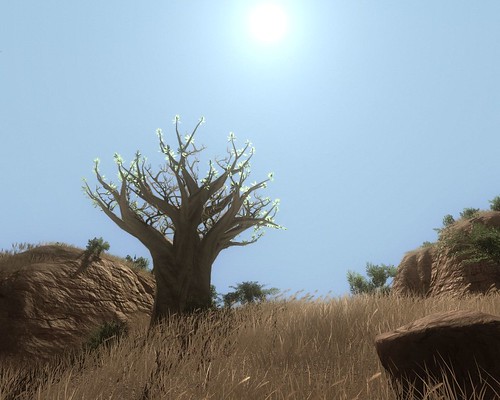
So I use foot power like the lowly commoner I am and install a mod that introduces ‘stage coaches’ that fits with the fiction of the game as well as providing an alternative method of quick travelling between major cities. When I walk, I actually quite enjoy the experience because I find the countryside calming, idyllic – enjoyable for its own sake. Interestingly, the games I’ve most recently spent the most time with all involve traversing the world – I mentioned on the special holiday edition of the Brainy Gamer podcast last year that a lot of the joy I get from playing Far Cry 2 is in learning to skilfully snake my way through a hostile environment. Similarly, the way I like to play Oblivion is just as grounded in inhabiting the world.

This week I was playing Oblivion, and as I walked my Orc north and then west from the Imperial City sewer exit all the way to Chorrol (practically via Bruma) I was quite deliberately taking the scenic route. The direct route would have cut the trip time in half, but I especially like the view from the Orange Road, you get some beautiful views of the Imperial Spire through gaps in the trees and much of the forest is made up of what looks like Silver Birch trees, my favourite (an aside: We had a beautiful silver birch outside our front door but it sadly died from a fungus a year or two ago and blew down in the wind. It was one of my favourite trees.)

On this occasion, I got about half way and spied an imp that looked like good target practice for my marksman skill. I started stalking him, readying my bow and arrow. Unaware of my presence, my first attack gained the benefit of extra damage. Success, a hit! But he is not going to be defeated by a single arrow as I’m still a lowly level 1 Orc, and so the creature flees. This happens because I have a mod installed that makes all sorts of back-end faction changes and the end result is that this Imp now behaves somewhat like a normal wounded animal. I finish him off and continue my journey west and shortly come across an intriguing scene. The bodies of multiple bandits are strewn across the road and the survivors of a pack of wolves haunt the road ahead. They were clearly weakened from their fight with the bandits with one of their number already dead, so I had no trouble finishing them off from a distance. But I was so shocked when I came across such a strange scene that for a moment I almost forgot I was playing a game.

I realised quickly that I was more surprised by the fact that this interaction was entirely natural and actually made complete sense. I could tell at a glance that the bandits, who had been hiding off to the side of the road waiting to pick off unwary travellers, had fallen prey themselves to a pack of hungry wolves. I didn’t see it happen, but the knowledge that this was off happening somewhere else in the world as I wandered around was thrilling. After all, why should my player character be the center of attention in the world? My character is just a nobody at this point, so why should everything in the game be planned and scripted in advance just for me? The real world doesn’t work in that way, so why should a videogame?

I guess this is the difference between games as entertainment – the highly scripted Hollywood film approach to games – and games as experiences. The difference has been described by many, but perhaps most effectively by Steve Gaynor in his post ‘Being There’. The games I love are not the ones that try to usher me along and give me a tightly controlled narrative experience, even though I still enjoy those occasionally. Instead, the games I love are about ‘Being There’.

But what makes one game better at ‘being there’ than another? And for that matter, what makes the ‘Being There’ itself enjoyable? For Oblivion I find that it’s the little details that build the world and make me love the game – stumbling upon unscripted events that could easily be happening without your presence tickle all the right places for me. Conversely I think a large part of why I struggled to engage with Fallout 3 (after all it’s just Oblivion with guns, right?) is that it seemed to lose much of these unexpected events, instead leaning heavily on discovering ‘places of interest’ that sit dormant waiting for you to find them. To me, Fallout 3 distinctly lacks the feeling that the world is ‘lived in’ by anyone at all, heightened by the fact that there are so few people ever doing anything in the world outside of major quest hubs.

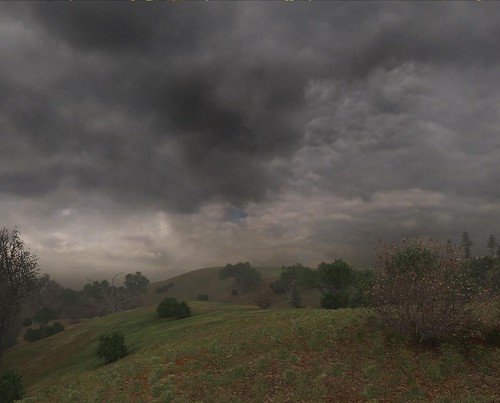
I’ve also been playing STALKER this week, and while it’s been lauded as a ‘living world’ game similar to Oblivion, I haven’t actually found it as engaging. I think, in this case, it comes down to the geographic design of the world. Areas in STALKER feel like wide corridors connected only by entry and exit points. It would be much more attractive to me if it did away with it’s ‘levels’ and opened up The Zone a bit more. I also wonder if the enjoyment of ‘Being There’ in Oblivion and Far Cry 2 is not present in STALKER because of its distinctly dark and brooding aesthetic. While there are undoubtedly moments of beauty, they seem much fewer and further between.

Lastly, in a strange and maybe unnatural comparison, I think I’m looking forward to (eventually) playing the new Empire: Total War game for somewhat similar reasons. Judging by this after action report by Tim Stone over at Rock, Paper, Shotgun the battles look like they encourage the feeling of ‘Being There’ with their rich level of detail and potential for player-created narratives. I look forward to seeing whether that impression is accurate.

In the meantime, does anyone else have any suggestions for games that encourage that feeling of ‘Being There’ - of watching the world flow around you? Hit up the comments and let me know and I’d also be interested to hear what particular aspects of those games make you feel like you’re 'really there'.

Thursday, 5 February 2009

In reply to Clint Hocking and Michael Abbott


An issue that’s been floating around the videogame blogs recently is that of spoiling a game’s story for other players, whether or not that’s important, and similarly whether or not it’s possible to spoil a games actual mechanics for another player.


The issue was first raised by Michael Abbott in his post, ‘The spoiler ball and chain’ in which was pointed out that if you’re going to talk seriously about a game and what it means, what it says, how it says it, then you’re probably going to have to assume a certain level of knowledge on the part of your reader.


And then in the comments thread CLINT HOCKING showed up to spoil the party. (I kid! Clint is a consummate professional) The point he was making was that ‘story’ or anything the player doesn’t actually have control over isn’t really part of the ‘game’. Here’s the important part of what he said, in full:

Here's a more pertinent question though - why are we even really concerned with giving away details of the PLOT in a video game. Elika doesn't die in PoP. There is no Elika, there is no Death of Elika, because there is no choice, there is no GAME there. The villain in CoD4 doesn't get his arm sniped off by a BAD SHOT, he gets his arm sniped off by an imposed narrative. The weakness of Passage is that the death of the wife is purely narrative, and the moving elements of the experience of Passage are the narrative ones. Telling the player these 'plot secrets' does nothing at all to impact the experience of the GAME in my opinion (you may still find these things moving, but they are not games, they are stories).


What I really like about this idea is that it is reflective of the school of thought that says games are interactive and everything else is secondary to the ‘game’. Which is a perspective I can see has a lot of validity – however on the other hand, you have Michael Abbott who steadfastly refuses to believe that story has necessarily be ‘tacked on’ to a game as some kind of garnish, which also seems like quite a sensible idea.


My initial sense is that it comes from conceptions of ‘game’ somewhat running at cross purposes. Specifically, differing conceptions of what is and is not extraneous to the actual ‘game’, which is an issue that Jesper Juul discusses in depth in his book Half-Real. In it, Juul offers a view of games as pared back as they come – essentially describing them as rule systems. However, he also acknowledges that equally important is the aesthetics or ‘fiction’ placed on top of those rules, which often have as much an impact on the actual end-user experience as what the X button on the controller does.


An example: If I were to rip out the music portion of Far Cry 2 and replace it with nothing or something completely irrelevant and jarring, is that not going to change the experience of the game? Of course it is! But has the underlying mechanics of Far Cry 2 actually been changed in any way? Not really, and yet the experience will fundamentally not be the same.


What Hocking says next, after this his initial comment, is quite challenging. He says,

I propose that we put this 'spoiler challenge' to the test - I'd like to see someone write a spoiler that was about a MECHANIC or a DYNAMIC of a game - something that is part of PLAY not part of the STORY, that *actually spoils the game* for me.


Go ahead, try it. Find a game, explain the ways in which the mechanics and dynamics moved you, and write it up so that it ruins my own subjective experience of the game.


I think on this point he’s actually bang on the money – I have never, and don’t ever expect to in the future, have a mechanic spoiled for me by a write up. Why? Because mechanics are truly best experienced, and there is no replacement for first hand experience. Gonzalo Frasca wrote about this issue in his paper Simulation vs. Narrative back in 2003, and he concisely outlined the difference between a simulation and a narrative thusly,

To an external observer, the sequence of signs produced by both the film and the simulation could look exactly the same…but simulation cannot be understood just through its output.


In other words, mechanics (here fungible with simulation) can really only be experienced and any attempts to describe them will be, at best, second hand descriptions without being truly evocative and therefore leaving our imagination with the task of ‘filling in the blanks’ with respect to the actual experience.


As a side note, I think my belief in this idea partly explains why I love New Games Journalism and the whole movement around subjective games writing so much, since I feel it sidesteps the clunky ‘descriptions’ of mechanics and, via the vehicle of creative writing and anecdote, actually gets closer to the mark than even the best of dry mechanical breakdowns. So I believe that Hocking is right in that you probably can’t spoil a mechanic any more than you can replace the experience of white water rafting with a story about it. Even if that story is a cracking good yarn, it’s never going to be able to get you wet.


The ironic part in all this is that while Hocking seems to really get the ‘experiencing mechanics’ issue, he seems to have (with this comment at least) ignored the fact that no matter how trivial the ‘fiction’ (as Juul would put it) or ‘content’ (as game developers would put it) of a game may seem in comparison to the mechanics it still remains important. Exactly how important, I have a hunch, is probably different from person to person as evidenced by the strong reaction provoked in Michael Abbott at the announcement of the somewhat “tacked on” nature of the narrative component of the latest downloadable content for the new Prince of Persia title. And that’s actually a feeling I can somewhat empathise with – the few extra missions released to add more story to my favorite game Far Cry 2 were more than welcome additions, and I wouldn’t want to see the story ruined or altered seriously like Michael seems to is the case. But since it’s also probably a bit less important for me, I’m not sure I’d see it as the ‘betrayal’ he feels it is.


So that’s what I think – Hocking’s right in that mechanics can’t be ruined because, like they say, there’s no substitute for the real thing. But on the other hand, story isn’t irrelevant to videogames either – it’s obviously not the core of them and there’s certainly plenty of future potential for growth in the area of making interactive stories, but I wouldn’t want to cut the idea off entirely. Then again, is it really a story if it’s interactive? Actually, I’ll leave that kind of discussion to the Corvus’ of the 'sphere, I think.