An issue that’s been floating around the videogame blogs recently is that of spoiling a game’s story for other players, whether or not that’s important, and similarly whether or not it’s possible to spoil a games actual mechanics for another player.
The issue was first raised by Michael Abbott in his post, ‘The spoiler ball and chain’ in which was pointed out that if you’re going to talk seriously about a game and what it means, what it says, how it says it, then you’re probably going to have to assume a certain level of knowledge on the part of your reader.
And then in the comments thread CLINT HOCKING showed up to spoil the party. (I kid! Clint is a consummate professional) The point he was making was that ‘story’ or anything the player doesn’t actually have control over isn’t really part of the ‘game’. Here’s the important part of what he said, in full:
Here's a more pertinent question though - why are we even really concerned with giving away details of the PLOT in a video game. Elika doesn't die in PoP. There is no Elika, there is no Death of Elika, because there is no choice, there is no GAME there. The villain in CoD4 doesn't get his arm sniped off by a BAD SHOT, he gets his arm sniped off by an imposed narrative. The weakness of Passage is that the death of the wife is purely narrative, and the moving elements of the experience of Passage are the narrative ones. Telling the player these 'plot secrets' does nothing at all to impact the experience of the GAME in my opinion (you may still find these things moving, but they are not games, they are stories).
What I really like about this idea is that it is reflective of the school of thought that says games are interactive and everything else is secondary to the ‘game’. Which is a perspective I can see has a lot of validity – however on the other hand, you have Michael Abbott who steadfastly refuses to believe that story has necessarily be ‘tacked on’ to a game as some kind of garnish, which also seems like quite a sensible idea.
My initial sense is that it comes from conceptions of ‘game’ somewhat running at cross purposes. Specifically, differing conceptions of what is and is not extraneous to the actual ‘game’, which is an issue that Jesper Juul discusses in depth in his book Half-Real. In it, Juul offers a view of games as pared back as they come – essentially describing them as rule systems. However, he also acknowledges that equally important is the aesthetics or ‘fiction’ placed on top of those rules, which often have as much an impact on the actual end-user experience as what the X button on the controller does.
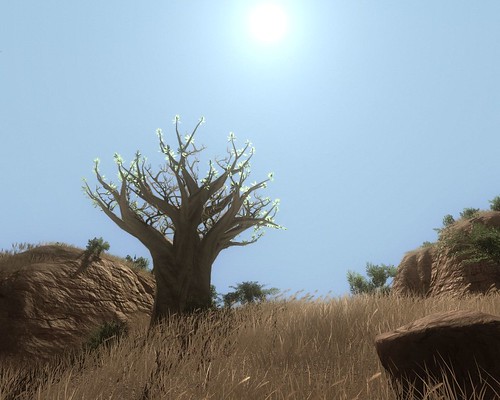
An example: If I were to rip out the music portion of Far Cry 2 and replace it with nothing or something completely irrelevant and jarring, is that not going to change the experience of the game? Of course it is! But has the underlying mechanics of Far Cry 2 actually been changed in any way? Not really, and yet the experience will fundamentally not be the same.
What Hocking says next, after this his initial comment, is quite challenging. He says,
I propose that we put this 'spoiler challenge' to the test - I'd like to see someone write a spoiler that was about a MECHANIC or a DYNAMIC of a game - something that is part of PLAY not part of the STORY, that *actually spoils the game* for me.
Go ahead, try it. Find a game, explain the ways in which the mechanics and dynamics moved you, and write it up so that it ruins my own subjective experience of the game.
I think on this point he’s actually bang on the money – I have never, and don’t ever expect to in the future, have a mechanic spoiled for me by a write up. Why? Because mechanics are truly best experienced, and there is no replacement for first hand experience. Gonzalo Frasca wrote about this issue in his paper Simulation vs. Narrative back in 2003, and he concisely outlined the difference between a simulation and a narrative thusly,
To an external observer, the sequence of signs produced by both the film and the simulation could look exactly the same…but simulation cannot be understood just through its output.
In other words, mechanics (here fungible with simulation) can really only be experienced and any attempts to describe them will be, at best, second hand descriptions without being truly evocative and therefore leaving our imagination with the task of ‘filling in the blanks’ with respect to the actual experience.
As a side note, I think my belief in this idea partly explains why I love New Games Journalism and the whole movement around subjective games writing so much, since I feel it sidesteps the clunky ‘descriptions’ of mechanics and, via the vehicle of creative writing and anecdote, actually gets closer to the mark than even the best of dry mechanical breakdowns. So I believe that Hocking is right in that you probably can’t spoil a mechanic any more than you can replace the experience of white water rafting with a story about it. Even if that story is a cracking good yarn, it’s never going to be able to get you wet.
The ironic part in all this is that while Hocking seems to really get the ‘experiencing mechanics’ issue, he seems to have (with this comment at least) ignored the fact that no matter how trivial the ‘fiction’ (as Juul would put it) or ‘content’ (as game developers would put it) of a game may seem in comparison to the mechanics it still remains important. Exactly how important, I have a hunch, is probably different from person to person as evidenced by the strong reaction provoked in Michael Abbott at the announcement of the somewhat “tacked on” nature of the narrative component of the latest downloadable content for the new Prince of Persia title. And that’s actually a feeling I can somewhat empathise with – the few extra missions released to add more story to my favorite game Far Cry 2 were more than welcome additions, and I wouldn’t want to see the story ruined or altered seriously like Michael seems to is the case. But since it’s also probably a bit less important for me, I’m not sure I’d see it as the ‘betrayal’ he feels it is.
So that’s what I think – Hocking’s right in that mechanics can’t be ruined because, like they say, there’s no substitute for the real thing. But on the other hand, story isn’t irrelevant to videogames either – it’s obviously not the core of them and there’s certainly plenty of future potential for growth in the area of making interactive stories, but I wouldn’t want to cut the idea off entirely. Then again, is it really a story if it’s interactive? Actually, I’ll leave that kind of discussion to the Corvus’ of the 'sphere, I think.