Showing posts with label virtual reality. Show all posts

Thursday, 8 January 2009

Gaming Soundtracks (and not the kind you’re thinking!)


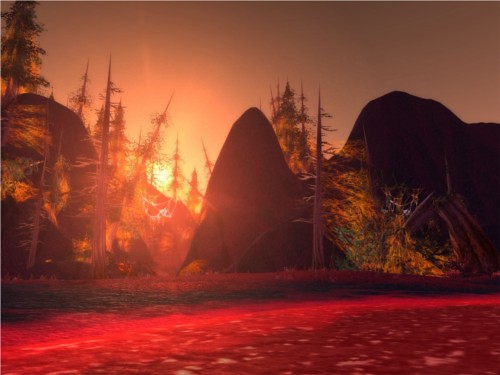
The first album from the Emo rock band ‘Panic! At the Disco’ has been stamped into my brain to such a degree that, if I can’t quite remember all the words, I can certainly always sing the melody. Also, whenever it’s played, a strange phenomenon occurs in my brain as it stirs up memories of a place far, far away from anywhere I have actually ever been. For me the album ‘A Fever You Can’t Sweat Out’ will always remind me of the crimson shores of Bloodmyst Isle, and a young Warrior in his low teens named Davetwo.


Back in the day I was a pretty serious WoW player, spending as much as 10-12 hours a day playing if given the chance and while I was levelling up my third character towards the goal of level 70 I also fell head over heels for Panic! At The Disco. The album was on massive high repeat, not entirely unlike the act of ‘grinding’ for XP. As an indication of just how much I listened to that album at the time, for a period of about a month I would often lie in bed awake at night listening to the album just because it was so infectious. I am frequently go on what Dan Bruno has called ‘bingeing’ on media (he originally applied it to games, but I think it’s an idea that has wider applicability also).


So when I put it on again just the other day it felt like being back there grinding on Blood Elves for XP. The sensation of being in that place was just below the surface, like having a word on the tip of your tongue but for a feeling of place. My response was almost one of synaesthesia in that the music becomes the sensation of ‘being there’ again. Of course, this album is by no means the only example, there was another in particular that also reminded me of Un’Goro Crater (another World of Warcraft zone) which I can’t recall right now but will probably recognise instantly the next time I hear it. And if this sort of thing is purely the result of the confluence of music and game levels then Metronomy’sNights Out’ album will remind me of my GoW2 marathon of the other night…


But I suspect Metronomy will be saved from that rather unfortunate fate for the time being. For starters, GoW2 wasn’t memorable enough (more on that a bit later), and there probably wasn’t enough repetition to ingrain the ‘location’ with the music into my brain. And in that sense, WoW is perhaps a stellar candidate for this kind of musical/locational imprinting because a player often spends long periods of time in one particular location doing highly repetitive tasks.


Another album that reminds me of a game level is ‘Lost in the sound of separation’ by Underoath (possibly the best album to Audiosurf to ever). There is a particular part in the 4th track of the album, where the cacophony cuts back to primarily the sound of the hi-hat beating out a straight rhythm. After having been barrelling along at 100mph the track comes to a period of relative calm (a flat area in the track) and it undulates up and down beneath you in time to the hi-hat. It’s quite memorable to the point that now whenever I hear that part of the song I see the track hopping up and down madly in time to the hi-hat in my mind, even if I’m not playing Audiosurf. However, Audiosurf is probably unique in that it renders levels unique for each song in a way that is generally representative of the song itself. Whether this improves the chances of imprinting the level/music combo, I have no idea, but the game also encourages replaying songs over with its scoring system.


I’m sure if I took the time I could think of a bunch more examples of non-game music reminding me of a place in a game, but the important fact is that the phenomenon happens at all. Videogame ‘levels’ are as real to my brain as ‘physical’ places.


Care to share a similar occurrence of game bingeing mixed with music bingeing? I’d love to hear about your own extra-game musical experiences if you have any. Let’s see if we can’t find some patterns about when and how they occur and whether it really is just as simple as plenty of repetition.


Monday, 10 November 2008

Embodiment and Immersion: Fallout & Far Cry, FIGHT!


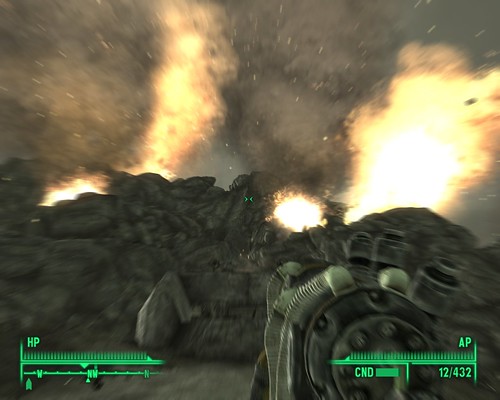
Not to harp on about a single topic or anything, but I’ve been pondering why I’ve felt so disappointed by Fallout 3. Yep, you read it right – I don’t entirely feel like the review scores it got were wholly deserved. I think I’m doubly stung because, in confluence with the hype train, they influenced my decision to go out and spend my hard earned dollars on the game. Okay, so I’m complicit in the last point for being a sucker for hype and the former can easily be countered by the suggestion that the review process is entirely subjective, which I tend to agree with, so lets skip past finger-pointing and try and identify why.


I’m a bit of a one trick pony at the moment, because I think it largely comes down to the sense of embodiment that the game offers, and certain things which only break my sense of immersion. For starters, when compared to Far Cry 2, my character in Fallout 3 feels like a lifeless sack of potatoes, and as Michael Abbott has recently noted, so do the other inhabitants. Why would I want to play a game in which I have to plod around everywhere like some machine reminiscent of Marvin the Paranoid Android when, with the swap of a disk and a click of a different icon on my desktop, I can effing sprint-slide into cover in Far Cry 2, and rip pieces of shrapnel from my body with a pair of pliers.


Secondly, and perhaps more importantly, as Kieron Gillen noted somewhere that I can’t seem to recall, in Fallout 3 you can do outrageous things like jump up on a table in the middle of a bar, and no-one cares. It would be fine, actually amazing, if there were responses for these out there actions but as it stands, nary a soul has one whit of a comment for many of the crazy things you can do in that game. And so as a player I find myself having to think up some (usually extremely tenuous) excuses for why other characters are downright uncaring about my kleptomania and other inexplicable behaviour, in order to maintain narrative coherence.


Take for example, any number of houses in Fallout: in a great many you will find a number of items that will fail to be marked as ‘owned’ by another character (shown by red text in game) which when picked up by the player results in thievery. Obviously, the majority of these are accidents, but as a result of this accidental design I find my sense of immersion broken by having to do a kind of “meta” thinking and decide whether or not I would (in character) take these items. More often than not I find myself reacting purely out of function and take the items anyway (sometimes I don’t) and take advantage of the exploit, but the fact is that every time I do it is immersion breaking. In a similar vein, by allowing me to jump on a table before beginning a conversation with an NPC, Bethesda has allowed for the occurrence of a situation in which the logical response of an NPC (which could be anything from “What do you think you are doing?” to “Get off mah dinner table, whippersnapper!”) is not present within the game. I find this extremely irritating.


The obvious counter argument is that “well you should be role playing, and if your character wouldn’t stand on a table then neither should you” and I suppose that is a valid argument. However it is most definitely NOT how I want to play a videogame – for me it’s all or nothing. If you can do something in a game, then there should be an appropriate response for it. Why even bother to let me jump on tables? What purpose does it actually serve? It’s not even as if it would be impossible to implement a system to prevent the majority of these oddities. Far Cry 2 contrives to make 100% certain that, when in a context for which a certain kind of action makes no sense (read: certain indoor areas), then you are stripped of the mere possibility of performing an incongruous action. Most notably, when you meet with certain mission-critical people indoors, you can no longer run, jump or fire your weapon – often having had your weapons taken off you before entry. This makes perfect sense, so I am only too happy to oblige!


I believe some of the reason for my difficulty in accepting the incongruity of an NPC ignoring my strange behaviour comes from not possessing a strong skill at, or even inclination towards Role Playing. And yet, even Role Players I know have commended the vintage game, Deus Ex for some of the small details that work to build a consistent and convincing world, specifically the noting of your characters entry into the womens’ bathroom. It seems to me that, while it is undoubtedly possible to force ones self into a way of playing that “only makes sense” in the game world, it makes even more sense to me to enforce certain behaviors unless they serve a purpose. In an interview I conducted with Marty O’Donnell, the audio director for Bungie studios’ and responsible for the sound and music of the Halo series, for my recently completed thesis we got onto the topic of giving the player control over “every aspect of the game”. O’Donnell said to me,

…game players have gotten into a habit [of thinking] that they should have control over all these things and basically I’m saying, you know what, no – you shouldn’t.


So, Bethesda, if you’re listening; in the future, either put in things to make sense of all my possible actions or please, please limit them to just sensible ones.


Friday, 24 October 2008

Far Cry 2: Wrongs and Rights

**SPOILER ALERT: These are mostly gameplay-related spoilers, but if you are trying to steer clear of anything and everything to do with the game before it comes out then perhaps you should stop reading now.**


Like just about every videogame in history, Far Cry 2 does some things well, and some things not so well. Lets get the wrong things out of the way first.


Okay, so FC2 has some of the same ‘open world’ problems shared by GTA, Oblivion and STALKER. While browsing an internet forum, I encountered a great and humorous way to sum it up (colourful language warning!). User ‘cpd’ said:

think gta but apartheid africa. plus fucking malaria FUCK OFF FUCKING PILLS

oh and the fact that EVERY c*** wants to shoot you. EVERY SINGLE JEEP will immediately swerve into your path to shoot the living fuck out of you. get out, kill them, repair jeep, drive 100m up the road, repeat.

So it can be kind of repetitive, and frustratingly so – but I’m kind of okay with some of that. I recognize a lot of people probably won’t be, but it kind of ties into the sense of space and physicality that I'll mention later on. I am, however, a guy who has played and nearly completed Oblivion with mods to disable fast-traveling (i.e. played the whole game on horse or foot), so maybe that rules me out. FC2 is at least as large as Oblivion, so getting around can at points become a large part of the game. While there are plenty of cars and utes lying around, the problem comes with transitions to fighting – you either have to get out of your car which takes precious time, or swap to a turret if you vehicle has one leaving you stationary and exposed. Perhaps this issue will be solved later on with the addition of someone riding shotgun, I will admit to only being about 8% of the way through (after nearly 6 hours I might add).


And the good!


The ‘buddy system’ is awesome. Specifically, the fact that if you die and you have a live buddy rested and waiting, they will immediately rush to your side, in a bid to save your life. They’ll pick you up, shoot most of the nearby enemies for you, and give you some breathing room to patch yourself up. It really does solve one of the biggest and most fundamental problems with player death – lets face it, reloading from a save game isn’t exactly all that fun. So it makes sense to do away with it if you can. John Walker from Rock, Paper, Shotgun (who I quoted in my last blog post) wrote back in September about the issue. He said,


I want a high profile, big budget, mainstream action game in which the player character is invincible. I believe that the next truly great game will be the one that does this.[1]


Far Cry 2 doesn’t make you invincible, but the number of times I have accidentally ‘died’ and have just begun to reach for the quick-load button only to fall into the arms or my buddy’s saving embrace, are many.


The other thing that Far Cry 2 does extremely well (and this is the one that I think everyone will or should be talking about soon) is give you a sense of embodiment within the world. As Steven Gaynor (Fullbright) pointed out over Twitter, ‘An FPS that visualizes your hand turning doorknobs? I think I'm in love.’[2] The comparison I couldn’t help but keep making was to Bioshock which often took control of the player and their hands to perform actions, usually in its on-the-rails cutscenes. In Far Cry 2, your hands are always doing this something and they really feel (to me at least) like they are my hands. Add to this the fact that when you need to you can see your body and legs (mostly in other on-rails sections) and you can start to see the building blocks of a really interesting system for representing the player in a virtual world.


In Far Cry 2 you never change to third person, ever – and this is a really good thing! Unfold your map and you will hold in your hands a map of the African country you're stranded in, represented as just another thing in your hands. Like a gun, but for information and orientation. When driving you can open up the map and hold it in one hand, and the net effect is similar to what you would do if performing a similar action in the real world. Your eyes flit back and forth between map and windscreen, balancing path finding with map-reading. No game has ever done that to me before. Also, getting in and out of a vehicle takes time, and while I decried it earlier as being frustrating in combat, it actually further adds to a sense of embodiment. It feels like I am a real human being with a body that takes a real amount of time to move, not some super ninja that flits around at the slightest twitch of a mouse.


In conclusion, it's too early to tell if Far Cry 2 is the ‘game changer’ that I hoped it would be in my previous post. However, even if it's not, it’s certainly another great step in the right direction, in this author’s humble opinion.


Post Script: Jim Rossignol, lover of all games open and exploratory, has posted his own initial thoughts on the game on Rock, Paper, Shotgun. He's pretty much spot on with everything except the Alt+Tab thing - mine works fine.


[1] http://www.rockpapershotgun.com/2008/09/18/rps-demands-i-want-to-live-forever/

[2] http://twitter.com/fullbright/status/971289072

Wednesday, 10 September 2008

The peaks and perils of First Person Camera


Corvus Elrod and I have been going back and forth over twitter this week about camera's and camera choice in games, and he's written up a series of posts about 3rd person camera (yesterday) as well as 1st person view. And its gotten me thinking about first person perspective games a lot (mostly because they are the kind of game I tend to gravitate towards) and in particular why I think Assassins Creed was actually better for being rendered in third person and conversely why I think Mirrors Edge, while commendable for trying a whole slew of new ideas and daring to be different just generally, is possibly doomed to have some serious problems.

The essential point is the difference in camera angle - where Assassins Creed generally uses a 3rd person over the head view to depict Altair scrambling up the side of buildings, Mirrors Edge uses First Person perspective. So what's great about the first person perspective? Primarily, with a First Person Perspective you get a strong and direct connection with 'you' as the player inside the game. You're are looking out your own characters eyes, after all, and in my opinion this view (with certain caveats) seems natural and instantly relatable; it's closer to the 'normal' way that we view the world from our bodies. Additionally, it allows for very precise actions, most commonly used for aiming weapons such as guns, bows and other projectiles.

Unfortunately there are equally a number of negative aspects with the first person perspective game and which for the sake of brevity I will not attempt to list. However, one aspect I want to foreground in this discussion is highlighted once we start aiming for rather more complex control relationships with our player avatar and ourselves.

Basically I see the issue as one of embodiment in the game-space. As I hinted at in Corvus' original post I don't think that anyone has yet made a first person perspective game where the 'camera' - your embodied view of the world - is anywhere near as flexible as our real world bodily configuration.

We have a pair of eyes that move independently of our heads, and on top of that our heads can also move independently of our torso. The whole history to date of the First Person Perspective game (to the best of my knowledge) has been limited to an avatar that moves his or her eyes, head and torso as one. And this is actually fine... for certain things. It's fine particularly for (surprise, surprise) shooting games as when you aim down the sights of a real-world weapon, you don't move your head or even your eyes far from the target.

Additionally the first person perspective can only give the player so much information about their surroundings. For starters, our display screens for videogames are woefully too small to represent the whole field of vision of the average person, and as such, first person representations of games are going to lose information that the player would have in an identical real-world situation.

Take for example, your feet. Do you have to look down at your feet to know where they are? Of course not. So when Halo makes the player aim down at their feet we just know that some information about the environment is being lost. And you know, this is also fine. As Corvus says, many videogame protagonists are supposedly wearing bulky, vision impairing helmets after all. Except that when playing a game we also lose two (well three if you count taste) other senses that could be delivering information as well! We don't get to feel the world - the cool brush of a breeze on our skin or the crunch of gravel under our feet - or smell the scents in a space. So all this information which we would in reality be receiving about our surroundings, whether consciously or not, is further lost.

I was reading recently the Game Set Watch Column 'Diamond in the Rough - A body in the dark' about the healing system in the most recent Alone in the Dark. The article rightly discusses some of the innovative features of the game and how it encourages embodiment in the game-space, however when I came to this passage I had to stop, suppressing the urge to guffaw.
The effect of all of this is to ground you in the body of your protagonist. You must constantly check yourself for new cuts or bruises, sometimes eliciting a tired shrug from Edward when a visual check reveals no new blemishes.


Okay, am I the only person to think that having to visually check your body for cuts and bruises is actually dis-engaging you from your body? Since when have you ever had to stop and look yourself over only to realise that actually "Oh, I'm bleeding from the stomach".

Yes, granted there have been some times when I have experienced an adrenaline rush that has suppressed the pain of small injuries, and I have heard of people 'shrugging off' larger injuries as well, but if you've got the time to 'look yourself over' you've got the time to take a breather and start feeling the pain!

So, all this gets me to the point of saying, for all the benefits the FPS brings with it's embodied perspective, it comes with a bunch of detractors. And that's why I think Assassins Creed went the right way with 3rd person parkour action. I believe that the use of the third person perspective can partially make up for what we lose in the form of experienced, embodied information about the world.

Just one last quick quote - this time from Clint Hocking of Far Cry 2 talking about their own implementation of specific areas and even types of injury, Hocking responded saying

...a contextual animation [plays] based on the type of injury you received and the location of the injury. If you fell from a cliff, you might have a dislocated ankle that needs to be relocated. If you were shot in the leg, you might need to prise the bullet out with a knife, if you were hit by a grenade blast you might need to pull shrapnel our of your elbow… the idea is to hit the player with a visceral ‘punch’ right at the moment that the intensity is highest and his adrenalin is pumping. The combined effect is to create powerful psychosomatic bonds between the player, the avatar and consequently the world itself.


I think Hocking's got the right idea - whether it's first, third or some odd combination of the two (think Oblivion style interchanging) the aim has to be to convey enough information to the player and about the player so as to aid a sense of embodiment, which only aids in the never-ending quest for 'immersion'. If that's the goal (and the actually result) then I don't really mind which one they choose. Maybe I could even learn to love Mirrors Edge (God knows I really want to!).

Wednesday, 3 September 2008

What speaks to me the most


In Mitch Krpata's Taxonomy of Gamers I'm dead-set a Tourist. Indeed before Mr. Krpata's series there was Richard A. Bartles 'HEARTS, CLUBS, DIAMONDS, SPADES: PLAYERS WHO SUIT MUDS' which I think extends to offline games remarkably well also,and in which I am similarly an 'Explorer' type player. The point that I want to make is that when I'm being a tourist, I prefer to do so from a First Person Perspective.

Corvus Elrod posted a few weeks back a small, almost throw-away, theory that personality type might have an influence on what perspective videogame players prefer to play in, whether First or Third. He asked for a quick poll in the comments and it seemed to me to be a little bit inconclusive, but I think that he's probably actually onto something.

The issue seems to me to be 'what flavour do you like your story'? All story driven videogames in recent memory that have captivated me have (primarily) told the meat of their story through story and plot that I experience in the game from the first person perspective. I'm experiencing it as the character. Now, I don't want to pretend that this could become some kind of hard and fast rule - after all I have also previously passionately enjoyed third person games like The Baldur's Gate series, and even many FPS games like Halo use 3rd person cut-scenes for certain sections of exposition.

Still, if you know me and have been paying attention to my thesis updates, etc, you'll know my shtick is all about what things are unique about videogames, and that we should be trying our best to capitalise on them. It's just what gets me excited about the medium - the idea of the new and things that have genuinely not been tried.

So I'm now wondering why more games haven't gone the route of the Half-Life's and the Call of Duty's. Both games tell their story exclusively (with very few exceptions) through first person experiences. Obviously I don't want to advocate that all videogames should ever do is tell a story in First Person Perspective, but it does seem like the industry hasn't really pushed the envelope very far past the previously mentioned examples. When can I expect the FPS equivalent of, Apocalypse Now (I'm talking about in terms of mood, atmosphere and focus on the psychological experience rather than the setting - Vietnam has been almost been done to death as much as WWII)? Casablanca? Doctor Zhivago?

The obvious point is that FPS games like those great films would be impossible, granted. After all, there's really very little shooting in them - but that's actually OK with me. I'm a tourist after all - I've climbed the highest peaks in Oblivion before just to see it, not because it had any intrinsic reward. I don't think I'm alone in this, there is definitely space in the videogame market for more tourist appealing games.

So, on that note, I've been talking to Corvus about the issue of perspective and personality type and he's suggested we set up a more comprehensive poll and aim for a bigger survey of people - if anything comes of it, I'll let you know.

Tuesday, 17 June 2008

A post for Xenia: Simulation and an apologetic explanation of Super Columbine Massacre RPG


This post is going to try and do a couple of things. Firstly, it’s a (very) short summary of the first half of Gonzalo Frasca’s essay “Simulation vs. Narrative”. Secondly, after explaining the ideas contained in Frasca’s paper, I hope to convince my good friend Xenia (the wife of one of my best friends, and a genuine friend of mine in her own right) that the videogame Super Columbine Massacre RPG is not the result of a sick and perverted mind, but instead a serious and thoughtful attempt to come to grips with the whole, messy, horrible situation. Thirdly, I’m going to try and apply a couple of Frasca’s ideas to the videogame Oblivion and suggest an explanation for why another of my good friends, Michael Abbot over at The Brainy Gamer, didn’t enjoy Oblivion as much as he should have (or maybe if I’m being more honest, could have. In the interest of Full Disclosure: I really like Oblivion in all it’s half-baked glory.)


Frasca opens his paper saying that “So far, the traditional –and most popular– research approach from both the industry and the academy has been to consider video games as extensions of drama and narrative.[1]” Frasca also states that:

Representation is such a powerful and ubiquitous form that it has become transparent to our civilization. …This is especially true with a particular form of structuring representation: narrative[2]


He argues that by its ubiquity it has become almost transparent to us and that we actually have a very hard time accepting “that there is an alternative to representation and narrative: simulation.[3]” Frasca provides some very excellent examples of where simulation is present outside of computation: in children’s play, when a toy plane becomes a plane (even a story is created about the plane, the game is still simulating a plane) as well as in Governmental legislation. But I’m getting ahead of myself. What exactly makes something a simulation? Frasca says that

to simulate is to model a (source) system through a different system which maintains to somebody some of the behaviors of the original system.[4]


Returning to our examples of a child at play – the toy plane is modelling the behaviour of a real plane – while it may not actually fly, when the child is whooshing it though the air, to him or her it may as well be. The ‘to somebody’ part of Frasca’s definition in this case is obviously the child – someone not engaged in the simulation (which incidentally may be running only in his or her head, but might also equally be shared by a playmate) the toy remains only that - a toy. To contrast this idea and demonstrate its difference from narrative – Frasca says that

A film about a plane landing is a narrative: an observer could interpret it in different ways (i.e. “it’s a normal landing” or “it’s an emergency landing”) but she cannot manipulate it and influence on how the plane will land since film sequences are fixed and unalterable. On the other hand, the flight simulator allows the player to perform actions that will modify the behavior of the system in a way that is similar to the behavior of the actual plane.[5]


The previous example of the government legislator is somewhat different again, and it shows that the notion of authorship of simulation is quite different to authorships of narrative. A government legislator when writing a new series of laws or by-laws is not explicitly authoring the story of the single working mother who may now be safe from exploitation by her boss as a result of the new law, and yet that story may indeed arise from it. Instead, the law maker is authoring rules as part of the society’s system and the stories (or narratives) that arise from the rules remain a largely unknown consequent.


To return to the point about the difficulty in acknowledging the difference of simulation from narrative, Frasca says that

To an external observer, the sequence of signs produced by both the film and the simulation could look exactly the same. This is what many supporters of the narrative paradigm fail to understand: their semiotic sequences might be identical, but simulation cannot be understood just through its output.[6]


That is, a flight simulator cannot be judged and evaluated as a simulation by simply watching it run – the experience of controlling the simulation is entirely different from the one of watching it – and this is an extremely important point as it has implications for videogame representations.


To turn my attention to the second point, many people when told of the existence of a Super Columbine Massacre RPG game are shocked, disgusted or even outraged, and I think largely because, as a society, we have little to no experience with having to deal with shocking images and situations unless it is presented as a narrative. The disconnect between a persons actions and a persons beliefs, cognitive dissonance even, is perhaps not possible outside of simulations like videogames. When reading a book about the holocaust, one does not feel complicit in the actions of the Nazi’s at Auschwitz, even when recounted in a novel from a personal perspective.


So let me ask you this: A person would be less likely to respond like the one mentioned above if it was instead a thoughtful, reasoned novel that attempted to examine and explain the tragedy of the columbine high school massacre, correct? Well, perhaps someone would, and that would be a valid reaction, potentially based in a general unease with trying to identify with the two killers – Eric and Dylan. But the objection would likely not be to the fact that there was a book about it, but rather the content of the book. So why then, does just the idea of a videogame about the events of Tuesday, April 20th 1999 provoke such consternation?


The answer is far from as simple as I am proposing, as numerous other legitimate, real factors come into play, however I am of the inclination that it is because many people do not have the requisite experience with simulation, and indeed with engaging seriously with simulational media, that is required to accept and understand the reasoning behind creating something like Super Columbine Massacre RPG. Frasca says that indeed ‘Video games imply an enormous paradigm shift for our culture because they represent the first complex simulational media for the masses’[7]. I guess what I would like every reader to understand is that, far from being designed for the glorification of the shooters themselves, the game is part of what can be described as the ‘the search for rationale’ in much the same way as any book or film about the subject, however instead of employing a narrative to make his point, the creator Danny Ledone decided to use a simulation – and that leaves people without the experience in disconnecting their actions in a simulation from their beliefs, quite understandably uneasy.


Sadly, I personally feel that, while an excellent effort and a great start, Super Columbine Massacre RPG does not succeed in its efforts but not through any fault of the medium. Without getting into an in depth critique of the game, it suffers from much of the same failings as many big budget videogames, such as Oblivion, which I have written about on the blog previously. Let me explain by saying that, if we take Frasca’s view, and that games are indeed simulations, then the vast majority of the source systems videogames are modelling (and I cannot stress this point enough) are narratives! Super Columbine Massacre RPG deploys Role Playing Game tropes and contentions but fails to escape the trap of trying to model a linear, progressive narrative story.


The Elder Scrolls IV: Oblivion is similarly an RPG and I believe falls into exactly the same trap. My good friend from the other side of the planet, Michael Abbott, failed to find Oblivion enjoyable for a number of reasons, among which the fact that he ‘just got bored’ and stopped enjoying the game. I propose that, similar to Super Columbine, Oblivion tried to render, intentionally or not, a narrative as their source simulation; however, I also believe that they had a conflicting desire to simulate a world (a distinctly non narrative thing)– a fact that is evident in much of the free-form structure of the game. If the developers of Oblivion had of concentrated on modelling a consistent world and, dare I suggest, left out entirely the narrative elements like the main storyline instead focussing on emergent possibilities – perhaps by finetuning the ‘Radiant AI’ system which gave each non-player character such things as motivations, desires and habits and then made them go about their business to satisfy these conditions – then I genuinely think the game would have been both extremely different and more attractive to some certain players. Now, I’m not 100% confident of this evaluation, but based on comments made by Michael and others, such as that ‘the NPC’s were very boring’ (a valid assessment – they were very generic) then perhaps by dropping the (I suggest crippling) overarching need to model a narrative, Oblivion would have been significantly better – there would still have been significant challenges to overcome to realise this ideal, but overall I think the point still stands.


In summing up, let me return, once again to Frasca who points to suggestions by proponents of Interactive Narrative that “Aristotelian closure” is the source of ‘the user’s pleasure’[8]. He says that ‘The biggest fallacy of “interactive narrative” is that it pretends to give freedom to the player while maintaining narrative coherence’[9]. Frasca says that instead

the gratification for [participants in simulation] is not the one of the professional actor but rather the one of the child who plays make-believe. The child is constantly adapting fantasy to different changes, without the grown-ups obsession with closure.[10]


As an interesting comparison, think of the difference between something like Hamlet and your typical game of Theatresports – the former is a narrative, and any attempts to incorporate interactivity would probably compromise its narrative coherence, whereas the latter, if constrained by a script, loses all of the charm and attractiveness derived from its spontaneity. The difference between simulation and narrative is a wide and often mis-understood (even at times mischaracterised) chasm, but one which remains largely uncharted. Let’s start today – I’m game, are you?


[1] Frasca, ‘Simulation vs. Narrative: Introduction to Ludology’ in Mark J.P. Wolf and Bernard Perron, Eds., The Video Game Theory Reader, p.221, also available as a PDF at: http://www.ludology.org/articles/VGT_final.pdf

[2] Ibid., p.222-223

[3] Ibid., p.223

[4] Ibid.

[5] Ibid., p.224

[6] Ibid.

[7] Ibid.

[8] Ibid., p.229

[9] Ibid.

[10] Ibid.

Thursday, 12 June 2008

Markov Chain Madness

I must warn you - The following text is generated by a Markov chain. Inspired by Mr Quixoric Engineer on Twitter I decided to have a little play around with some Markov generated text, using my paper on virtual reality and the FPS as the input text. Needless to say, the results were stunning. Better than anything I could have written

In the virtual from raw ingredients often bringing conventions and game means stepping into a phrase, everything about the largest city and this peculiarity of the map’ and those far away hills I made my own experience. Finally, I believe there is a large body of wanderlust through a mountain ranges – with his main argument down into a picture of wanderlust through the player, relating a taxonomy of a children’s game Oblivion is Alchemy, which they may employ an unreal image to the massive draw distance – with ancient ruins and reaction. At a reading for engaging with possibility.

I really like the bit where it says "Oblivion is Alchemy". Of COURSE! Why didn't I think of that? It makes so much sense now. So there you have it. Play with Markov chain generative text here. After my initial experiments, the markov generator came up with this last piece of inspired literature, which makes a kind of scary sense.

In this research paper aimed at discussing some of the group ‘Iraq and Afghanistan Veterans of America’ spoke to the author of the issues raised in the Baudrillardian sense, that the developers chose to employ an invisible barrier as their means of keeping the game that I wish to explore the world, I began to enacting the role playing game into a world in which to move about and interact with the same topics in greater depth. One addition to the FPS solely owns the ‘first person perspective’ videogames have not been an independently delineated genre – rather existing simply as a popular first person viewpoint gameplay conventions and tropes set in place by a desire to explore the world, I experience a heightened level of ‘simulation fever’ because, as just mentioned, I have been problems for the player. For example, not having the time to fill in the case in most, if not all games, and is clearly room for telling stories in other places however there was one small barrier between me and those far away hills of promise, and it was later released as a focus on state-of-the-art graphics with other role playing game, The Elder Scrolls IV: Oblivion. I then made a small assertion that virtual comes from the surface, stay in touch with reality” . Ryan says

…the meaning of virtual ice climbing I was rather excited. I had, after all, spent the last several minutes on the DVD to store the extra environment or not having enough space on the other the virtual as fake and the other side.

When I finally did reach a section of the game as encouraging the practice of stopping to smell the flowers.

A different aspect of the many ‘skills’ that a play can employ within


Think I could get away with Markov chaining my whole Literature Review? Feel free to link me some of your excellent finds in the comments.

Monday, 19 May 2008

Becoming Gamer; or "My last ever log out."

I hearthed to Shattrath, at the request of a very good friend of mine. She had something to show me, she said, and I had a good idea of what exactly that was. I had, after all, 'twinked' her with 1,000 gold a few weeks prior and, as it turned out, it was her snowy gryphon mount that she had purchased with my parting gift, that she wanted to share with me. I felt like a big brother to a little sister - I had never met her in the 'real 'world. She hugged me, made a *sniff emote and said with lots of exclamation marks that she'd miss me. I was going to miss her too.

Recently, after a particularly bad experience with an overly controlling and somewhat arrogant guild leader, I was left without a World of Warcraft guild that I called home. I wanted to 'progress' and to see (and beat) new content but finding a new raiding guild to start building relationships within was just not something I was prepared to do again. University was also starting to heat up, with an increasing amount of work having to go into assessment tasks and my major thesis, when my job, which that suited me and my study timetable perfectly, sadly dried up. Without a steady income, and having to still pay the bills (not many, but a few) I decided that, well, after a good run of a year and 6 months with the World of Warcaft, maybe it had become time to hang up the gauntlets and retire gracefully.

So I did. And it's probably one of the best things I could have done. Now, I'm not saying that wow is the devil or anything knee-jerkingly reactionist like that (although I *do* have some serious issues with some elements of it: the grind, only having one somewhat flawed model of guild leadership, etc, etc). But instead, much like Mr Brainy Gamer himself, Michael Abbott, said - it means that I can play other games again. I mean, in all honesty, how many people who play wow seriously do you think also play other games seriously and critically on a regular basis? I'd wager not many.

I make no secret of the fact that I want to work in the games industry. I am working towards that with my degree and with my thesis, and also, now, so with this. I can't just play WoW all the time and call myself a gamer. I honestly have no desire to work in any other field. I recognise that I probably will, but I hope that eventually I will be able to work for a living on what I am so most passionate about. My passion is for gaming, and that's really what this experience has been all about. I've left WoW and all of the amazing wonderful (and some horrible) people that I met on the Alliance side of the Dath'Remmar Oceanic Realm, and yeah, I'll miss them too. But I'm not a really a WoW-er. Not anymore. I'm a GAME-er.

Wednesday, 14 May 2008

1st Academic Conference held in the World (of Warcraft): "Convergence of the Real and the Virtual" Conference

So, I thought I'd just upload a few quick pics of the conference session that I attended, through the power of caffeine and some late evening visitors beforehand. The session I attended was on last Saturday at 12:30 Eastern US time (which translates to 2:30am START for me... how convenient.)

All of the discussions were held in guild chat, and it was interesting sitting around in a cavern full of avatars, all sitting and doing nothing. It seemed very unnatural for wow, and perhaps represents an attempt to colonise the popular phenomena that is WoW by academia. That said, there was some audience participation in the form of /agree /nod and /cheers at interesting points, but overall, it was an experience very detached from normal every-day WoW.

Here's a couple happy-snaps I took of the session that I attended (the 2nd session) and it was held in the Undercity.


Aww, lovely - we're fishing for Orks-es


Left hand side shot of the cavern it was held in


Accompanying right hand shot.

So, there were about 230 people online at the time, with maybe 200 of those actually in attendance. The discussion was kinda interesting, but not particularly illuminating. Constance someone from Germany made probably the most interesting points, and I've got a transcript that I've started editing and might include some of the more interesting points.

Like I said earlier though, the most interesting aspect of the conference was just gathering 200 academics from around the world and watching them interact. The build up to the conference and the activities where everyone got involved seems much more interesting, and I think they could support a conference type structure in themselves.

Coming soon: Update on the 'Call of Duty' presentation I gave to my Honours class, and some more ideas it spawned about VR and Immersion. Till then.

Saturday, 10 May 2008

Virtual Reality and the First Person Shooter

Ok, so here's the deal with this post. It's a proposal for a research paper that I had to submit for a subject at Uni, and I thought that it had some interesting enough ideas that I'd post it for anyone who would care to read.

Two posts in less than a week - madness, I know.

________________________________________________________________


Research Paper Proposal

Ben Abraham

Throughout the course of researching my presentation topic for week 12’s virtualities I have identified a notion that I wish to explore in my research paper. The intersection of my thesis topic – broadly defined as the First Person Shooter (FPS) category of videogames – and the discussion of virtual reality has lead me to identify certain commonalities between the two areas. Additionally, an inverse relationship between the rise of the FPS as a genre and the decline in media representation of and interest in VR can be loosely correlated, and it is this issue, thinking about First Person Shooter videogames as a kind of virtual reality, that I wish to explore. In this proposal I will give an example of how one particular ‘exemplary’[1] FPS game engages with this issue and I will finish by elucidating a number of the concepts which I plan to employ to talk around this topic. I have also appended a short annotated bibliography to demonstrate the breadth of resources available on the topic but which were not directly referenced in the body of the proposal.

In her article on Immersion and Interactivity in literature, Marie-Laure Ryan sets up a definition of virtual reality saying that VR is “an immersive, interactive experience generated by a computer[2]”. This definition leaves a lot of latitude for interpretation, for any computer based activity that leaves the user with a sense of being immersed in the activity could then be considered ‘virtual reality’, allowing for someone to argue that even incredibly banal activities like word processing and data entry could be considered VR. She does however add further caveats to the definition, such as being able to ‘apprehend a world as real’ and ‘to be able to interact physically with it’[3].

From my own first hand experience growing up in the 1990’s, Virtual Reality seemed to me, as portrayed by the media, as being about donning gloves and a visor and perhaps a body suit, in order to experience a three dimensional world like out own, albeit one that only exists as 1’s and 0’s in a computer and in the imagination of the person. Prime examples of this kind of representation include the 1992 film The Lawnmower Man, in which a Virtual Reality researcher, played by Pierce Brosnan, increases the intelligence of a mentally handicapped man via a mixture of Virtual Reality games and drugs, with the result being the stimulation of his mind, which in turn endows him with telekinetic powers in the ‘real’ world. This idea of VR, one with blocky characters and clumsy interactions based on bodily inputs, it seems to me has dropped below the radar of public consciousness, to be replaces instead by the humble computer monitor and gaming control pad. I will try to explore this in my research paper, examining the notion that they have been replaced by this new and different idea of VR, and one I might say is more promising in terms of expressive potential and narrative possibility.

The main text when talking about videogames and virtual reality is undoubtedly Janet Murray’s Hamlet on the Holodeck, in which she uses the ‘holodeck’ technology from the Star Trek universe to paint an excellent illustration of some of the issues surrounding virtual reality. Videogames are similar to the holodeck in the sense that they are often visual representations of a physical space. Naturally, virtual reality can encompass non visual representations, and videogames like these, particularly MUD’s and other online games, are discussed by both Ryan and Murray – however I wish to concentrate specifically on graphical representations and the use of an ‘avatar’. By giving the player a representation of themselves, the avatar with which to explore and interact with the space, videogames have developed some rather unique methods of telling stories. While there have been and will continue to be games made that rely solely on text based or spoken word methods of explicating story elements, a number of particularly striking games of recent times have devised alternative methods of explicating a narrative, often integrating them with more traditional techniques.

As an example of this dual layered approach to telling the story, a useful example is the critically lauded game ‘Half Life 2’ by Valve Software[4]. The game is a ‘first person shooter’, a genre of games that give the player a ‘virtual self’ to move and shoot and perform actions in a way unrestrained by the barriers imposed by real life and to tell their story Valve employ both ‘old media’ style narrative exposition as well as some tricks rather more unique to videogames. Much of what they do in this way they describe as ‘training’ the player in the rules of the gameworld, and at the same time they are often weaving in narrative exposition elements that expand the players insight into the world. Robin Walker, a developer with Valve, describes one example from very early on in Half Life 2 when they player is still ‘learning’ how to interact with the world. In this particular example, the players progress is impeded by a police officer who tells the player to pick up an empty soft drink can before they can progress.

…the cop who tells you to pick up the can… we want you to press use, but at the same time you're learning about the relationship between the Metro Cops and the players, and the way they use civilians. But at the same time you're building this animosity between you and this character that eventually you'll be able to deal with when you get a weapon…[5] (emphasis added).

In this way, Half Life 2 combines teaching the player how to play the game with telling the player about the game – in this case that civilians like yourself have to do what they are told by the police, and thus setting up the world the players avatar inhabits with its 1984 style government that strictly controls its citizens.

Another aspect of the issue that I propose to discuss is what Ian Bogost calls ‘simulation fever’. Videogames, despite being simulations and therefore viewed as ‘objective representations’ of what their designers intended, Bogost says, are inherently subjective by virtue of their nature as ‘reductive’[6]. Even when a simulation attempts to render every physical aspect of an environment or situation in detail, it still abstracts concepts like the application and implication of the value of human life, a point which Bogost elucidates by referencing a military simulation of a sarin nerve gas attack modelling simulation. While it represents the progression of the gas on a university campus, showing such useful information as potential evacuation routes, it does not represent other concerns, such who to prioritise for evacuation; the Nobel Prize winning professors or the students with years of possible contribution in their lives still left unrealised[7]. Simulation Fever, Bogost says, occurs when the game player “[struggles] between the omissions and inclusions of a source system and the player’s subjective response to those decisions[8]”. It is a useful concept as it directly engages with the idea of a videogame as a form of virtual reality and reveals an aspect of how videogames manage that relation.

Finally, I want to briefly mention one last resource that I intend to use in my research paper, as it is indicative of my intention to draw upon the large body of writing about the subject, and that is an online blog post discussing the concept of Immersion. Michael Abbot, a professor at a liberal arts college in the United States, also runs a blog called ‘The Brainy Gamer’, and makes a habit of posting his thoughts on games to encourage and solicit intelligent discussion on the subject. One particular post, inspired by a talk given at the Game Developers Conference 2008, was about the concept of immersion in games. His line of reasoning was that, in his experience, many of the games that have been the most immersive to him have been the ones with the least, or the most abstracted level, of graphical representation, for example sports management simulations, which represent players and games as “a spreadsheet[9]”. This idea is interesting because it has very real implications for how videogames make manifest their virtual reality, and while I am choosing to focus in on the FPS genre of videogames, which are often characterised as aiming for photorealism, and are often the driving force behind computer hardware upgrades[10], there are still many unexplored possibilities within the realm of representational styles[11].

In conclusion, I have very briefly touched upon some of the material that I plan to use in discussion of the conception of videogames as a form of virtual reality. Obviously much more could be said about the topic, not least about the implications and implementation of the ideas I propose to cover, but I believe I have provided a concise window into the subject and my rationale for the project.


Bibliography

Abbott, Michael. ‘Immersion - Is it just me?’, The Brainy Gamer. http://www.brainygamer.com/the_brainy_gamer/2008/03/immersion---is.html, first posted 2 March 2008, accessed 26th March 2008.

Adams, David. ‘Half-Life 2 Sells Millions.’ Ign.com. http://pc.ign.com/articles/583/583162p1.html. accessed 6th May 2008

Bogost, Ian. Unit Operations : An Approach to Videogame Criticism. Cambridge, Mass.: MIT Press, 2006.

Bramwell, Tom. ‘Opening the Valve Interview’. Eurogamer.net. http://www.eurogamer.net/article.php?article_id=65391. accessed 26th April 2008.

Murray, Janet Horowitz. Hamlet on the Holodeck : The Future of Narrative in Cyberspace. New York: Free Press, 1997.

Ryan, Marie-Laure, 1999, ‘Immersion vs. Interactivity: Virtual Reality and Literary Theory’, SubStance - Issue 89 (Volume 28, Number 2), pp. 110-137.

Shim, Richard. ‘'Doom 3' may doom users' current systems’. CNet News. www.news.com/2100-1043_3-5295390.html. accessed 7th May 2008.

Valve Corporation. ‘Awards and Honours.’ Valvesoftware.com . http://www.valvesoftware.com/awards.html. accessed 7th April 2008.

Annotated Bibliography

Artful Gamer, The. ‘Inviting the Imagination: The Power of Words’. The Artful Gamer. http://www.artfulgamer.com/2008/01/19/inviting-the-imagination-the-power-of-words/. accessed 26th March 2008.

Chris at The Artful Gamer blog discusses Michael Abbott’s blog post on Immersion and Interactivity, discussing the power of words to immerse.

Bogost, Ian. Persuasive Games : The Expressive Power of Videogames. Cambridge, MA: MIT Press, 2007.

Bogost in his second book argues the case that games possess a 'procedural rhetoric' as well as a number of other concepts useful for Videogame criticism.

Borden, Ed. ‘Gaming is an out of body experience.’ Ed Borden: PWNING 9-5. http://www.edbordenblog.com/2008/03/immersion-immersion-immersion.html. accessed 26th March 2008.

In this post on his personal blog, Ed Borden riffs on Michael Abbott’s post on immersion, adding his own perspective and addressing some issues not covered in the original.

Gee, James Paul. What Video Games Have to Teach Us About Learning and Literacy. New York: Palgrave Macmillan, 2003.

Gee argues in his book for viewing videogames, and learning about videogames, from within their context, or 'semiotic domain'. His also includes a semi-autobiographical tale of how he came to appreciate games, coming from a very non-typical background, and making interesting points about immersion and storytelling.

Hocking, Clint. ‘GDC 2008 i-fi: Immersive Fidelity in Games’. Click Nothing. http://clicknothing.typepad.com/Design/hockingc_GDC08_Immersion.zip, accessed 7th May 2008.

In this downloadable file, Hocking includes the slides and a PDF transcript of the talk he gave the GDC 2008, the talk which inspired Michael Abbott’s blog post on the same subject.

Rose, John. ‘Fewer Mechanics, Better Game’. Gamasutra – The Art & Business of making games. http://www.gamasutra.com/view/feature/3621/fewer_mechanics_better_game.php. accessed 22nd April 2008.

In this article for Gamasutra, an games industry publishing website, John Rose talks about how sometimes ‘less is more’ in terms of a games functionality, and talks about the lebel of abstraction present in games like Half-Life.

Travis, Roger. ‘Bungie’s Epic Achievement: Halo and the Aeneid’. The Escapist Magazine. http://www.escapistmagazine.com/articles/view/issues/issue_66/384-Bungie-s-Epic-Achievement. Accessed 2nd May 2008.

In this opinion piece for The Escapist Magazine, Travis talks about how one particular FPS game, Halo 2 for the Xbox, contains within its narrative an allegory of the epic Latin poem ‘The Aeneid’. Both stories focus on an “eponymous hero”, and the author elaborates on the parallels between them.

[1] Exemplary as defined through critical reception, financial success and a certain indefinable presence as part of popular culture. I acknowledge this is a somewhat problematic proposition.

[2] Ryan, Marie-Laure, 1999, ‘Immersion vs. Interactivity: Virtual Reality and Literary Theory’, SubStance - Issue 89 (Volume 28, Number 2), p. 110.

[3] Ibid.

[4] With a score of 96 out of 100 on Metacritic.com, a reviews aggregate website, winner of no less than 35 “Game of the Year” awards for the year of 2004 (http://www.valvesoftware.com/awards.html, accessed 6th May 2008) and according to an IGN news item sold approximately 1.7million copies of the game in the first two months of release (http://pc.ign.com/articles/583/583162p1.html, accessed 6th May 2008), I believe this claim to be largely beyond doubt.

[5] Tom Bramwell, ‘Opening the Valve Interview’, Eurogamer, http://www.eurogamer.net/article.php?article_id=65391, accessed 26th April 2008.

[6] Ian Bogost, Unit Operations : An Approach to Videogame Criticism (Cambridge, Mass.: MIT Press, 2006). See Ch. 9, ‘The Simulation Gap’.

[7] Ibid., p.98

[8] Bogost, Unit Operations : An Approach to Videogame Criticism, p.132.

[9] Michael Abbott, ‘Immersion - Is it just me?’, The Brainy Gamer, http://www.brainygamer.com/the_brainy_gamer/2008/03/immersion---is.html, first posted 2 March 2008, accessed 26th March 2008.

[10] Richard Shim, ‘'Doom 3' may doom users' current systems’, CNet News, www.news.com/2100-1043_3-5295390.html, accessed 7th May 2008.

[11] For one interesting example of an alternative to the photorealism of many ‘bleeding edge’ FPS games, the also Valve Software developed game ‘Team Fortress 2’ released in November of 2007 chooses to represent the players avatars in a cell shaded cartoon style.