Showing posts with label gamers. Show all posts

Sunday, 18 January 2009

Suddenly: GONZO


This post was entirely written on a mobile phone in the early hours of this morning then meticulously copied over to PC by hand.


§1

There are few places colder and sadder than Strathfield station at 12:30 in the morning. I’m listening to electronic music and plotting ways of killing a friend, out of some deep irrational, simmering hatred that finds its was to the surface after a vodka and red bull.


* a paragraph is missing here. It was accidentally deleted. I said something about being the whitest dude on the station, and explained that I was working on this post, writing on my Nokia phone to take my mind off my predicament. *


§2

Because I’m typing this on my phone, I just lost the last two paragraphs, but that’s ok. I’ll pretend they’re still in here and you can guess what was in there.


…So can a 3D space in a videogame ever be proper Gonzo?


§3

I’m tempted to think not, but only because I can’t see how a method of storytelling that relies so much on the reader trying to imagine the outlandish and the plainly ridiculous… (I failed to finish this sentence, the slow type speed broke my train of thought)


Could a narrative be told then in a game that is Gonzo in style? The best games clearly ‘show not tell’ their stories which would render the florid descriptions of scenes crafted to highlight the insane, pointless. Could we visually highlight the crazy, or must we rely imperfectly on a narrator?


§4

Oh man, Metronomy just came on my iPod and it stirs up a feeling of regret; i missed their concert just the other day because i didn’t have anyone to go with. (note: Spencer Greenwood was considering it) That’s partly why I’m pissed at my mate (note: not Spencer), because he wasn’t there to go with me to see them. But also it’s because of a girl (Shhh! Don’t tell!).


What makes a situation Gonzo worthy? L.B. Jeffries pointed out that it’s not the drugs that makes Gonzo, that was just what HST just used to get in the groove or the flow or something. The drug culture (freaks) however, and identifying with its ethos, was however and the clash of cultures was often the source of most of his anecdotes. Having the head political wizard of the McGovern campaign (note: Frank Mankiewicz) waiting for Thompson in the bushes outside his hotel to club him over the head in retribution for something Hunter had done was very much an invasionary possession of the poor fellow by some demon of drug-taking.


§5

Editing on a nokia phone isn’t easy so getting it right the first time is important. Thankfully it’s impossible to write faster than a few words per minute, so the pace of writing is in my favour at least. The train is also so empty by this time, being ten minutes good of 1am. That’s also ok, it’s just me and a sleeping old guy who has shifted in his sleep once the whole trip. I accidentally the whole trip. And the whole ticket collector, who checked my ticket in a lovely way, wishing me a lovely trip. There’s an ad campaign running at the moment “a lot goes into a forgettable trip”, and the slogan could be applied to game design. The unforgettable games are often the worst ones, or the worst experiences.


When I was a fair bit yo9unger I hired Playstation games based on what was supposed to be good. Resident Evil and Metal Gear Solid, both, were atrocious for someone of my age, experience and skill. It didn’t make sense to me to run from zombies and hide from the guards at the bottom of the elevator. Games are bout killing and doing stuff, not running away and hiding, surely! A slight variation on the basic idea and we get ‘hiding’ as the main game verb, and just so with Gonzo – an injection of personality into reportage.


And in that same way, we get blogging on a phone – a slight variation on the theme and a product of a very particular situation. Short and sweet, take it or leave it. FIN.


Thursday, 16 October 2008

October Round Table: Playing Halo with my Mother

'It’s a Family Affair': This month’s Round Table invites you to explore your earliest memories of playing games with your family.

How does one shoehorn family and videogames into the same sentence? In my case it’s to say that the two never were in the same sentence. As a pre-adolescent, and then as a teenager, videogames were an escape from the bullying I received while at school, and – for my parents – a welcome method of keeping me occupied for a while at home. I will admit that, as a child, I was one that demanded a lot of attention from parents and caregivers, and it was probably a happy day when they were able to sit me down with SimTower and not have to worry about keeping me occupied for an hour.


When I reached an age old enough to have my own computer (around 14 if memory serves) I began to spend entire Saturdays locked away in my bedroom playing games like the original Half-Life, Black & White, Baldur’s Gate and anything else I could pirate from friends. So it really wasn’t until last year that the phrases “my parents” and “videogames” ever really started to go together in any sentence that wasn’t an admonishment about spending so much time on my computer.

When my mother noticed how much fun my brother and I had when playing cooperatively in the Halo series of games (and how much of our focus it took away from useful and productive things like chores, eating, etc.) she declared that, it looked like fun and that one day you’ll have to show me how to play Halo. And so my brother and I introduced mum to the Halo games.


Yes, she was pretty bad at first, but she made good progress, and the fact that we played cooperatively meant it was an easy learning curve for her. The thing it made me realise, however, was just how much accumulated skill we as gamers now possess – more specifically, the ability to rapidly adapt to new control schemes and button mappings. When my brother and I played The Orange Box on Xbox 360, we perhaps took 15 minutes to become reasonably competent at the Valve variant of console shooter controls, whereas my mother with her near complete lack of previous gamepad experience still has trouble moving and looking at the same time after a number of hours playing.


So I learnt a lot from playing with family – there is such an amazing level of knowledge that we gamers take for granted. When we complain about ‘arbitrary’ control schemes, I now take a minute and think about how, well really, all control schemes are largely arbitrary to you also happen to have a similar shared gaming background. I mean, why does shoot always have to be under the right index finger? Just because that’s what we use that when shooting a physical gun? Okay, that’s a bad example because maybe there is something to be said for some button mappings, but jump as A? That’s also reasonably standard, and there is no correspondence between using your legs and pressing A with your thumb.


Thinking back to it now, when I first played Half-Life all those years ago, I had no-one to tell me about the WASD control scheme. Imagine if, instead of looking into the control mapping and thinking oh, that’s interesting, I think I’ll try that, I instead said, oh stuff that – arrow keys for me k thnx. I’d probably be horrible at modern PC shooters (in b4 “you’re already horrible at PC shooters”).


This issue of accumulated, similar experience among gamers is one that’s cropped up a fair bit in the last couple of days – Both Matt Gallant at the Quixotic Engineer and Dan Purvis at Graffiti Gamer have addressed the question of whether the ‘enthusiast’ or ‘hardcore’ gamers and press have different interests and experience to your more ‘average’ gamer (if there is such a person). I think I’m definitely on the affirmative side of the issue in question, as playing with my mother has shown me exactly how big that gap can be.

Sunday, 27 July 2008

Of Indie Games and Children


A few weeks back I was babysitting a family of four kids all under the age of 11 for the whole day, 9-5. It was fun, as they're all great kids and all I've gotta do to keep them entertained for a while is put on a Star Wars DVD and let em go nuts with the movie. By go nuts I mean be incredibly absorbed for multiple hours.

Anyway, as the day dragged on and they got progressively less interested in the movie (I think we were up to episode 6 by then) I decided to show them a couple of cool things on the PC. They showed me a few fun mini clip games that they enjoyed, and it got me thinking about sharing a few of the Indie games I was rather into at the time with the kids. I downloaded the cult classic Death Worm (which I've mentioned before in my 10 indie games to be playing while not working on your thesis post) and prepped the kiddies on how to gobble up lions and elephants and people like a good Death Worm should.

They got stuck into it like professional gamers. They loved it, and I quickly downloaded the two player version of the game, which delighted them even more, as there are 4 of them and in their family there's always someone wanting to do whatever another one is. Two players means one less person to be left out. Coincidentally, they were actually better at the game than me I'm mildly ashamed to say. It seems to me that kids are getting better and better at games, and at younger and younger ages too. I've got no chance these days.

Anyway, their parents get home about an hour or so later and I suddenly realised that... well... maybe Death Worm was a little bit of a mature game to be letting a bunch of (remember max age) 11 year olds play. Worries aside, their parents are super-cool and were totally fine with them playing it (I wish my parents were that understanding!) and that was that. Did I mention how awesome I think their parents are yet - both generally and specifically about games? Oh I did. Oh well, can't really stress it enough.

But it got me thinking... there are Indie games out there, for instance Randy Balma: Municipal Abortionist, which while not explicitly depicting abortion, at least hints at the act and is quite a mature kind of experience. Oh, and by the way, it's not at all rated by any classification system, because it's free to download. As far as I know, no idie game that is free to download comes with any kind of classification, offical or not!

I know, I know, Caveat Emptor and all that goes without saying on Teh Intertubes, but it's a bit of an interesting situation we're in whereby politicians are shouting left right and centre "WON'T SOMEBODY THINK OF TEH CHILDREN!!!" whenever any game aimed at a mature audience comes out (For a recent local Australian TRAVESTY of an incident, see this video in which an audience member asks a panel of politicians and journo's why Australia can't have an R18+ classification for videogames and in which Fallout 3 is described as being 'all about killing people'. Incidentally what I want to know is why the FRAK did the question asker, apparently a writer for an Aussie online gaming portal, answered 'basically, yes' to that description... GAH!). Additionally, these same politicians are choosing to ignore current information, statistics even, that says the average Australian gamer is aged 28, and that there are games being made without classification being targeted at this same age bracket (indeed like Randy Balma and Death Worm).

So anyway, the lesson to be learned this is;
Don't forget when showing friends your Indie games to think about age appropriateness, because chances are if you're like me, you've probably never even given it a second (or first!) thought before.

Or maybe you have and I'm an idiot for giving Death Worm to a bunch of tiddlewinks. Either or.

Friday, 27 June 2008

More proof of the versatility of 'Obilivion'


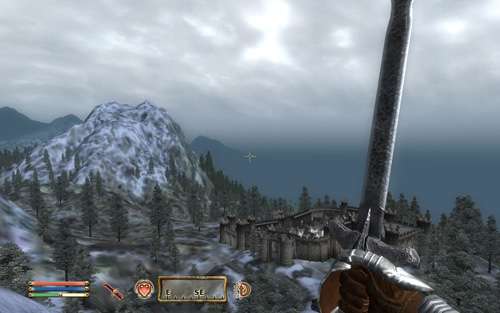
The main point of this post is to link to Christopher Livingston's highly entertaining travel-blogue which is based around creating a character and role playing him as an NPC in the world. The travel-blogue is called 'Living Oblivion' and he uses a bunch of mods to starts his character Nondrik in the port town of Anvil (somewhat reminiscent of Morrowind) and roleplaying as an NPC, Livingston refuses to run to destinations or to use the quick travel feature, resulting in what must be a very leisurely pace at times.

An extract from 'Day 19 & 20' of the Travel-blogue:

I’ll be honest — walking everywhere and never fast-traveling isn’t… easy. The click of my mouse could instantly transport me to any city in the game. Sprinting would decimate my lengthy travel time. There are long stretches, like today, where I’m not attacked, there are few ingredients to pick, and not much of anything interesting to look at, and I think, man, why the hell am I playing like this?


But at moments like this it somehow feels worth it. In other playings of this game I’ve spent days, weeks even, in Imperial City. I know it inside and out. I barely even look at the city, I just zip there, run to the merchants, unload my junk, and dematerialize to my next location. But playing as Nondrick has restored a good deal of majesty and mystery on Imperial City, and catching a glimpse of it through the trees, seeing it grow closer and larger each time, is a bit of a thrill.


Oh, also, for a little bit of contextualisation, Chris Livingston is the guy who wrote, posed and print-screened 'Concerned: The Half-Life and Death of Gordon Frohman' which is a must read for anyone interested in the Half-Life universe.

Also, just wanted to give a heads-up for a post I'm working on "What Videogames have can learn from Digital Musicians" which is hopefully going to explain how I went from a Digital Musics major to a videogame theoretician (if I can even really call myself that...). I've got some interesting ideas, so I hope people will come back for that next week. Until then!

Tuesday, 17 June 2008

A post for Xenia: Simulation and an apologetic explanation of Super Columbine Massacre RPG


This post is going to try and do a couple of things. Firstly, it’s a (very) short summary of the first half of Gonzalo Frasca’s essay “Simulation vs. Narrative”. Secondly, after explaining the ideas contained in Frasca’s paper, I hope to convince my good friend Xenia (the wife of one of my best friends, and a genuine friend of mine in her own right) that the videogame Super Columbine Massacre RPG is not the result of a sick and perverted mind, but instead a serious and thoughtful attempt to come to grips with the whole, messy, horrible situation. Thirdly, I’m going to try and apply a couple of Frasca’s ideas to the videogame Oblivion and suggest an explanation for why another of my good friends, Michael Abbot over at The Brainy Gamer, didn’t enjoy Oblivion as much as he should have (or maybe if I’m being more honest, could have. In the interest of Full Disclosure: I really like Oblivion in all it’s half-baked glory.)


Frasca opens his paper saying that “So far, the traditional –and most popular– research approach from both the industry and the academy has been to consider video games as extensions of drama and narrative.[1]” Frasca also states that:

Representation is such a powerful and ubiquitous form that it has become transparent to our civilization. …This is especially true with a particular form of structuring representation: narrative[2]


He argues that by its ubiquity it has become almost transparent to us and that we actually have a very hard time accepting “that there is an alternative to representation and narrative: simulation.[3]” Frasca provides some very excellent examples of where simulation is present outside of computation: in children’s play, when a toy plane becomes a plane (even a story is created about the plane, the game is still simulating a plane) as well as in Governmental legislation. But I’m getting ahead of myself. What exactly makes something a simulation? Frasca says that

to simulate is to model a (source) system through a different system which maintains to somebody some of the behaviors of the original system.[4]


Returning to our examples of a child at play – the toy plane is modelling the behaviour of a real plane – while it may not actually fly, when the child is whooshing it though the air, to him or her it may as well be. The ‘to somebody’ part of Frasca’s definition in this case is obviously the child – someone not engaged in the simulation (which incidentally may be running only in his or her head, but might also equally be shared by a playmate) the toy remains only that - a toy. To contrast this idea and demonstrate its difference from narrative – Frasca says that

A film about a plane landing is a narrative: an observer could interpret it in different ways (i.e. “it’s a normal landing” or “it’s an emergency landing”) but she cannot manipulate it and influence on how the plane will land since film sequences are fixed and unalterable. On the other hand, the flight simulator allows the player to perform actions that will modify the behavior of the system in a way that is similar to the behavior of the actual plane.[5]


The previous example of the government legislator is somewhat different again, and it shows that the notion of authorship of simulation is quite different to authorships of narrative. A government legislator when writing a new series of laws or by-laws is not explicitly authoring the story of the single working mother who may now be safe from exploitation by her boss as a result of the new law, and yet that story may indeed arise from it. Instead, the law maker is authoring rules as part of the society’s system and the stories (or narratives) that arise from the rules remain a largely unknown consequent.


To return to the point about the difficulty in acknowledging the difference of simulation from narrative, Frasca says that

To an external observer, the sequence of signs produced by both the film and the simulation could look exactly the same. This is what many supporters of the narrative paradigm fail to understand: their semiotic sequences might be identical, but simulation cannot be understood just through its output.[6]


That is, a flight simulator cannot be judged and evaluated as a simulation by simply watching it run – the experience of controlling the simulation is entirely different from the one of watching it – and this is an extremely important point as it has implications for videogame representations.


To turn my attention to the second point, many people when told of the existence of a Super Columbine Massacre RPG game are shocked, disgusted or even outraged, and I think largely because, as a society, we have little to no experience with having to deal with shocking images and situations unless it is presented as a narrative. The disconnect between a persons actions and a persons beliefs, cognitive dissonance even, is perhaps not possible outside of simulations like videogames. When reading a book about the holocaust, one does not feel complicit in the actions of the Nazi’s at Auschwitz, even when recounted in a novel from a personal perspective.


So let me ask you this: A person would be less likely to respond like the one mentioned above if it was instead a thoughtful, reasoned novel that attempted to examine and explain the tragedy of the columbine high school massacre, correct? Well, perhaps someone would, and that would be a valid reaction, potentially based in a general unease with trying to identify with the two killers – Eric and Dylan. But the objection would likely not be to the fact that there was a book about it, but rather the content of the book. So why then, does just the idea of a videogame about the events of Tuesday, April 20th 1999 provoke such consternation?


The answer is far from as simple as I am proposing, as numerous other legitimate, real factors come into play, however I am of the inclination that it is because many people do not have the requisite experience with simulation, and indeed with engaging seriously with simulational media, that is required to accept and understand the reasoning behind creating something like Super Columbine Massacre RPG. Frasca says that indeed ‘Video games imply an enormous paradigm shift for our culture because they represent the first complex simulational media for the masses’[7]. I guess what I would like every reader to understand is that, far from being designed for the glorification of the shooters themselves, the game is part of what can be described as the ‘the search for rationale’ in much the same way as any book or film about the subject, however instead of employing a narrative to make his point, the creator Danny Ledone decided to use a simulation – and that leaves people without the experience in disconnecting their actions in a simulation from their beliefs, quite understandably uneasy.


Sadly, I personally feel that, while an excellent effort and a great start, Super Columbine Massacre RPG does not succeed in its efforts but not through any fault of the medium. Without getting into an in depth critique of the game, it suffers from much of the same failings as many big budget videogames, such as Oblivion, which I have written about on the blog previously. Let me explain by saying that, if we take Frasca’s view, and that games are indeed simulations, then the vast majority of the source systems videogames are modelling (and I cannot stress this point enough) are narratives! Super Columbine Massacre RPG deploys Role Playing Game tropes and contentions but fails to escape the trap of trying to model a linear, progressive narrative story.


The Elder Scrolls IV: Oblivion is similarly an RPG and I believe falls into exactly the same trap. My good friend from the other side of the planet, Michael Abbott, failed to find Oblivion enjoyable for a number of reasons, among which the fact that he ‘just got bored’ and stopped enjoying the game. I propose that, similar to Super Columbine, Oblivion tried to render, intentionally or not, a narrative as their source simulation; however, I also believe that they had a conflicting desire to simulate a world (a distinctly non narrative thing)– a fact that is evident in much of the free-form structure of the game. If the developers of Oblivion had of concentrated on modelling a consistent world and, dare I suggest, left out entirely the narrative elements like the main storyline instead focussing on emergent possibilities – perhaps by finetuning the ‘Radiant AI’ system which gave each non-player character such things as motivations, desires and habits and then made them go about their business to satisfy these conditions – then I genuinely think the game would have been both extremely different and more attractive to some certain players. Now, I’m not 100% confident of this evaluation, but based on comments made by Michael and others, such as that ‘the NPC’s were very boring’ (a valid assessment – they were very generic) then perhaps by dropping the (I suggest crippling) overarching need to model a narrative, Oblivion would have been significantly better – there would still have been significant challenges to overcome to realise this ideal, but overall I think the point still stands.


In summing up, let me return, once again to Frasca who points to suggestions by proponents of Interactive Narrative that “Aristotelian closure” is the source of ‘the user’s pleasure’[8]. He says that ‘The biggest fallacy of “interactive narrative” is that it pretends to give freedom to the player while maintaining narrative coherence’[9]. Frasca says that instead

the gratification for [participants in simulation] is not the one of the professional actor but rather the one of the child who plays make-believe. The child is constantly adapting fantasy to different changes, without the grown-ups obsession with closure.[10]


As an interesting comparison, think of the difference between something like Hamlet and your typical game of Theatresports – the former is a narrative, and any attempts to incorporate interactivity would probably compromise its narrative coherence, whereas the latter, if constrained by a script, loses all of the charm and attractiveness derived from its spontaneity. The difference between simulation and narrative is a wide and often mis-understood (even at times mischaracterised) chasm, but one which remains largely uncharted. Let’s start today – I’m game, are you?



[1] Frasca, ‘Simulation vs. Narrative: Introduction to Ludology’ in Mark J.P. Wolf and Bernard Perron, Eds., The Video Game Theory Reader, p.221, also available as a PDF at: http://www.ludology.org/articles/VGT_final.pdf

[2] Ibid., p.222-223

[3] Ibid., p.223

[4] Ibid.

[5] Ibid., p.224

[6] Ibid.

[7] Ibid.

[8] Ibid., p.229

[9] Ibid.

[10] Ibid.

Monday, 19 May 2008

Becoming Gamer; or "My last ever log out."

I hearthed to Shattrath, at the request of a very good friend of mine. She had something to show me, she said, and I had a good idea of what exactly that was. I had, after all, 'twinked' her with 1,000 gold a few weeks prior and, as it turned out, it was her snowy gryphon mount that she had purchased with my parting gift, that she wanted to share with me. I felt like a big brother to a little sister - I had never met her in the 'real 'world. She hugged me, made a *sniff emote and said with lots of exclamation marks that she'd miss me. I was going to miss her too.

Recently, after a particularly bad experience with an overly controlling and somewhat arrogant guild leader, I was left without a World of Warcraft guild that I called home. I wanted to 'progress' and to see (and beat) new content but finding a new raiding guild to start building relationships within was just not something I was prepared to do again. University was also starting to heat up, with an increasing amount of work having to go into assessment tasks and my major thesis, when my job, which that suited me and my study timetable perfectly, sadly dried up. Without a steady income, and having to still pay the bills (not many, but a few) I decided that, well, after a good run of a year and 6 months with the World of Warcaft, maybe it had become time to hang up the gauntlets and retire gracefully.

So I did. And it's probably one of the best things I could have done. Now, I'm not saying that wow is the devil or anything knee-jerkingly reactionist like that (although I *do* have some serious issues with some elements of it: the grind, only having one somewhat flawed model of guild leadership, etc, etc). But instead, much like Mr Brainy Gamer himself, Michael Abbott, said - it means that I can play other games again. I mean, in all honesty, how many people who play wow seriously do you think also play other games seriously and critically on a regular basis? I'd wager not many.

I make no secret of the fact that I want to work in the games industry. I am working towards that with my degree and with my thesis, and also, now, so with this. I can't just play WoW all the time and call myself a gamer. I honestly have no desire to work in any other field. I recognise that I probably will, but I hope that eventually I will be able to work for a living on what I am so most passionate about. My passion is for gaming, and that's really what this experience has been all about. I've left WoW and all of the amazing wonderful (and some horrible) people that I met on the Alliance side of the Dath'Remmar Oceanic Realm, and yeah, I'll miss them too. But I'm not a really a WoW-er. Not anymore. I'm a GAME-er.