Showing posts with label virtual worlds. Show all posts

Tuesday, 21 April 2009

World of Warcraft is The Loneliest Road

For all that it is called a massively multiplayer online game, World of Warcraft is a surprisingly solitary experience. Obviously there are thousands of other people in your world with you, but to play WoW – to enjoy WoW – is to become absorbed in your avatar. You can’t touch, bump into, or otherwise interact with other players without the aid of a spell or weapon. Even public chat via the “say” command, which displays as a speech bubble from your character, leaves no lasting trace of its existence. The spoken word is as ephemeral as the players themselves, and they avoid walking through each other, spread out in group raid photos, to avoid breaking the illusion that they are actually in the world with other players.

WoW remains the most embodied and immuring game I have ever played. Every action and interaction is mediated through your avatar. The story of WoW is your story and it is reflected in every quest text and every suggested goal. You see the world through the prism of your character and while the viewpoint of above and behind gives the illusion of an objective view of Azeroth, you cannot escape the invisible ties that bind you to your character.

You also can’t make other people play better, level up quicker, or keep pace along side you. Anyone who has played for longer than a few minutes knows that all it takes is a little bit of extra time spent questing or grinding to find that your friend who was once the same level as you is now far below (or beyond) your abilities, becoming another cloud of dust on the horizon, another runner in front or behind you on the road. Any attempts to “slow down” the inexorable pull towards the level cap (and beyond, with item acquisition and stat improvement), that elusive goal of perfection and ultimate attainment, are irresistible short of outright rejection. Waiting around for someone else feels like 'wasted time' in the WoW paradigm, and so you’re back to square one. Back to a single player game and grinding alone on trolls in Stranglethorn Vale in the hope of one day reaching the peak at level 60, 70, 80.

Dominic and I tried it a couple of times, first on our original toons (both were Warlocks; I was Daverick, he was Marcos) and then later with our alternatives. By then I was onto Davethree (literally named as such) and he was a Warrior. Dominic was a Paladin. We spent a fantastic afternoon one day in the twilight days of ’07 working together on quests as per the instructions in the popular Jame’s Leveling Guide. He enjoyed collecting a number of enemies on himself while I swung a selection of large swords at them.


That afternoon we fought trolls, goblins, tigers, panthers, crocodiles and other players and enjoyed the simple pleasure of having each other’s company. We were glad not to have to travel that section of the loneliest road alone. Inevitably though, school and other commitments made him log off for a while and an abundance of time left me to plod along by myself. I rapidly out-leveled him.

We met up again, months down the track. By then I was 70, and he was still 68. Getting keyed and geared for Karazhan was my goal while he was still grinding mobs in Blade’s Edge, focusing on the inexorable accumulation of experience points. The loneliest road took us to 70 separately and resisted our best efforts and resolutions to “stick together”.

Tolkien placed these words into the mouth of Bilbo Baggins;

"It's a dangerous business, Frodo, going out of your door," he used to say. "You step into the Road, and if you don't keep your feet, there is no knowing where you might be swept off to."

World of Warcraft will do more than sweep you away. Like an overflowing river that has burst its banks, it stands ready to break apart the group of unwary travellers that attempt to cross it. The current will carry them downstream for miles one by one - how far it carries them wil be governed by how well they can swim. I was a WoW player and I was carried off by myself for 18 months. How about you?

---

This post was inspired by the recent discussion of World of Warcraft and the addicting nature of some videogames on the Idle Thumbs podcast – episode 25 ‘pause theme from battletoads’.

Monday, 10 November 2008

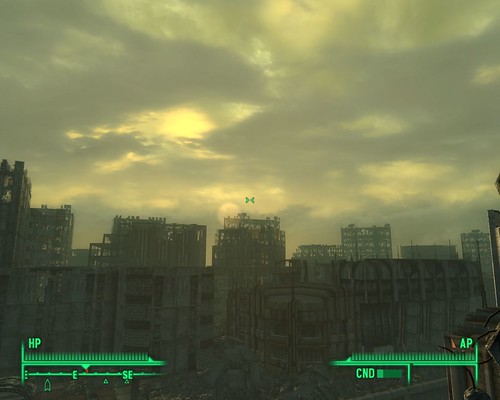
Embodiment and Immersion: Fallout & Far Cry, FIGHT!


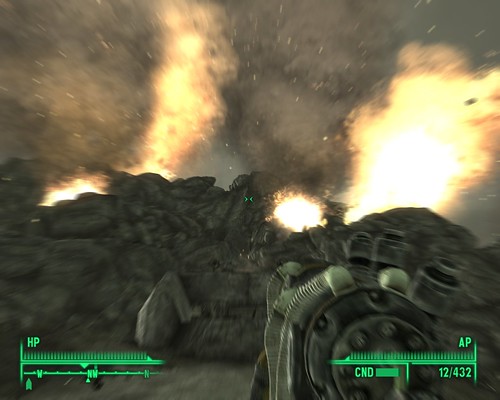
Not to harp on about a single topic or anything, but I’ve been pondering why I’ve felt so disappointed by Fallout 3. Yep, you read it right – I don’t entirely feel like the review scores it got were wholly deserved. I think I’m doubly stung because, in confluence with the hype train, they influenced my decision to go out and spend my hard earned dollars on the game. Okay, so I’m complicit in the last point for being a sucker for hype and the former can easily be countered by the suggestion that the review process is entirely subjective, which I tend to agree with, so lets skip past finger-pointing and try and identify why.


I’m a bit of a one trick pony at the moment, because I think it largely comes down to the sense of embodiment that the game offers, and certain things which only break my sense of immersion. For starters, when compared to Far Cry 2, my character in Fallout 3 feels like a lifeless sack of potatoes, and as Michael Abbott has recently noted, so do the other inhabitants. Why would I want to play a game in which I have to plod around everywhere like some machine reminiscent of Marvin the Paranoid Android when, with the swap of a disk and a click of a different icon on my desktop, I can effing sprint-slide into cover in Far Cry 2, and rip pieces of shrapnel from my body with a pair of pliers.


Secondly, and perhaps more importantly, as Kieron Gillen noted somewhere that I can’t seem to recall, in Fallout 3 you can do outrageous things like jump up on a table in the middle of a bar, and no-one cares. It would be fine, actually amazing, if there were responses for these out there actions but as it stands, nary a soul has one whit of a comment for many of the crazy things you can do in that game. And so as a player I find myself having to think up some (usually extremely tenuous) excuses for why other characters are downright uncaring about my kleptomania and other inexplicable behaviour, in order to maintain narrative coherence.


Take for example, any number of houses in Fallout: in a great many you will find a number of items that will fail to be marked as ‘owned’ by another character (shown by red text in game) which when picked up by the player results in thievery. Obviously, the majority of these are accidents, but as a result of this accidental design I find my sense of immersion broken by having to do a kind of “meta” thinking and decide whether or not I would (in character) take these items. More often than not I find myself reacting purely out of function and take the items anyway (sometimes I don’t) and take advantage of the exploit, but the fact is that every time I do it is immersion breaking. In a similar vein, by allowing me to jump on a table before beginning a conversation with an NPC, Bethesda has allowed for the occurrence of a situation in which the logical response of an NPC (which could be anything from “What do you think you are doing?” to “Get off mah dinner table, whippersnapper!”) is not present within the game. I find this extremely irritating.


The obvious counter argument is that “well you should be role playing, and if your character wouldn’t stand on a table then neither should you” and I suppose that is a valid argument. However it is most definitely NOT how I want to play a videogame – for me it’s all or nothing. If you can do something in a game, then there should be an appropriate response for it. Why even bother to let me jump on tables? What purpose does it actually serve? It’s not even as if it would be impossible to implement a system to prevent the majority of these oddities. Far Cry 2 contrives to make 100% certain that, when in a context for which a certain kind of action makes no sense (read: certain indoor areas), then you are stripped of the mere possibility of performing an incongruous action. Most notably, when you meet with certain mission-critical people indoors, you can no longer run, jump or fire your weapon – often having had your weapons taken off you before entry. This makes perfect sense, so I am only too happy to oblige!


I believe some of the reason for my difficulty in accepting the incongruity of an NPC ignoring my strange behaviour comes from not possessing a strong skill at, or even inclination towards Role Playing. And yet, even Role Players I know have commended the vintage game, Deus Ex for some of the small details that work to build a consistent and convincing world, specifically the noting of your characters entry into the womens’ bathroom. It seems to me that, while it is undoubtedly possible to force ones self into a way of playing that “only makes sense” in the game world, it makes even more sense to me to enforce certain behaviors unless they serve a purpose. In an interview I conducted with Marty O’Donnell, the audio director for Bungie studios’ and responsible for the sound and music of the Halo series, for my recently completed thesis we got onto the topic of giving the player control over “every aspect of the game”. O’Donnell said to me,

…game players have gotten into a habit [of thinking] that they should have control over all these things and basically I’m saying, you know what, no – you shouldn’t.


So, Bethesda, if you’re listening; in the future, either put in things to make sense of all my possible actions or please, please limit them to just sensible ones.


Thursday, 6 November 2008

A Spoiled Gamer, Am I.

I am a spoiled gamer. For the past few weeks I have done little but play videogames and write about them; in between deciding that I don’t want to pursue a PhD and career as a life-long student, of course. However, that is not exactly what has spoiled me.

I’ve been playing Fallout 3 for the past two days (pretty much to the exclusion of all else) and while it’s certainly a lot of fun, by my reckoning it seems weirdly perverse to award the game a 10 out of 10 score, as a number of outlets have[1]. I can’t help but wonder if these reviewers were even playing the same version of the game as me. A 10/10 game you expect to be polished to perfection and bug free. Fallout 3 is not. A 10/10 game you expect to push gaming conventions forward in new and unexplored directions. Fallout 3 largely does not. Finally, a 10/10 game you expect to be as good or better in every respect to other, lesser scored games of a similar vintage and again, I cannot help resist making certain comparisons that say Fallout 3 is not.


The main thing that I find particularly hard to swallow, amplified a hundred fold by the fact that the last game I played was Far Cry 2, is the sense of embodiment in the world. Far Cry, in this respect, is the more truly Next-Gen game in my opinion, and I discussed how a sense of embodiment is one of its greatest achievements in a previous post. While there are obviously other areas of the game that are less inspired, the importance of what Hocking and his team have achieved in giving you a sense of body, I believe, cannot be over emphasized.


So comparatively Fallout from the moment you begin feels different. Ignoring the fact that I had an audio bug during the intro video which obscured the voice-over behind some static noise (10/10? Really?), your character’s movements in Fallout seem like a direct rip from Oblivion. While Far Cry 2 goes to extraordinary effort to animate and portray you as a character to the best of current technical limitations, Fallout 3 reflects a character design aesthetic stuck in yester-year that doesn’t seem to mind stilted and jerky animations. It was fine in 2006 that your character slid around the world on somewhat greasy shoes, but in 2008 (nearly 2009 now!) haven’t we come a bit further? I’m by no means the only person to pick up on this aspect of the game, notably Alec Meer in his (in my mind much more clear-headed review of Fallout[2]) noted some very real issues with the game and scored it much more appropriately, giving it an 8.8. Additionally, I was linked to a piece on Boing Boing Gadgets by friend of SLRC, Aandnota, that described an encounter with a prostitute, saying:

The prostitute NPC mutely follows you up to your room and lies down on the bed beside you like a fetal lump. You then get to sleep on the bed beside her. And that's it. The next morning, you wake up, and she patrol-puppets out without a word.[3]


After experiencing Far Cry 2 in all its whacky, embodied insanity I am now spoiled for a sense of physical connection to my character. If Kieron Gillen is right, and Far Cry 2 follows a similar trajectory of influence to the original Half-Life, it will probably be two to three years before we see games directly ripping-off its focus on a sense of body. Which somewhat saddens me because I think a Bethesda-style RPG with Far Cry’s animation and determination to be grounded in the world would be an absolutely KILLER combo. I hear all the time people saying that they just wanted a tiny bit less of being always on the run in Far Cry and maybe a little bit more of some RPG elements, like a heightened sense of factions. Traditionally, these things could be sorted by fan made modifications, however it’s been stated that there will be no modding tools for Far Cry 2. What I wouldn’t give to see that change.


Ah well, a guy can dream, right?


[1] See, http://www.metacritic.com/games/platforms/pc/fallout3 - The list includes 1up.com, Eurogamer, Gamespy, GameRevolution, G4TV, Thunderbolt, and LEVEL.

[2] See http://www.rockpapershotgun.com/2008/10/28/attack-of-the-fallout-3-reviews/ for a quick summary and a link to the full text.

[3] John Brownlee, “Fallout 3, or "Why can't Bethesda make fucking post-apocalyptic hookers fun?", http://gadgets.boingboing.net/2008/11/05/fallout-3-or-why-can.html

Friday, 24 October 2008

Far Cry 2: Wrongs and Rights

**SPOILER ALERT: These are mostly gameplay-related spoilers, but if you are trying to steer clear of anything and everything to do with the game before it comes out then perhaps you should stop reading now.**


Like just about every videogame in history, Far Cry 2 does some things well, and some things not so well. Lets get the wrong things out of the way first.


Okay, so FC2 has some of the same ‘open world’ problems shared by GTA, Oblivion and STALKER. While browsing an internet forum, I encountered a great and humorous way to sum it up (colourful language warning!). User ‘cpd’ said:

think gta but apartheid africa. plus fucking malaria FUCK OFF FUCKING PILLS

oh and the fact that EVERY c*** wants to shoot you. EVERY SINGLE JEEP will immediately swerve into your path to shoot the living fuck out of you. get out, kill them, repair jeep, drive 100m up the road, repeat.

So it can be kind of repetitive, and frustratingly so – but I’m kind of okay with some of that. I recognize a lot of people probably won’t be, but it kind of ties into the sense of space and physicality that I'll mention later on. I am, however, a guy who has played and nearly completed Oblivion with mods to disable fast-traveling (i.e. played the whole game on horse or foot), so maybe that rules me out. FC2 is at least as large as Oblivion, so getting around can at points become a large part of the game. While there are plenty of cars and utes lying around, the problem comes with transitions to fighting – you either have to get out of your car which takes precious time, or swap to a turret if you vehicle has one leaving you stationary and exposed. Perhaps this issue will be solved later on with the addition of someone riding shotgun, I will admit to only being about 8% of the way through (after nearly 6 hours I might add).


And the good!


The ‘buddy system’ is awesome. Specifically, the fact that if you die and you have a live buddy rested and waiting, they will immediately rush to your side, in a bid to save your life. They’ll pick you up, shoot most of the nearby enemies for you, and give you some breathing room to patch yourself up. It really does solve one of the biggest and most fundamental problems with player death – lets face it, reloading from a save game isn’t exactly all that fun. So it makes sense to do away with it if you can. John Walker from Rock, Paper, Shotgun (who I quoted in my last blog post) wrote back in September about the issue. He said,


I want a high profile, big budget, mainstream action game in which the player character is invincible. I believe that the next truly great game will be the one that does this.[1]


Far Cry 2 doesn’t make you invincible, but the number of times I have accidentally ‘died’ and have just begun to reach for the quick-load button only to fall into the arms or my buddy’s saving embrace, are many.


The other thing that Far Cry 2 does extremely well (and this is the one that I think everyone will or should be talking about soon) is give you a sense of embodiment within the world. As Steven Gaynor (Fullbright) pointed out over Twitter, ‘An FPS that visualizes your hand turning doorknobs? I think I'm in love.’[2] The comparison I couldn’t help but keep making was to Bioshock which often took control of the player and their hands to perform actions, usually in its on-the-rails cutscenes. In Far Cry 2, your hands are always doing this something and they really feel (to me at least) like they are my hands. Add to this the fact that when you need to you can see your body and legs (mostly in other on-rails sections) and you can start to see the building blocks of a really interesting system for representing the player in a virtual world.


In Far Cry 2 you never change to third person, ever – and this is a really good thing! Unfold your map and you will hold in your hands a map of the African country you're stranded in, represented as just another thing in your hands. Like a gun, but for information and orientation. When driving you can open up the map and hold it in one hand, and the net effect is similar to what you would do if performing a similar action in the real world. Your eyes flit back and forth between map and windscreen, balancing path finding with map-reading. No game has ever done that to me before. Also, getting in and out of a vehicle takes time, and while I decried it earlier as being frustrating in combat, it actually further adds to a sense of embodiment. It feels like I am a real human being with a body that takes a real amount of time to move, not some super ninja that flits around at the slightest twitch of a mouse.


In conclusion, it's too early to tell if Far Cry 2 is the ‘game changer’ that I hoped it would be in my previous post. However, even if it's not, it’s certainly another great step in the right direction, in this author’s humble opinion.


Post Script: Jim Rossignol, lover of all games open and exploratory, has posted his own initial thoughts on the game on Rock, Paper, Shotgun. He's pretty much spot on with everything except the Alt+Tab thing - mine works fine.


[1] http://www.rockpapershotgun.com/2008/09/18/rps-demands-i-want-to-live-forever/

[2] http://twitter.com/fullbright/status/971289072

Wednesday, 22 October 2008

Why I'm so fracking excited about Far Cry 2


“I think Far Cry 2 is going to be amazing…” John Walker, RPS Wireless Show, Ep.2

I also think Far Cry 2 is going to be amazing, and it’s partly because of what the guys at RPS have said about it, and partly because of what the Creative Director, Clint Hocking has said. In an interview for Edge Magazine, he used a literary comparison to explain its difference from the original Far Cry.


The original Far Cry is The Island Of Dr Moreau, a story of a mad scientist that has unlocked the inner savagery in man and created literal monsters,” says Far Cry 2’s creative director Clint Hocking. “But at the same time HG Wells was writing Moreau, Joseph Conrad was writing Heart Of Darkness, which actually has very similar themes. It’s about someone in the jungle that has discovered and is leveraging man’s inner madness, and become a metaphorical rather than literal monster. This is Far Cry 2.


The focus on the “inner madness” is an area that I am only too happy to explore. Could Far Cry 2 become the Apocalypse Now of our gaming generation? Kieron Gillen, in the same RPS Podcast as the earlier quote from Walker, explained why he thought that it was going to be a “game changer” of a game. In terms of the open world nature of the game and how the story is told, Gillen said


…the sort of narrative structure is basically you choose who you want to be from a list…and then all the other characters become NPC’s in the story…the structure generates via programming…and that’s really clever. That absolutely how we should be trying to do narratives in games instead of just the ridiculous cut-scene approach…of… your metal gear solid 4 approach, which is ludicrous. That this is absolutely embracing the form and wouldn’t be possible in any other form, [is] really interesting and novel.


If there’s one phrase that can get me instantly interested in a topic about videogames it’s “embracing the form”. To any developer who is interested in creating a game that wouldn’t be possible in any other medium, I instantly say “Yes! Lets!” and want to give them all my money. Gillen seemed to think that Far Cry 2 had the potential to change the way we perceive games, even what games are possible of, saying


Far Cry…kinda sounds like… well you can’t really go back after this. …The idea that suddenly an entire generation of gamers will be injected with something which changes how they think a shooter could work is exciting, cause that hasn’t happened since Half-Life. …Wouldn’t it be amazing if, this Christmas everything changed? The idea that the sort of things people expect form the genre changed? It hasn’t changed since 1998.


I also find that notion to be terribly exciting. However, there is always the potential that it will be ignored, missed by the game developing community at large, and generally passed over. John Walker questioned Gillen’s belief, saying


I’d love to think that were true, but unfortunately, that when PoP came out I said ‘Oh my goodness, no platform game can ever be the same again because of this game’ and yet not one single platform game has done it right at all – I mean, Braid? …Tomb Raider games…still don’t have rewinding time in them and there’s no reason not to. I mean, there’s enough mysticism and magic going on. ‘Oh yeah, but they’d be stealing that idea directly from Prince of Persia’ well what was PoP? *laughs* A direct steal from Tomb Raider. Loads of these brilliant redefining games just seem to get ignored for years, which is really frustrating.


Gillen, in response, suggests that, perhaps in this case, Prince of Persia was largely passed over because it “wasn’t the number 1 game in the industry. Whereas Half-Life was.” He says,


I think Far Cry 2 is going to be huge. If it’s huge, people rip it off more. Especially if it’s in a genre which is popular, which a shooter is.”


Early reviews are in. The verdict, so far, is quite good. Tom Chick:


The objective of Far Cry 2 as a game is to get out of the way and let you experience the game world. And there is no other game world quite like this one: haunting, spectacular, meditative, explosive, violent, and serene, all at once, and all in a mere shooter.

I for one, can’t wait to get my hands on it.

Wednesday, 10 September 2008

The peaks and perils of First Person Camera


Corvus Elrod and I have been going back and forth over twitter this week about camera's and camera choice in games, and he's written up a series of posts about 3rd person camera (yesterday) as well as 1st person view. And its gotten me thinking about first person perspective games a lot (mostly because they are the kind of game I tend to gravitate towards) and in particular why I think Assassins Creed was actually better for being rendered in third person and conversely why I think Mirrors Edge, while commendable for trying a whole slew of new ideas and daring to be different just generally, is possibly doomed to have some serious problems.

The essential point is the difference in camera angle - where Assassins Creed generally uses a 3rd person over the head view to depict Altair scrambling up the side of buildings, Mirrors Edge uses First Person perspective. So what's great about the first person perspective? Primarily, with a First Person Perspective you get a strong and direct connection with 'you' as the player inside the game. You're are looking out your own characters eyes, after all, and in my opinion this view (with certain caveats) seems natural and instantly relatable; it's closer to the 'normal' way that we view the world from our bodies. Additionally, it allows for very precise actions, most commonly used for aiming weapons such as guns, bows and other projectiles.

Unfortunately there are equally a number of negative aspects with the first person perspective game and which for the sake of brevity I will not attempt to list. However, one aspect I want to foreground in this discussion is highlighted once we start aiming for rather more complex control relationships with our player avatar and ourselves.

Basically I see the issue as one of embodiment in the game-space. As I hinted at in Corvus' original post I don't think that anyone has yet made a first person perspective game where the 'camera' - your embodied view of the world - is anywhere near as flexible as our real world bodily configuration.

We have a pair of eyes that move independently of our heads, and on top of that our heads can also move independently of our torso. The whole history to date of the First Person Perspective game (to the best of my knowledge) has been limited to an avatar that moves his or her eyes, head and torso as one. And this is actually fine... for certain things. It's fine particularly for (surprise, surprise) shooting games as when you aim down the sights of a real-world weapon, you don't move your head or even your eyes far from the target.

Additionally the first person perspective can only give the player so much information about their surroundings. For starters, our display screens for videogames are woefully too small to represent the whole field of vision of the average person, and as such, first person representations of games are going to lose information that the player would have in an identical real-world situation.

Take for example, your feet. Do you have to look down at your feet to know where they are? Of course not. So when Halo makes the player aim down at their feet we just know that some information about the environment is being lost. And you know, this is also fine. As Corvus says, many videogame protagonists are supposedly wearing bulky, vision impairing helmets after all. Except that when playing a game we also lose two (well three if you count taste) other senses that could be delivering information as well! We don't get to feel the world - the cool brush of a breeze on our skin or the crunch of gravel under our feet - or smell the scents in a space. So all this information which we would in reality be receiving about our surroundings, whether consciously or not, is further lost.

I was reading recently the Game Set Watch Column 'Diamond in the Rough - A body in the dark' about the healing system in the most recent Alone in the Dark. The article rightly discusses some of the innovative features of the game and how it encourages embodiment in the game-space, however when I came to this passage I had to stop, suppressing the urge to guffaw.
The effect of all of this is to ground you in the body of your protagonist. You must constantly check yourself for new cuts or bruises, sometimes eliciting a tired shrug from Edward when a visual check reveals no new blemishes.


Okay, am I the only person to think that having to visually check your body for cuts and bruises is actually dis-engaging you from your body? Since when have you ever had to stop and look yourself over only to realise that actually "Oh, I'm bleeding from the stomach".

Yes, granted there have been some times when I have experienced an adrenaline rush that has suppressed the pain of small injuries, and I have heard of people 'shrugging off' larger injuries as well, but if you've got the time to 'look yourself over' you've got the time to take a breather and start feeling the pain!

So, all this gets me to the point of saying, for all the benefits the FPS brings with it's embodied perspective, it comes with a bunch of detractors. And that's why I think Assassins Creed went the right way with 3rd person parkour action. I believe that the use of the third person perspective can partially make up for what we lose in the form of experienced, embodied information about the world.

Just one last quick quote - this time from Clint Hocking of Far Cry 2 talking about their own implementation of specific areas and even types of injury, Hocking responded saying

...a contextual animation [plays] based on the type of injury you received and the location of the injury. If you fell from a cliff, you might have a dislocated ankle that needs to be relocated. If you were shot in the leg, you might need to prise the bullet out with a knife, if you were hit by a grenade blast you might need to pull shrapnel our of your elbow… the idea is to hit the player with a visceral ‘punch’ right at the moment that the intensity is highest and his adrenalin is pumping. The combined effect is to create powerful psychosomatic bonds between the player, the avatar and consequently the world itself.


I think Hocking's got the right idea - whether it's first, third or some odd combination of the two (think Oblivion style interchanging) the aim has to be to convey enough information to the player and about the player so as to aid a sense of embodiment, which only aids in the never-ending quest for 'immersion'. If that's the goal (and the actually result) then I don't really mind which one they choose. Maybe I could even learn to love Mirrors Edge (God knows I really want to!).

Wednesday, 3 September 2008

What speaks to me the most


In Mitch Krpata's Taxonomy of Gamers I'm dead-set a Tourist. Indeed before Mr. Krpata's series there was Richard A. Bartles 'HEARTS, CLUBS, DIAMONDS, SPADES: PLAYERS WHO SUIT MUDS' which I think extends to offline games remarkably well also,and in which I am similarly an 'Explorer' type player. The point that I want to make is that when I'm being a tourist, I prefer to do so from a First Person Perspective.

Corvus Elrod posted a few weeks back a small, almost throw-away, theory that personality type might have an influence on what perspective videogame players prefer to play in, whether First or Third. He asked for a quick poll in the comments and it seemed to me to be a little bit inconclusive, but I think that he's probably actually onto something.

The issue seems to me to be 'what flavour do you like your story'? All story driven videogames in recent memory that have captivated me have (primarily) told the meat of their story through story and plot that I experience in the game from the first person perspective. I'm experiencing it as the character. Now, I don't want to pretend that this could become some kind of hard and fast rule - after all I have also previously passionately enjoyed third person games like The Baldur's Gate series, and even many FPS games like Halo use 3rd person cut-scenes for certain sections of exposition.

Still, if you know me and have been paying attention to my thesis updates, etc, you'll know my shtick is all about what things are unique about videogames, and that we should be trying our best to capitalise on them. It's just what gets me excited about the medium - the idea of the new and things that have genuinely not been tried.

So I'm now wondering why more games haven't gone the route of the Half-Life's and the Call of Duty's. Both games tell their story exclusively (with very few exceptions) through first person experiences. Obviously I don't want to advocate that all videogames should ever do is tell a story in First Person Perspective, but it does seem like the industry hasn't really pushed the envelope very far past the previously mentioned examples. When can I expect the FPS equivalent of, Apocalypse Now (I'm talking about in terms of mood, atmosphere and focus on the psychological experience rather than the setting - Vietnam has been almost been done to death as much as WWII)? Casablanca? Doctor Zhivago?

The obvious point is that FPS games like those great films would be impossible, granted. After all, there's really very little shooting in them - but that's actually OK with me. I'm a tourist after all - I've climbed the highest peaks in Oblivion before just to see it, not because it had any intrinsic reward. I don't think I'm alone in this, there is definitely space in the videogame market for more tourist appealing games.

So, on that note, I've been talking to Corvus about the issue of perspective and personality type and he's suggested we set up a more comprehensive poll and aim for a bigger survey of people - if anything comes of it, I'll let you know.

Monday, 19 May 2008

Becoming Gamer; or "My last ever log out."

I hearthed to Shattrath, at the request of a very good friend of mine. She had something to show me, she said, and I had a good idea of what exactly that was. I had, after all, 'twinked' her with 1,000 gold a few weeks prior and, as it turned out, it was her snowy gryphon mount that she had purchased with my parting gift, that she wanted to share with me. I felt like a big brother to a little sister - I had never met her in the 'real 'world. She hugged me, made a *sniff emote and said with lots of exclamation marks that she'd miss me. I was going to miss her too.

Recently, after a particularly bad experience with an overly controlling and somewhat arrogant guild leader, I was left without a World of Warcraft guild that I called home. I wanted to 'progress' and to see (and beat) new content but finding a new raiding guild to start building relationships within was just not something I was prepared to do again. University was also starting to heat up, with an increasing amount of work having to go into assessment tasks and my major thesis, when my job, which that suited me and my study timetable perfectly, sadly dried up. Without a steady income, and having to still pay the bills (not many, but a few) I decided that, well, after a good run of a year and 6 months with the World of Warcaft, maybe it had become time to hang up the gauntlets and retire gracefully.

So I did. And it's probably one of the best things I could have done. Now, I'm not saying that wow is the devil or anything knee-jerkingly reactionist like that (although I *do* have some serious issues with some elements of it: the grind, only having one somewhat flawed model of guild leadership, etc, etc). But instead, much like Mr Brainy Gamer himself, Michael Abbott, said - it means that I can play other games again. I mean, in all honesty, how many people who play wow seriously do you think also play other games seriously and critically on a regular basis? I'd wager not many.

I make no secret of the fact that I want to work in the games industry. I am working towards that with my degree and with my thesis, and also, now, so with this. I can't just play WoW all the time and call myself a gamer. I honestly have no desire to work in any other field. I recognise that I probably will, but I hope that eventually I will be able to work for a living on what I am so most passionate about. My passion is for gaming, and that's really what this experience has been all about. I've left WoW and all of the amazing wonderful (and some horrible) people that I met on the Alliance side of the Dath'Remmar Oceanic Realm, and yeah, I'll miss them too. But I'm not a really a WoW-er. Not anymore. I'm a GAME-er.