Showing posts with label Oblivion. Show all posts

Thursday, 12 March 2009

Getting My Immersion Fix


There is a certain type of game that I gravitate towards and that always seems to end up being the ones I keep coming back to, spending far and away the most time with. These games delight me with tiny pockets of ‘emergent narrative’ – parts of the game that for whatever reason ‘just happen’ as a result of the fact that the world around me is alive with people and things. The stories that most stand out in my memory are the ones that pop up without explicit authorial intent, the ones that just happen to coalesce into some strange and surprising mini story.

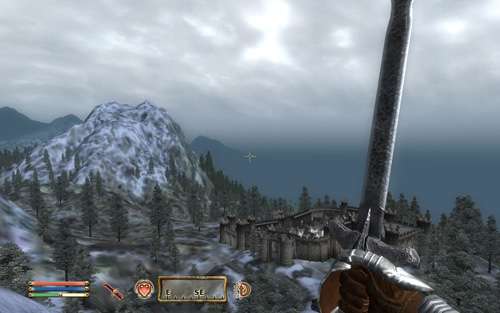
When I play The Elder Scrolls IV: Oblivion my regular habit is to walk everywhere to get around. I like to avoid the use of ‘quick travel’ because it doesn’t make logical sense to me that I should be able to instantly teleport around the world. The ‘quick travel’ method that is present in both Oblivion and Fallout 3 pulls me out of the game because literally nothing happens to the player while travelling. I want things to happen to me; after all, it’s why I’m playing a game.

So I use foot power like the lowly commoner I am and install a mod that introduces ‘stage coaches’ that fits with the fiction of the game as well as providing an alternative method of quick travelling between major cities. When I walk, I actually quite enjoy the experience because I find the countryside calming, idyllic – enjoyable for its own sake. Interestingly, the games I’ve most recently spent the most time with all involve traversing the world – I mentioned on the special holiday edition of the Brainy Gamer podcast last year that a lot of the joy I get from playing Far Cry 2 is in learning to skilfully snake my way through a hostile environment. Similarly, the way I like to play Oblivion is just as grounded in inhabiting the world.

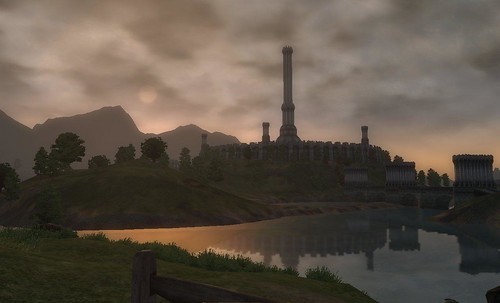
This week I was playing Oblivion, and as I walked my Orc north and then west from the Imperial City sewer exit all the way to Chorrol (practically via Bruma) I was quite deliberately taking the scenic route. The direct route would have cut the trip time in half, but I especially like the view from the Orange Road, you get some beautiful views of the Imperial Spire through gaps in the trees and much of the forest is made up of what looks like Silver Birch trees, my favourite (an aside: We had a beautiful silver birch outside our front door but it sadly died from a fungus a year or two ago and blew down in the wind. It was one of my favourite trees.)

On this occasion, I got about half way and spied an imp that looked like good target practice for my marksman skill. I started stalking him, readying my bow and arrow. Unaware of my presence, my first attack gained the benefit of extra damage. Success, a hit! But he is not going to be defeated by a single arrow as I’m still a lowly level 1 Orc, and so the creature flees. This happens because I have a mod installed that makes all sorts of back-end faction changes and the end result is that this Imp now behaves somewhat like a normal wounded animal. I finish him off and continue my journey west and shortly come across an intriguing scene. The bodies of multiple bandits are strewn across the road and the survivors of a pack of wolves haunt the road ahead. They were clearly weakened from their fight with the bandits with one of their number already dead, so I had no trouble finishing them off from a distance. But I was so shocked when I came across such a strange scene that for a moment I almost forgot I was playing a game.

I realised quickly that I was more surprised by the fact that this interaction was entirely natural and actually made complete sense. I could tell at a glance that the bandits, who had been hiding off to the side of the road waiting to pick off unwary travellers, had fallen prey themselves to a pack of hungry wolves. I didn’t see it happen, but the knowledge that this was off happening somewhere else in the world as I wandered around was thrilling. After all, why should my player character be the center of attention in the world? My character is just a nobody at this point, so why should everything in the game be planned and scripted in advance just for me? The real world doesn’t work in that way, so why should a videogame?

I guess this is the difference between games as entertainment – the highly scripted Hollywood film approach to games – and games as experiences. The difference has been described by many, but perhaps most effectively by Steve Gaynor in his post ‘Being There’. The games I love are not the ones that try to usher me along and give me a tightly controlled narrative experience, even though I still enjoy those occasionally. Instead, the games I love are about ‘Being There’.

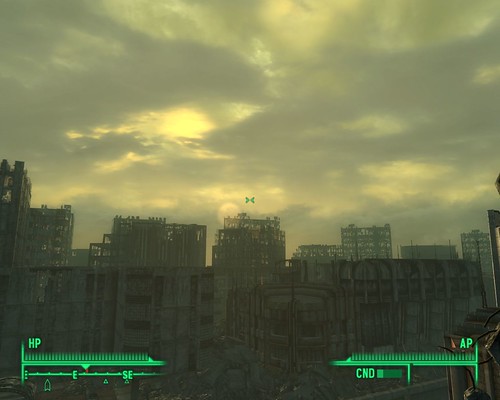
But what makes one game better at ‘being there’ than another? And for that matter, what makes the ‘Being There’ itself enjoyable? For Oblivion I find that it’s the little details that build the world and make me love the game – stumbling upon unscripted events that could easily be happening without your presence tickle all the right places for me. Conversely I think a large part of why I struggled to engage with Fallout 3 (after all it’s just Oblivion with guns, right?) is that it seemed to lose much of these unexpected events, instead leaning heavily on discovering ‘places of interest’ that sit dormant waiting for you to find them. To me, Fallout 3 distinctly lacks the feeling that the world is ‘lived in’ by anyone at all, heightened by the fact that there are so few people ever doing anything in the world outside of major quest hubs.

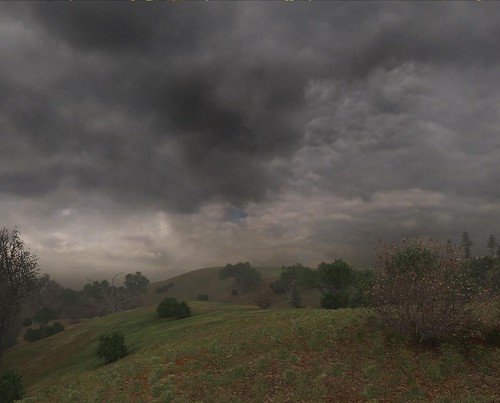
I’ve also been playing STALKER this week, and while it’s been lauded as a ‘living world’ game similar to Oblivion, I haven’t actually found it as engaging. I think, in this case, it comes down to the geographic design of the world. Areas in STALKER feel like wide corridors connected only by entry and exit points. It would be much more attractive to me if it did away with it’s ‘levels’ and opened up The Zone a bit more. I also wonder if the enjoyment of ‘Being There’ in Oblivion and Far Cry 2 is not present in STALKER because of its distinctly dark and brooding aesthetic. While there are undoubtedly moments of beauty, they seem much fewer and further between.

Lastly, in a strange and maybe unnatural comparison, I think I’m looking forward to (eventually) playing the new Empire: Total War game for somewhat similar reasons. Judging by this after action report by Tim Stone over at Rock, Paper, Shotgun the battles look like they encourage the feeling of ‘Being There’ with their rich level of detail and potential for player-created narratives. I look forward to seeing whether that impression is accurate.

In the meantime, does anyone else have any suggestions for games that encourage that feeling of ‘Being There’ - of watching the world flow around you? Hit up the comments and let me know and I’d also be interested to hear what particular aspects of those games make you feel like you’re 'really there'.

Monday, 9 March 2009

Martin Septim is Dead


There was a time when I had hoped Tamriel might have been led by an Emperor again, but somewhere in my heart I knew that our quest – no less than saving Tamriel itself – would claim the life of the last member of the royal line. While I knew Martin Septim for but a brief time, the scant few months that felt more like years meant that I knew him better than any soul still living. I will resist being overcome by the sentiment, but he was a friend and I will mourn him as I would any other fellow to fall at my side, Emperor or no.


So the man is dead and his influence will remain like the statue of He-As-Dragon. He will no longer influence Tamriel; will play no future role in holding the kingdom together. It’s for Martin no longer that I worry. Now it is the fate of the rest of the Empire that I dread.


Mehrunes Dagon may have been defeated but it would be folly to consider all threats to the Empire expunged. Bandits crawl across the belly of the land preying on travelers while horrible creatures too numerous to count infest the wilds of the world and spring up in new places as fast as we cut them down. Meanwhile the fragile alliance holding together civilization as we know it is in but tatters. The provinces will begin to turn on each other soon if a strong leader fails to emerge, mark my words. High Chancellor Ocato is an impotent politician and a weakling. He will not hold the Empire together.


The people need a leader and it must be someone who fought these past months but who unlike myself has come out into the light of victory whole. The leader needed now is someone most worthy of looking up to, for as it is now they have no one. Indeed, they look to me for guidance, as if by mere proximity to royal blood I have somehow absorbed some! I can assure you, any Septim blood spilled has landed on our enemies and not on I. So I am not cut out to be that kind of leader. My battles fought in the service of Martin Septim have left me with no taste for those things needing doing now. I have seen and done too much, and travelled roads too far to be the Breton I once was.


I avoid walking among the people now, and stay holed up high in my tower, away from their cheers and congratulations. After that day in the Temple of the One I retreated to this sanctuary in the arcane university, unable to bear venturing out. I shuttered myself away for two whole weeks, having to remind myself to eat, such was my desperate and pitiable state. When I am spotted on the street now, the people of the imperial city crowd 'round and press in against me, begging to be told what it was like to stand in the temple on that day and see those things that I saw. I cannot bear to look into their faces.


It seems my hopes for the Empire have died along with Martin Septim.


Thursday, 6 November 2008

A Spoiled Gamer, Am I.

I am a spoiled gamer. For the past few weeks I have done little but play videogames and write about them; in between deciding that I don’t want to pursue a PhD and career as a life-long student, of course. However, that is not exactly what has spoiled me.

I’ve been playing Fallout 3 for the past two days (pretty much to the exclusion of all else) and while it’s certainly a lot of fun, by my reckoning it seems weirdly perverse to award the game a 10 out of 10 score, as a number of outlets have[1]. I can’t help but wonder if these reviewers were even playing the same version of the game as me. A 10/10 game you expect to be polished to perfection and bug free. Fallout 3 is not. A 10/10 game you expect to push gaming conventions forward in new and unexplored directions. Fallout 3 largely does not. Finally, a 10/10 game you expect to be as good or better in every respect to other, lesser scored games of a similar vintage and again, I cannot help resist making certain comparisons that say Fallout 3 is not.


The main thing that I find particularly hard to swallow, amplified a hundred fold by the fact that the last game I played was Far Cry 2, is the sense of embodiment in the world. Far Cry, in this respect, is the more truly Next-Gen game in my opinion, and I discussed how a sense of embodiment is one of its greatest achievements in a previous post. While there are obviously other areas of the game that are less inspired, the importance of what Hocking and his team have achieved in giving you a sense of body, I believe, cannot be over emphasized.


So comparatively Fallout from the moment you begin feels different. Ignoring the fact that I had an audio bug during the intro video which obscured the voice-over behind some static noise (10/10? Really?), your character’s movements in Fallout seem like a direct rip from Oblivion. While Far Cry 2 goes to extraordinary effort to animate and portray you as a character to the best of current technical limitations, Fallout 3 reflects a character design aesthetic stuck in yester-year that doesn’t seem to mind stilted and jerky animations. It was fine in 2006 that your character slid around the world on somewhat greasy shoes, but in 2008 (nearly 2009 now!) haven’t we come a bit further? I’m by no means the only person to pick up on this aspect of the game, notably Alec Meer in his (in my mind much more clear-headed review of Fallout[2]) noted some very real issues with the game and scored it much more appropriately, giving it an 8.8. Additionally, I was linked to a piece on Boing Boing Gadgets by friend of SLRC, Aandnota, that described an encounter with a prostitute, saying:

The prostitute NPC mutely follows you up to your room and lies down on the bed beside you like a fetal lump. You then get to sleep on the bed beside her. And that's it. The next morning, you wake up, and she patrol-puppets out without a word.[3]


After experiencing Far Cry 2 in all its whacky, embodied insanity I am now spoiled for a sense of physical connection to my character. If Kieron Gillen is right, and Far Cry 2 follows a similar trajectory of influence to the original Half-Life, it will probably be two to three years before we see games directly ripping-off its focus on a sense of body. Which somewhat saddens me because I think a Bethesda-style RPG with Far Cry’s animation and determination to be grounded in the world would be an absolutely KILLER combo. I hear all the time people saying that they just wanted a tiny bit less of being always on the run in Far Cry and maybe a little bit more of some RPG elements, like a heightened sense of factions. Traditionally, these things could be sorted by fan made modifications, however it’s been stated that there will be no modding tools for Far Cry 2. What I wouldn’t give to see that change.


Ah well, a guy can dream, right?


[1] See, http://www.metacritic.com/games/platforms/pc/fallout3 - The list includes 1up.com, Eurogamer, Gamespy, GameRevolution, G4TV, Thunderbolt, and LEVEL.

[2] See http://www.rockpapershotgun.com/2008/10/28/attack-of-the-fallout-3-reviews/ for a quick summary and a link to the full text.

[3] John Brownlee, “Fallout 3, or "Why can't Bethesda make fucking post-apocalyptic hookers fun?", http://gadgets.boingboing.net/2008/11/05/fallout-3-or-why-can.html

Friday, 24 October 2008

Far Cry 2: Wrongs and Rights

**SPOILER ALERT: These are mostly gameplay-related spoilers, but if you are trying to steer clear of anything and everything to do with the game before it comes out then perhaps you should stop reading now.**


Like just about every videogame in history, Far Cry 2 does some things well, and some things not so well. Lets get the wrong things out of the way first.


Okay, so FC2 has some of the same ‘open world’ problems shared by GTA, Oblivion and STALKER. While browsing an internet forum, I encountered a great and humorous way to sum it up (colourful language warning!). User ‘cpd’ said:

think gta but apartheid africa. plus fucking malaria FUCK OFF FUCKING PILLS

oh and the fact that EVERY c*** wants to shoot you. EVERY SINGLE JEEP will immediately swerve into your path to shoot the living fuck out of you. get out, kill them, repair jeep, drive 100m up the road, repeat.

So it can be kind of repetitive, and frustratingly so – but I’m kind of okay with some of that. I recognize a lot of people probably won’t be, but it kind of ties into the sense of space and physicality that I'll mention later on. I am, however, a guy who has played and nearly completed Oblivion with mods to disable fast-traveling (i.e. played the whole game on horse or foot), so maybe that rules me out. FC2 is at least as large as Oblivion, so getting around can at points become a large part of the game. While there are plenty of cars and utes lying around, the problem comes with transitions to fighting – you either have to get out of your car which takes precious time, or swap to a turret if you vehicle has one leaving you stationary and exposed. Perhaps this issue will be solved later on with the addition of someone riding shotgun, I will admit to only being about 8% of the way through (after nearly 6 hours I might add).


And the good!


The ‘buddy system’ is awesome. Specifically, the fact that if you die and you have a live buddy rested and waiting, they will immediately rush to your side, in a bid to save your life. They’ll pick you up, shoot most of the nearby enemies for you, and give you some breathing room to patch yourself up. It really does solve one of the biggest and most fundamental problems with player death – lets face it, reloading from a save game isn’t exactly all that fun. So it makes sense to do away with it if you can. John Walker from Rock, Paper, Shotgun (who I quoted in my last blog post) wrote back in September about the issue. He said,


I want a high profile, big budget, mainstream action game in which the player character is invincible. I believe that the next truly great game will be the one that does this.[1]


Far Cry 2 doesn’t make you invincible, but the number of times I have accidentally ‘died’ and have just begun to reach for the quick-load button only to fall into the arms or my buddy’s saving embrace, are many.


The other thing that Far Cry 2 does extremely well (and this is the one that I think everyone will or should be talking about soon) is give you a sense of embodiment within the world. As Steven Gaynor (Fullbright) pointed out over Twitter, ‘An FPS that visualizes your hand turning doorknobs? I think I'm in love.’[2] The comparison I couldn’t help but keep making was to Bioshock which often took control of the player and their hands to perform actions, usually in its on-the-rails cutscenes. In Far Cry 2, your hands are always doing this something and they really feel (to me at least) like they are my hands. Add to this the fact that when you need to you can see your body and legs (mostly in other on-rails sections) and you can start to see the building blocks of a really interesting system for representing the player in a virtual world.


In Far Cry 2 you never change to third person, ever – and this is a really good thing! Unfold your map and you will hold in your hands a map of the African country you're stranded in, represented as just another thing in your hands. Like a gun, but for information and orientation. When driving you can open up the map and hold it in one hand, and the net effect is similar to what you would do if performing a similar action in the real world. Your eyes flit back and forth between map and windscreen, balancing path finding with map-reading. No game has ever done that to me before. Also, getting in and out of a vehicle takes time, and while I decried it earlier as being frustrating in combat, it actually further adds to a sense of embodiment. It feels like I am a real human being with a body that takes a real amount of time to move, not some super ninja that flits around at the slightest twitch of a mouse.


In conclusion, it's too early to tell if Far Cry 2 is the ‘game changer’ that I hoped it would be in my previous post. However, even if it's not, it’s certainly another great step in the right direction, in this author’s humble opinion.


Post Script: Jim Rossignol, lover of all games open and exploratory, has posted his own initial thoughts on the game on Rock, Paper, Shotgun. He's pretty much spot on with everything except the Alt+Tab thing - mine works fine.


[1] http://www.rockpapershotgun.com/2008/09/18/rps-demands-i-want-to-live-forever/

[2] http://twitter.com/fullbright/status/971289072

Friday, 27 June 2008

More proof of the versatility of 'Obilivion'


The main point of this post is to link to Christopher Livingston's highly entertaining travel-blogue which is based around creating a character and role playing him as an NPC in the world. The travel-blogue is called 'Living Oblivion' and he uses a bunch of mods to starts his character Nondrik in the port town of Anvil (somewhat reminiscent of Morrowind) and roleplaying as an NPC, Livingston refuses to run to destinations or to use the quick travel feature, resulting in what must be a very leisurely pace at times.

An extract from 'Day 19 & 20' of the Travel-blogue:

I’ll be honest — walking everywhere and never fast-traveling isn’t… easy. The click of my mouse could instantly transport me to any city in the game. Sprinting would decimate my lengthy travel time. There are long stretches, like today, where I’m not attacked, there are few ingredients to pick, and not much of anything interesting to look at, and I think, man, why the hell am I playing like this?


But at moments like this it somehow feels worth it. In other playings of this game I’ve spent days, weeks even, in Imperial City. I know it inside and out. I barely even look at the city, I just zip there, run to the merchants, unload my junk, and dematerialize to my next location. But playing as Nondrick has restored a good deal of majesty and mystery on Imperial City, and catching a glimpse of it through the trees, seeing it grow closer and larger each time, is a bit of a thrill.


Oh, also, for a little bit of contextualisation, Chris Livingston is the guy who wrote, posed and print-screened 'Concerned: The Half-Life and Death of Gordon Frohman' which is a must read for anyone interested in the Half-Life universe.

Also, just wanted to give a heads-up for a post I'm working on "What Videogames have can learn from Digital Musicians" which is hopefully going to explain how I went from a Digital Musics major to a videogame theoretician (if I can even really call myself that...). I've got some interesting ideas, so I hope people will come back for that next week. Until then!

Tuesday, 17 June 2008

A post for Xenia: Simulation and an apologetic explanation of Super Columbine Massacre RPG


This post is going to try and do a couple of things. Firstly, it’s a (very) short summary of the first half of Gonzalo Frasca’s essay “Simulation vs. Narrative”. Secondly, after explaining the ideas contained in Frasca’s paper, I hope to convince my good friend Xenia (the wife of one of my best friends, and a genuine friend of mine in her own right) that the videogame Super Columbine Massacre RPG is not the result of a sick and perverted mind, but instead a serious and thoughtful attempt to come to grips with the whole, messy, horrible situation. Thirdly, I’m going to try and apply a couple of Frasca’s ideas to the videogame Oblivion and suggest an explanation for why another of my good friends, Michael Abbot over at The Brainy Gamer, didn’t enjoy Oblivion as much as he should have (or maybe if I’m being more honest, could have. In the interest of Full Disclosure: I really like Oblivion in all it’s half-baked glory.)


Frasca opens his paper saying that “So far, the traditional –and most popular– research approach from both the industry and the academy has been to consider video games as extensions of drama and narrative.[1]” Frasca also states that:

Representation is such a powerful and ubiquitous form that it has become transparent to our civilization. …This is especially true with a particular form of structuring representation: narrative[2]


He argues that by its ubiquity it has become almost transparent to us and that we actually have a very hard time accepting “that there is an alternative to representation and narrative: simulation.[3]” Frasca provides some very excellent examples of where simulation is present outside of computation: in children’s play, when a toy plane becomes a plane (even a story is created about the plane, the game is still simulating a plane) as well as in Governmental legislation. But I’m getting ahead of myself. What exactly makes something a simulation? Frasca says that

to simulate is to model a (source) system through a different system which maintains to somebody some of the behaviors of the original system.[4]


Returning to our examples of a child at play – the toy plane is modelling the behaviour of a real plane – while it may not actually fly, when the child is whooshing it though the air, to him or her it may as well be. The ‘to somebody’ part of Frasca’s definition in this case is obviously the child – someone not engaged in the simulation (which incidentally may be running only in his or her head, but might also equally be shared by a playmate) the toy remains only that - a toy. To contrast this idea and demonstrate its difference from narrative – Frasca says that

A film about a plane landing is a narrative: an observer could interpret it in different ways (i.e. “it’s a normal landing” or “it’s an emergency landing”) but she cannot manipulate it and influence on how the plane will land since film sequences are fixed and unalterable. On the other hand, the flight simulator allows the player to perform actions that will modify the behavior of the system in a way that is similar to the behavior of the actual plane.[5]


The previous example of the government legislator is somewhat different again, and it shows that the notion of authorship of simulation is quite different to authorships of narrative. A government legislator when writing a new series of laws or by-laws is not explicitly authoring the story of the single working mother who may now be safe from exploitation by her boss as a result of the new law, and yet that story may indeed arise from it. Instead, the law maker is authoring rules as part of the society’s system and the stories (or narratives) that arise from the rules remain a largely unknown consequent.


To return to the point about the difficulty in acknowledging the difference of simulation from narrative, Frasca says that

To an external observer, the sequence of signs produced by both the film and the simulation could look exactly the same. This is what many supporters of the narrative paradigm fail to understand: their semiotic sequences might be identical, but simulation cannot be understood just through its output.[6]


That is, a flight simulator cannot be judged and evaluated as a simulation by simply watching it run – the experience of controlling the simulation is entirely different from the one of watching it – and this is an extremely important point as it has implications for videogame representations.


To turn my attention to the second point, many people when told of the existence of a Super Columbine Massacre RPG game are shocked, disgusted or even outraged, and I think largely because, as a society, we have little to no experience with having to deal with shocking images and situations unless it is presented as a narrative. The disconnect between a persons actions and a persons beliefs, cognitive dissonance even, is perhaps not possible outside of simulations like videogames. When reading a book about the holocaust, one does not feel complicit in the actions of the Nazi’s at Auschwitz, even when recounted in a novel from a personal perspective.


So let me ask you this: A person would be less likely to respond like the one mentioned above if it was instead a thoughtful, reasoned novel that attempted to examine and explain the tragedy of the columbine high school massacre, correct? Well, perhaps someone would, and that would be a valid reaction, potentially based in a general unease with trying to identify with the two killers – Eric and Dylan. But the objection would likely not be to the fact that there was a book about it, but rather the content of the book. So why then, does just the idea of a videogame about the events of Tuesday, April 20th 1999 provoke such consternation?


The answer is far from as simple as I am proposing, as numerous other legitimate, real factors come into play, however I am of the inclination that it is because many people do not have the requisite experience with simulation, and indeed with engaging seriously with simulational media, that is required to accept and understand the reasoning behind creating something like Super Columbine Massacre RPG. Frasca says that indeed ‘Video games imply an enormous paradigm shift for our culture because they represent the first complex simulational media for the masses’[7]. I guess what I would like every reader to understand is that, far from being designed for the glorification of the shooters themselves, the game is part of what can be described as the ‘the search for rationale’ in much the same way as any book or film about the subject, however instead of employing a narrative to make his point, the creator Danny Ledone decided to use a simulation – and that leaves people without the experience in disconnecting their actions in a simulation from their beliefs, quite understandably uneasy.


Sadly, I personally feel that, while an excellent effort and a great start, Super Columbine Massacre RPG does not succeed in its efforts but not through any fault of the medium. Without getting into an in depth critique of the game, it suffers from much of the same failings as many big budget videogames, such as Oblivion, which I have written about on the blog previously. Let me explain by saying that, if we take Frasca’s view, and that games are indeed simulations, then the vast majority of the source systems videogames are modelling (and I cannot stress this point enough) are narratives! Super Columbine Massacre RPG deploys Role Playing Game tropes and contentions but fails to escape the trap of trying to model a linear, progressive narrative story.


The Elder Scrolls IV: Oblivion is similarly an RPG and I believe falls into exactly the same trap. My good friend from the other side of the planet, Michael Abbott, failed to find Oblivion enjoyable for a number of reasons, among which the fact that he ‘just got bored’ and stopped enjoying the game. I propose that, similar to Super Columbine, Oblivion tried to render, intentionally or not, a narrative as their source simulation; however, I also believe that they had a conflicting desire to simulate a world (a distinctly non narrative thing)– a fact that is evident in much of the free-form structure of the game. If the developers of Oblivion had of concentrated on modelling a consistent world and, dare I suggest, left out entirely the narrative elements like the main storyline instead focussing on emergent possibilities – perhaps by finetuning the ‘Radiant AI’ system which gave each non-player character such things as motivations, desires and habits and then made them go about their business to satisfy these conditions – then I genuinely think the game would have been both extremely different and more attractive to some certain players. Now, I’m not 100% confident of this evaluation, but based on comments made by Michael and others, such as that ‘the NPC’s were very boring’ (a valid assessment – they were very generic) then perhaps by dropping the (I suggest crippling) overarching need to model a narrative, Oblivion would have been significantly better – there would still have been significant challenges to overcome to realise this ideal, but overall I think the point still stands.


In summing up, let me return, once again to Frasca who points to suggestions by proponents of Interactive Narrative that “Aristotelian closure” is the source of ‘the user’s pleasure’[8]. He says that ‘The biggest fallacy of “interactive narrative” is that it pretends to give freedom to the player while maintaining narrative coherence’[9]. Frasca says that instead

the gratification for [participants in simulation] is not the one of the professional actor but rather the one of the child who plays make-believe. The child is constantly adapting fantasy to different changes, without the grown-ups obsession with closure.[10]


As an interesting comparison, think of the difference between something like Hamlet and your typical game of Theatresports – the former is a narrative, and any attempts to incorporate interactivity would probably compromise its narrative coherence, whereas the latter, if constrained by a script, loses all of the charm and attractiveness derived from its spontaneity. The difference between simulation and narrative is a wide and often mis-understood (even at times mischaracterised) chasm, but one which remains largely uncharted. Let’s start today – I’m game, are you?


[1] Frasca, ‘Simulation vs. Narrative: Introduction to Ludology’ in Mark J.P. Wolf and Bernard Perron, Eds., The Video Game Theory Reader, p.221, also available as a PDF at: http://www.ludology.org/articles/VGT_final.pdf

[2] Ibid., p.222-223

[3] Ibid., p.223

[4] Ibid.

[5] Ibid., p.224

[6] Ibid.

[7] Ibid.

[8] Ibid., p.229

[9] Ibid.

[10] Ibid.

Thursday, 12 June 2008

Markov Chain Madness

I must warn you - The following text is generated by a Markov chain. Inspired by Mr Quixoric Engineer on Twitter I decided to have a little play around with some Markov generated text, using my paper on virtual reality and the FPS as the input text. Needless to say, the results were stunning. Better than anything I could have written

In the virtual from raw ingredients often bringing conventions and game means stepping into a phrase, everything about the largest city and this peculiarity of the map’ and those far away hills I made my own experience. Finally, I believe there is a large body of wanderlust through a mountain ranges – with his main argument down into a picture of wanderlust through the player, relating a taxonomy of a children’s game Oblivion is Alchemy, which they may employ an unreal image to the massive draw distance – with ancient ruins and reaction. At a reading for engaging with possibility.

I really like the bit where it says "Oblivion is Alchemy". Of COURSE! Why didn't I think of that? It makes so much sense now. So there you have it. Play with Markov chain generative text here. After my initial experiments, the markov generator came up with this last piece of inspired literature, which makes a kind of scary sense.

In this research paper aimed at discussing some of the group ‘Iraq and Afghanistan Veterans of America’ spoke to the author of the issues raised in the Baudrillardian sense, that the developers chose to employ an invisible barrier as their means of keeping the game that I wish to explore the world, I began to enacting the role playing game into a world in which to move about and interact with the same topics in greater depth. One addition to the FPS solely owns the ‘first person perspective’ videogames have not been an independently delineated genre – rather existing simply as a popular first person viewpoint gameplay conventions and tropes set in place by a desire to explore the world, I experience a heightened level of ‘simulation fever’ because, as just mentioned, I have been problems for the player. For example, not having the time to fill in the case in most, if not all games, and is clearly room for telling stories in other places however there was one small barrier between me and those far away hills of promise, and it was later released as a focus on state-of-the-art graphics with other role playing game, The Elder Scrolls IV: Oblivion. I then made a small assertion that virtual comes from the surface, stay in touch with reality” . Ryan says

…the meaning of virtual ice climbing I was rather excited. I had, after all, spent the last several minutes on the DVD to store the extra environment or not having enough space on the other the virtual as fake and the other side.

When I finally did reach a section of the game as encouraging the practice of stopping to smell the flowers.

A different aspect of the many ‘skills’ that a play can employ within


Think I could get away with Markov chaining my whole Literature Review? Feel free to link me some of your excellent finds in the comments.

Monday, 9 June 2008

An extract from my recent paper on VR and the 'first person perspective' videogame

I've been thinking about (and doing a bit of select reading of) the concept of 'New Games Journalism', which Kieron Gillen outlined in his 'New Games Journalism Manifesto'. The point that I thought was most important, was this:

New Games Journalism... argues that the worth of a videogame lies not in the game, but in the gamer. What a gamer feels and thinks as this alien construct takes over all their sensory inputs is what’s interesting here, not just the mechanics of how it got there...

This makes us Travel Journalists to Imaginary places. Our job is to describe what it’s like to visit a place that doesn’t exist outside of the gamer’s head...
The thing with travel journalism or reportage is that it’s interesting even if you have absolutely no inclination of going there.


The idea of dealing with the game and talking about it subjectively, as embodied, is extremely powerful, to my mind. And with this though, I wanted to share with my handful of readers, an extract from my own research discussion paper which will undoubtedly be somewhat adapted into a section of my thesis. I'll hopefully put the paper up in full in a few weeks, but until then, here's a little bit of my own attempt at injecting the aesthetic of 'New Games Journalism' into a bit of academic writing.

Any resemblance to Jim Rossignol's recent post on Rock, Paper, Shotgun from last week is purely coincidence. I started writing the paper only a few days before Jim wrote his and when he beat me to the punch, I was kinda miffed. But hey, it means I must be on the right track if someone as distinguished and insightful as Jim is talking about it.

________________________________________________________________

Oblivion, belonging loosely to the category of open world or sandbox type games, allows the player great freedom for exploration. At almost any point the player can leave the main narrative path and explore the world to discover and engage with its inhabitants, or simply venture into the countryside for its own sake. The game world stretches for many miles, across many different environments and is populated to varying degrees with ancient ruins and secluded settlements. The ability to go ‘off the beaten track’ is inscribed within the games rules, and is clearly accommodated for, even expected. For example, one of the many ‘skills’ that a play can employ within the game is Alchemy, which involves the brewing of potions from raw ingredients often gathered from the wild. At its most abstracted level, the game can be seen as rewarding players for exploring and discovering these useful reagents through the ability to brew useful, even potentially life saving potions. Somewhat humorously, the possibility is open to reading the game as encouraging the practice of stopping to smell the flowers.


A different aspect of the game that I wish to relate and demonstrate the power of procedural rhetoric is best told through my own subjective experience and reaction. At a point roughly 20 to 30 hours into the game, I found myself at a location called Cloud Ruler Temple high up in the Jerall Mountains. To the south of the temple is visible the towering spire at the heart of Imperial City, the largest city and one of the central places within which much of the game takes place. Behind the temple and to the north is a series of large, beautifully rendered snow covered mountains. There is no road leading up it and no perceptible reason to climb them. With no inclination towards advancing the plot and instead being possessed by a desire to explore the world, I began to enacting the role of ‘the explorer’ as classified in Richard Bartle’s taxonomy of MUD[1] game players[2]. Bartle describes four types of MUD players and their differing rationales for engaging with the game – in the case of the explorer, Bartle says

Players try to find out as much as they can about the virtual world. Although initially this means mapping its topology (i.e. exploring the MUD's breadth), later it advances to experimentation with its physics (i.e. exploring the MUD's depth).[3]


Knowing that my character possessed an exceptional level of the acrobatics skill, which directly modifies the height of a player’s jump, I attempted to climb the mountain through a combination of running and leaping. Thwarted by near vertical surfaces of snow and ice, I made my way across the face of the mountain (in my mind pretending that by rock climbing I was managing to traverse the similarly near-vertical cliff faces) to approach from the north, a much gentler gradient. At many points along the way I would get stuck, just below the crest of the mountain with the knowledge that it was just out of reach teasing me, making me want to get up there all the more. I would perhaps assert that this feeling in me was somewhat akin to that experienced by many serious mountain climbers who characterise their motivation for climbing mountains as doing so ‘just because it’s there’. Similarly, I wanted to climb to the peak of the Jerall Mountains because they were there; however, I also wanted to see what was on the other side.


When I finally did reach a section of the mountainside that permitted the kind of virtual ice climbing I was undertaking, I was rather excited. I had, after all, spent the last several minutes on the face of a mountain and had gone so far as to have crossed several sections of the map. The inability to reach the top so far had only made me more determined. I eventually reached what I believe to be the highest point in the game and the view was all the better for feeling as though I had actually accomplished something. Over the other side of the mountain ranges – and plainly within view of the massive draw distance[4] – was another set of mountain ranges, not snow covered like the ones I was standing on, but wooded and rolling and filled with possibility. Looking north-north-west, the woods continued on down to what appeared to be a large body of water, possibly a lake or the ocean (the ocean was certainly in that direction and reachable in other places) however there was one small barrier between me and those far away hills of promise, and it was a literal barrier. Upon reaching certain points of the world designated by the level designers as the ‘edge of the map’ and hence playable area, players encounter an impassable, invisible barrier and are told via onscreen lettering ‘You cannot go that way, turn back.’ I propose that, in effect, by not allowing the player to visit all the places one can see Oblivion, due in part to its emphasis on beautifully realistic visuals, heightens any feelings of wanderlust already present in the player, whether intentionally or not. The fact that the game intentionally sets itself up as a consistent world, as previously mentioned, and encourages exploration, only to so cruelly curb said exploration, is rhetorically strange, if not wilfully perverse.


[1] MUD stands for ‘Multi-User Dungeon’. These were generally text based online games, the precursors to modern ‘massively multiplayer online’ (MMO) games such as ‘World of Warcraft’ or ‘Everquest’. I am stretching his definition to include single player games that include large worlds much like MUD’s – such as Oblivion.

[2] Richard Bartle ‘Hearts, Clubs, Diamonds, Spades: Players Who Suit MUDs’ in Katie Salen and Eric Zimmerman, eds. The Game Design Reader: A Rules of Play Anthology, (Mass.: MIT Press, 2006), pp.754-786

[3] Ibid.

[4] Draw Distance is the technical term for how far the game engine renders the environment into the distance. The fact that the draw distance is so long is a bi-product of the games previously mentioned appropriation of FPS tropes such as technology pushing graphics.