Showing posts with label Kieron Gillen. Show all posts

Monday, 22 December 2008

Featured on The Brainy Gamer Podcast


As a special part of the end-of-year discussion, Michael Abbott of The Brainy Gamer has assembled the whole crew of The Gamers Confab to do a huge round-up of their favorite games of '08. I'm in the second half of the 1st podcast (being 3 in all - there sure are a lot of us bloggers!) and you'll get to hear me rave about the game that I love from this year (the biggest non-secret around I believe) saying such silly things as "In the game the environment almost becomes a character itself...etc". Phew!

Also, a big thank you to Kieron Gillen over at Rock, Paper, Shotgun for linking to my post on Audiosurf yesterday/ earlier today in The Suday Papers. It's very nice to know someone like him is reading (even occasionally) the things I write, and it's a great privelege to be linked to by the boys.

Tuesday, 9 December 2008

Things I don't want to do

N'Gai Croal can have my man-babies. Hi N'Gai!


This post could also be called “Things I’m not particularly good at, and hence largely shy away from”, but that was a bit long I thought. It might also help to keep that in mind while reading.


As a member of the burgeoning blogeratti, us pretentious, occasionally intelligent videogame writers (admittedly a somewhat unknown in comparison to the likes of Michael Abbott, Iroquois Pliskin, Leigh Alexander, N’Gai Croal, etc.) there’s a particular thing that I see others doing and that I struggle to be interested in.


Reading around, I get the sense that there’s a lot of thought being put into things like defining the proper terminology for talking about games; whether that terminology should be specialist or general enough to be inclusive; and what kinds of things need brand new words or explanations. And I really struggle to want be a part of it. And when I stopped to think about it, I wondered if maybe I was onto something.


This is going to run the risk of seeming like I’m calling him out, but Corvus Elrod (whom I greatly respect) has devoted a generous amount of words and blog posts to things like his definition of ‘play’ or the definition of ‘mechanics’. I think the first time I saw it happening I actually did a double take. Does an established word like ‘play’ really need redefinition just solely for the context of videogames? Isn’t just the context of a videogame blog enough for people to generally understand what you mean? If you do think there is a case for it, wouldn’t it perhaps be better to come up with some new and descriptive word rather than repurpose an existing one? Can’t we also by this point assume that many (most?) people who are reading our blogs pretty much know most of the terms and understand what we mean when we say things about a game? Surely they don’t really need us to explain that “videogames involve a player’s input, whereas a movie doesn’t”. If a particular reader doesn’t know that sort of thing already, what are they doing on my blog?! Go out and play some games first! Seriously, shoo! Go play Halo or The Sims – you’ll pick up on that whole player input aspect pretty darn quick, let me tell you. And if my mum can do it, so can you.


James Paul Gee wrote in What videogames have to teach us about learning and literacy that the best videogames, the ones that are successful, actually teach the player about how games work. So why do we in the blogosphere seem to think we have to explain the wheel to our readers? They’ve all played Call of Duty, they’ve know all the tricks. And if they don’t, can we even expect them to understand this interactive medium without experiencing it? Gonzalo Frasca, the granddaddy of academic videogame theory, says that in media that is simulational (videogames), unlike traditional narrative’s with which most people have already had significant exposure to in the form of film, books, etc, you can’t actually come to grips with it from the outside or without experiencing it for yourself.


In another example of the terminology discussion, Iroquois Pliskin (who, again, I greatly admire for his near-overnight rise to prominence and contribution to discussion) in a recent post criticized Clint Hocking’s bastard phrase, ‘ludonarrative dissonance’. He described it as,

“needlessly florid, and…the sort of thing that gives aid and comfort to the people who think that games writin' has gotten too fancy.”


I commented on the post, but I’ll reiterate here – I think ludonarrative dissonance is a fantastic term, and honestly it’s not just because I’m enamoured with the work of Clint Hocking himself (heh). It’s because it’s a term that describes quite exactly a specific occurrence in videogames – one that only occurs in videogames. But hey, just a second ago, wasn’t I advocating against discussing terminology and such? True, but in this instance ludonarrative dissonance is actually a term specific to videogames – unless it involves rules or mechanics that “say” one thing, and a story that says another you can’t get ludonarrative dissonance. There is no potential for ludonarrative dissonance in media like film, so I think it’s quite a valuable term for describing something rather unique to videogames and as such hasn’t really had a name before. And it avoids repurposing old words which, frankly I think is actually doing more to create a specialist vocabulary about games than phrases like the above. In what other context does ‘play’ mean “the self-guided exploration of possibility within a bounded space.”1


Okay, so the counter argument to that all this is, well, look in the dictionary – there’s already a bunch of given meanings for ‘play’ that are all different, some subtly, others wildly. But I don’t think I’m alone in feeling like this is an issue. The recent hoopla over the snappy gamer’s article, which tried to call out fantastic games writers as being “overly intellectual” and ruining it for everyone else, so pooh pooh, made Leigh Alexander comment that, while the author was being a dick, he did kind of have a point.


All of which makes me think that, shock horror, Kieron Gillen and New Games Journalism maybe actually had the right idea. You really, truly can’t dissect a game without reducing it to less than its whole. I just don’t think it works as it fails to capture the essence of what’s really great about games and why we play them. What I believe Gillen was onto with NGJ was identifying and writing about ourselves. Ultimately, people and their reactions, their feelings, their thoughts their stories (which I am also a big fan of, gaming anecdotes [RPS’ Planetside, the 1% and the ‘I was there, man’ syndrome is an amazing example]) are always going to be more interesting to read than a technical breakdown of game mechanics and why the pistol in Halo 1 was overpowered.


So, let’s bring this train wreck to a conclusion – what am I trying to say? Is it misguided to attempt to nail down some important and novel terms and ways of thinking about games? Well, no not really, there’ll always be a place for that. But, if writing about games is going to really truly transcend accusations of ‘over thinking it all’ then I believe the blogosphere has got to stop trying to clinically explain ‘how it is’. Let it go a little more often - go a bit wild. I think the really successful writers are already doing it, and I tip my hat in the direction of Duncan Fyfe and his writing at Hit Self Destruct. Also, Rock, Paper, Shotgun are often exceptionally good at this too.


Lastly, to both the guys who I criticized earlier, please don’t take it personally. Feel free to disagree with me, take my argument apart and show me the gaping flaws in my logic – please tell me if you think I’m aiming way off base. I am eternally thankful that, largely, we’re all an incredibly mature, friendly and thoughtful bunch and that that in itself goes miles towards overcoming any disagreements.

Monday, 8 December 2008

I have two hands and with them I touch the world

I have two hands, and with them, I touch the world.


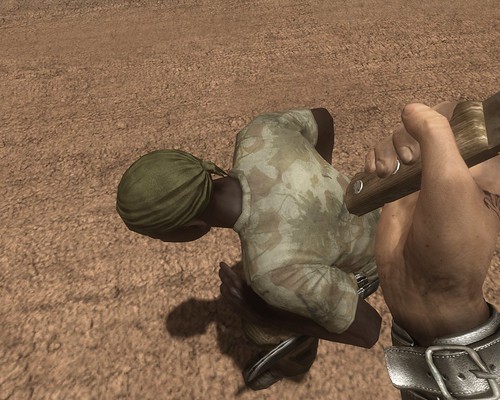
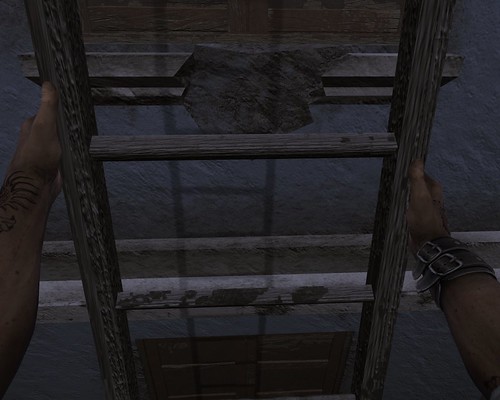
In the post release discussions of Far Cry 2 that I have read few others have mentioned what I think is perhaps the single most genre-innovating aspect of the game. The first person shooter’s de rigeur level of interaction is based on weapons – usually guns. Since as far back as Doom and earlier however, the ‘fist’ or ‘gauntlet’ or other hand-held melee device has been a present reminder that a person can readily do other things with their hands than simply aim and squeeze a trigger. Far Cry 2 takes note, and says ‘alright, let’s see what that means for the FPS’.


The things my hands hath wrought in Far Cry 2 are as varied as their real world counterparts – they are utilitarian, opening doors and containers, picking up objects like weapons, briefcases and diamonds. Immersion in the first person perspective is apparently paramount, and the realistic application of my hand to a door-handle is one small detail that is by no means lost on this author. The ‘procedural animation’ system makes my hand always appear to touch the object I am reaching for, twisting, collecting, opening. While it is intentionally perhaps not quite as versatile as the animation system in Spore, it doesn’t need to be. Yet it remains a significant raising of the bar for the standards of first person interaction. We will see only in time whether those standards are met, much as I suggested in my initial post on the game. If Gillen, et al. are to be believed, the Half-Life cycle of influence takes approximately two years, and I would add that the case of Halo seems to follow a similar pattern. That seems an unfortunately long time to wait for someone who, like me, is now well and truly ensnared by the Far Cry 2 immersion factor.


My hands are also my last saving grace when an explosion or gunshot wound renders me close to death, and given sufficient time can work their restorative magic upon the rest of my body. Indeed they themselves appear to miraculously heal from wounds that were inflicted mere moments earlier – an interesting parallel with the gradual healing of whole body wounds which we now take for granted and which are, admittedly, perhaps even sillier in concept than the somewhat arbitrary hit-point ‘n’ health pack combo paradigm they seem to universally have replaced. However I would not wish a return to those heady days of fighting Nazi’s on 5 hp as a result of an inability to find a health pack within arms reach. After all, the health pack only allows me to increase a semi arbitrary numerical value that somehow represents my ‘wellness’ and distance from death. Admittedly, auto regenerating health and body parts vastly improves game flow and rhythm – but it remains an abstraction. Still, even on that front Far Cry 2 proposes a slightly more refined version: Take too much of a beating and your health won’t regenerate beyond a certain point. That is, only until you stop to pump some more morphine into your blood stream – delivered via your hands and lower arms, of course – a novel mix of the arbitrary health pack and the auto regeneration systems.


Lastly, my hands are more than up to the task of bringing swift retribution to those who would visit violence on my own body. After all the above, this almost seems like the least interesting possibility, and I wonder whether compared to the amount of time spent holding a map in your hands or steering a vehicle, this last option does not actually plateau into a more even distribution. My hands are, after all, the most prominent manifestation of my avatar that I see through the game – and that they should spend most of their time trying to kill and maim others starts to seem oddly nihilistic. Then again, that is what the game’s about isn’t it?


Monday, 10 November 2008

Embodiment and Immersion: Fallout & Far Cry, FIGHT!


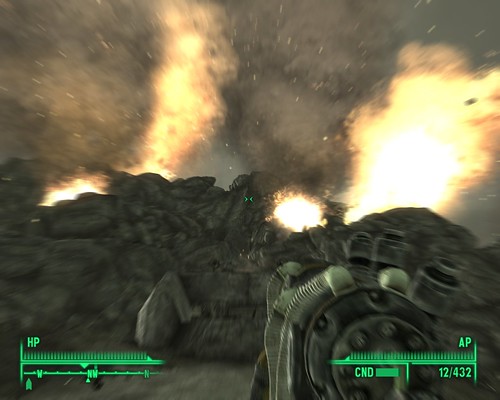
Not to harp on about a single topic or anything, but I’ve been pondering why I’ve felt so disappointed by Fallout 3. Yep, you read it right – I don’t entirely feel like the review scores it got were wholly deserved. I think I’m doubly stung because, in confluence with the hype train, they influenced my decision to go out and spend my hard earned dollars on the game. Okay, so I’m complicit in the last point for being a sucker for hype and the former can easily be countered by the suggestion that the review process is entirely subjective, which I tend to agree with, so lets skip past finger-pointing and try and identify why.


I’m a bit of a one trick pony at the moment, because I think it largely comes down to the sense of embodiment that the game offers, and certain things which only break my sense of immersion. For starters, when compared to Far Cry 2, my character in Fallout 3 feels like a lifeless sack of potatoes, and as Michael Abbott has recently noted, so do the other inhabitants. Why would I want to play a game in which I have to plod around everywhere like some machine reminiscent of Marvin the Paranoid Android when, with the swap of a disk and a click of a different icon on my desktop, I can effing sprint-slide into cover in Far Cry 2, and rip pieces of shrapnel from my body with a pair of pliers.


Secondly, and perhaps more importantly, as Kieron Gillen noted somewhere that I can’t seem to recall, in Fallout 3 you can do outrageous things like jump up on a table in the middle of a bar, and no-one cares. It would be fine, actually amazing, if there were responses for these out there actions but as it stands, nary a soul has one whit of a comment for many of the crazy things you can do in that game. And so as a player I find myself having to think up some (usually extremely tenuous) excuses for why other characters are downright uncaring about my kleptomania and other inexplicable behaviour, in order to maintain narrative coherence.


Take for example, any number of houses in Fallout: in a great many you will find a number of items that will fail to be marked as ‘owned’ by another character (shown by red text in game) which when picked up by the player results in thievery. Obviously, the majority of these are accidents, but as a result of this accidental design I find my sense of immersion broken by having to do a kind of “meta” thinking and decide whether or not I would (in character) take these items. More often than not I find myself reacting purely out of function and take the items anyway (sometimes I don’t) and take advantage of the exploit, but the fact is that every time I do it is immersion breaking. In a similar vein, by allowing me to jump on a table before beginning a conversation with an NPC, Bethesda has allowed for the occurrence of a situation in which the logical response of an NPC (which could be anything from “What do you think you are doing?” to “Get off mah dinner table, whippersnapper!”) is not present within the game. I find this extremely irritating.


The obvious counter argument is that “well you should be role playing, and if your character wouldn’t stand on a table then neither should you” and I suppose that is a valid argument. However it is most definitely NOT how I want to play a videogame – for me it’s all or nothing. If you can do something in a game, then there should be an appropriate response for it. Why even bother to let me jump on tables? What purpose does it actually serve? It’s not even as if it would be impossible to implement a system to prevent the majority of these oddities. Far Cry 2 contrives to make 100% certain that, when in a context for which a certain kind of action makes no sense (read: certain indoor areas), then you are stripped of the mere possibility of performing an incongruous action. Most notably, when you meet with certain mission-critical people indoors, you can no longer run, jump or fire your weapon – often having had your weapons taken off you before entry. This makes perfect sense, so I am only too happy to oblige!


I believe some of the reason for my difficulty in accepting the incongruity of an NPC ignoring my strange behaviour comes from not possessing a strong skill at, or even inclination towards Role Playing. And yet, even Role Players I know have commended the vintage game, Deus Ex for some of the small details that work to build a consistent and convincing world, specifically the noting of your characters entry into the womens’ bathroom. It seems to me that, while it is undoubtedly possible to force ones self into a way of playing that “only makes sense” in the game world, it makes even more sense to me to enforce certain behaviors unless they serve a purpose. In an interview I conducted with Marty O’Donnell, the audio director for Bungie studios’ and responsible for the sound and music of the Halo series, for my recently completed thesis we got onto the topic of giving the player control over “every aspect of the game”. O’Donnell said to me,

…game players have gotten into a habit [of thinking] that they should have control over all these things and basically I’m saying, you know what, no – you shouldn’t.


So, Bethesda, if you’re listening; in the future, either put in things to make sense of all my possible actions or please, please limit them to just sensible ones.


Wednesday, 22 October 2008

Why I'm so fracking excited about Far Cry 2


“I think Far Cry 2 is going to be amazing…” John Walker, RPS Wireless Show, Ep.2

I also think Far Cry 2 is going to be amazing, and it’s partly because of what the guys at RPS have said about it, and partly because of what the Creative Director, Clint Hocking has said. In an interview for Edge Magazine, he used a literary comparison to explain its difference from the original Far Cry.


The original Far Cry is The Island Of Dr Moreau, a story of a mad scientist that has unlocked the inner savagery in man and created literal monsters,” says Far Cry 2’s creative director Clint Hocking. “But at the same time HG Wells was writing Moreau, Joseph Conrad was writing Heart Of Darkness, which actually has very similar themes. It’s about someone in the jungle that has discovered and is leveraging man’s inner madness, and become a metaphorical rather than literal monster. This is Far Cry 2.


The focus on the “inner madness” is an area that I am only too happy to explore. Could Far Cry 2 become the Apocalypse Now of our gaming generation? Kieron Gillen, in the same RPS Podcast as the earlier quote from Walker, explained why he thought that it was going to be a “game changer” of a game. In terms of the open world nature of the game and how the story is told, Gillen said


…the sort of narrative structure is basically you choose who you want to be from a list…and then all the other characters become NPC’s in the story…the structure generates via programming…and that’s really clever. That absolutely how we should be trying to do narratives in games instead of just the ridiculous cut-scene approach…of… your metal gear solid 4 approach, which is ludicrous. That this is absolutely embracing the form and wouldn’t be possible in any other form, [is] really interesting and novel.


If there’s one phrase that can get me instantly interested in a topic about videogames it’s “embracing the form”. To any developer who is interested in creating a game that wouldn’t be possible in any other medium, I instantly say “Yes! Lets!” and want to give them all my money. Gillen seemed to think that Far Cry 2 had the potential to change the way we perceive games, even what games are possible of, saying


Far Cry…kinda sounds like… well you can’t really go back after this. …The idea that suddenly an entire generation of gamers will be injected with something which changes how they think a shooter could work is exciting, cause that hasn’t happened since Half-Life. …Wouldn’t it be amazing if, this Christmas everything changed? The idea that the sort of things people expect form the genre changed? It hasn’t changed since 1998.


I also find that notion to be terribly exciting. However, there is always the potential that it will be ignored, missed by the game developing community at large, and generally passed over. John Walker questioned Gillen’s belief, saying


I’d love to think that were true, but unfortunately, that when PoP came out I said ‘Oh my goodness, no platform game can ever be the same again because of this game’ and yet not one single platform game has done it right at all – I mean, Braid? …Tomb Raider games…still don’t have rewinding time in them and there’s no reason not to. I mean, there’s enough mysticism and magic going on. ‘Oh yeah, but they’d be stealing that idea directly from Prince of Persia’ well what was PoP? *laughs* A direct steal from Tomb Raider. Loads of these brilliant redefining games just seem to get ignored for years, which is really frustrating.


Gillen, in response, suggests that, perhaps in this case, Prince of Persia was largely passed over because it “wasn’t the number 1 game in the industry. Whereas Half-Life was.” He says,


I think Far Cry 2 is going to be huge. If it’s huge, people rip it off more. Especially if it’s in a genre which is popular, which a shooter is.”


Early reviews are in. The verdict, so far, is quite good. Tom Chick:


The objective of Far Cry 2 as a game is to get out of the way and let you experience the game world. And there is no other game world quite like this one: haunting, spectacular, meditative, explosive, violent, and serene, all at once, and all in a mere shooter.

I for one, can’t wait to get my hands on it.

Monday, 9 June 2008

An extract from my recent paper on VR and the 'first person perspective' videogame

I've been thinking about (and doing a bit of select reading of) the concept of 'New Games Journalism', which Kieron Gillen outlined in his 'New Games Journalism Manifesto'. The point that I thought was most important, was this:

New Games Journalism... argues that the worth of a videogame lies not in the game, but in the gamer. What a gamer feels and thinks as this alien construct takes over all their sensory inputs is what’s interesting here, not just the mechanics of how it got there...

This makes us Travel Journalists to Imaginary places. Our job is to describe what it’s like to visit a place that doesn’t exist outside of the gamer’s head...
The thing with travel journalism or reportage is that it’s interesting even if you have absolutely no inclination of going there.


The idea of dealing with the game and talking about it subjectively, as embodied, is extremely powerful, to my mind. And with this though, I wanted to share with my handful of readers, an extract from my own research discussion paper which will undoubtedly be somewhat adapted into a section of my thesis. I'll hopefully put the paper up in full in a few weeks, but until then, here's a little bit of my own attempt at injecting the aesthetic of 'New Games Journalism' into a bit of academic writing.

Any resemblance to Jim Rossignol's recent post on Rock, Paper, Shotgun from last week is purely coincidence. I started writing the paper only a few days before Jim wrote his and when he beat me to the punch, I was kinda miffed. But hey, it means I must be on the right track if someone as distinguished and insightful as Jim is talking about it.

________________________________________________________________

Oblivion, belonging loosely to the category of open world or sandbox type games, allows the player great freedom for exploration. At almost any point the player can leave the main narrative path and explore the world to discover and engage with its inhabitants, or simply venture into the countryside for its own sake. The game world stretches for many miles, across many different environments and is populated to varying degrees with ancient ruins and secluded settlements. The ability to go ‘off the beaten track’ is inscribed within the games rules, and is clearly accommodated for, even expected. For example, one of the many ‘skills’ that a play can employ within the game is Alchemy, which involves the brewing of potions from raw ingredients often gathered from the wild. At its most abstracted level, the game can be seen as rewarding players for exploring and discovering these useful reagents through the ability to brew useful, even potentially life saving potions. Somewhat humorously, the possibility is open to reading the game as encouraging the practice of stopping to smell the flowers.


A different aspect of the game that I wish to relate and demonstrate the power of procedural rhetoric is best told through my own subjective experience and reaction. At a point roughly 20 to 30 hours into the game, I found myself at a location called Cloud Ruler Temple high up in the Jerall Mountains. To the south of the temple is visible the towering spire at the heart of Imperial City, the largest city and one of the central places within which much of the game takes place. Behind the temple and to the north is a series of large, beautifully rendered snow covered mountains. There is no road leading up it and no perceptible reason to climb them. With no inclination towards advancing the plot and instead being possessed by a desire to explore the world, I began to enacting the role of ‘the explorer’ as classified in Richard Bartle’s taxonomy of MUD[1] game players[2]. Bartle describes four types of MUD players and their differing rationales for engaging with the game – in the case of the explorer, Bartle says

Players try to find out as much as they can about the virtual world. Although initially this means mapping its topology (i.e. exploring the MUD's breadth), later it advances to experimentation with its physics (i.e. exploring the MUD's depth).[3]


Knowing that my character possessed an exceptional level of the acrobatics skill, which directly modifies the height of a player’s jump, I attempted to climb the mountain through a combination of running and leaping. Thwarted by near vertical surfaces of snow and ice, I made my way across the face of the mountain (in my mind pretending that by rock climbing I was managing to traverse the similarly near-vertical cliff faces) to approach from the north, a much gentler gradient. At many points along the way I would get stuck, just below the crest of the mountain with the knowledge that it was just out of reach teasing me, making me want to get up there all the more. I would perhaps assert that this feeling in me was somewhat akin to that experienced by many serious mountain climbers who characterise their motivation for climbing mountains as doing so ‘just because it’s there’. Similarly, I wanted to climb to the peak of the Jerall Mountains because they were there; however, I also wanted to see what was on the other side.


When I finally did reach a section of the mountainside that permitted the kind of virtual ice climbing I was undertaking, I was rather excited. I had, after all, spent the last several minutes on the face of a mountain and had gone so far as to have crossed several sections of the map. The inability to reach the top so far had only made me more determined. I eventually reached what I believe to be the highest point in the game and the view was all the better for feeling as though I had actually accomplished something. Over the other side of the mountain ranges – and plainly within view of the massive draw distance[4] – was another set of mountain ranges, not snow covered like the ones I was standing on, but wooded and rolling and filled with possibility. Looking north-north-west, the woods continued on down to what appeared to be a large body of water, possibly a lake or the ocean (the ocean was certainly in that direction and reachable in other places) however there was one small barrier between me and those far away hills of promise, and it was a literal barrier. Upon reaching certain points of the world designated by the level designers as the ‘edge of the map’ and hence playable area, players encounter an impassable, invisible barrier and are told via onscreen lettering ‘You cannot go that way, turn back.’ I propose that, in effect, by not allowing the player to visit all the places one can see Oblivion, due in part to its emphasis on beautifully realistic visuals, heightens any feelings of wanderlust already present in the player, whether intentionally or not. The fact that the game intentionally sets itself up as a consistent world, as previously mentioned, and encourages exploration, only to so cruelly curb said exploration, is rhetorically strange, if not wilfully perverse.


[1] MUD stands for ‘Multi-User Dungeon’. These were generally text based online games, the precursors to modern ‘massively multiplayer online’ (MMO) games such as ‘World of Warcraft’ or ‘Everquest’. I am stretching his definition to include single player games that include large worlds much like MUD’s – such as Oblivion.

[2] Richard Bartle ‘Hearts, Clubs, Diamonds, Spades: Players Who Suit MUDs’ in Katie Salen and Eric Zimmerman, eds. The Game Design Reader: A Rules of Play Anthology, (Mass.: MIT Press, 2006), pp.754-786

[3] Ibid.

[4] Draw Distance is the technical term for how far the game engine renders the environment into the distance. The fact that the draw distance is so long is a bi-product of the games previously mentioned appropriation of FPS tropes such as technology pushing graphics.