Showing posts with label Project. Show all posts

Tuesday, 16 December 2008

An investigation of new musical potential in videogames; A Thesis


So the day has finally arrived and the chickens can now be counted. First the raw mark:


For my thesis, which I spent all year writing, I received a mark of 86 which is safely within the High Distinction band. Accordingly, the full text of my thesis is now available here. Go read it, print it, bind it, critique it, lambast it, or just put it on your coffee table and let it look pretty.


So here's the inside scoop on what to expect:


- Chapter 1 is me raving, perhaps somewhat inadvisably, about a loony Indie game for 1000 of my 17,000 word limit before getting around to talking about music and what I'm going to say in this wordy monstrosity.


- Chapter 2 is my literature review (highly skippable if you aren't interested in either a) Ian Bogost or b) Gonzalo Frasca)


- Chapter 3 is all about how I think the current musical paradigm in videogames is, erm... how you say? COMPLETELY RUBBISH (okay, not quite, but almost) and then I talk about games like Guitar Hero, Audiosurf and Everyday Shooter and how wicked awesoe they are....


- Chapter 4 is the thesis, really, and it's where I interview the awesome Marty O'Donnell in an attempt to glean some insights about music for videogames from him. If you only read one chapter, it should really be this one.


Which also reminds me that I've got the full text of the interview ready to put up, so I'll kick start that series later in the week - keep an eye out for it. I think Marty has some genuinely interesting and important things to say about sound and music in games - and about game design more generally.


What are you still doing here? Go download it already!


Also: props to my man in Melbourne, Dan Golding, who recently posted his own thesis for which he got an even better mark (90) so go download and read his when you're done with mine.


Edit: Matthew Gallant from The Quixotic Engineer has graciously provided hosting for my thesis so I don't have to use Mediafire. Isn't he lovely? =)


Sunday, 24 August 2008

Videogames and Digital Musicians


Before I proceed, I must confess that this is stepping on the toes of my thesis a tiny bit – but I think anything I’d write at this stage probably would anyway. Maybe bits of this will find their way into the thesis anyway, so that’ll make it worthwhile.


I’ve been meaning to write this blog post for night on three months now. Obviously I’ve been busy writing other things (I just completed a first draft for my thesis - quite an accomplishment in itself) but now that I’m taking a couple days to catch my breath I wanted to jot down some thoughts I've had which also might incidentally help explain how and/or why I, a Bachelor of Music student, came to be writing a thesis on music in videogames. Because there is a connection.


My major was ‘digital music’ a kind of catch-all subject for anything music related that was technical (nyquist frequency anyone?) or that used a computer. Suffice to say that I love the subject. I hadn’t actually realised until recently but most of my listening habits have arisen from the desire to find people making the kind of music that I felt that I could make. Primarily that is computer and effects based music, with artists like The Knife, Röyksopp, and Junior Boys inspiring me with their synth-tones and crisp TR-808 samples. Anyway, one of the bigger parts of the 'Digital Musics' subject stream was live electronic music performance and it's here that I want to make an observation – videogame designers could stand to learn a lot by looking at live electronic musicians.


Artists like those that perform at the NIME (New Interfaces for Musical Expression) Conference every year, not least of all my own honours supervisor, the brilliant Dr. Garth Paine, have been making interesting and engaging live music with computers for decades. And a central concern in these performances is often keeping the audience engaged and the performer looking like they’re doing more than just checking email. They accomplish this mainly through interesting and engaging performance interfaces like wacom tablets and by connecting swathes of transducers (anything that takes a real world input and converts it to an electronic signal) to their bodies.


So what the heck does that have to do with videogame music? Well as hardware gets more and more powerful, I believe, we are going to see more and more music generated ‘on the fly’ in videogames, and when we do, videogame developers would do extremely well to pay attention to those musicians that have already experimented with making music on the go to glean what they can; what works, what doesn’t, how to keep an audience engaged, and (most importantly for this discussion) how to meaningfully connect audio to visuals.


Significantly, videogames don’t have to worry about keeping an audience visually entertained – the games visuals should have that aspect covered. However, what if the videogame’s visuals much like the electronic musicians visual performance gestures were similarly connected? Can you see the potential? This is getting at the heart of what my thesis is about, so I don’t want to give it all away, but I am incredibly excited by the potential for music in games to be generated by game elements on a level that goes beyond those like what Tommy Tallarico recently depicted. In an interview with Tom Kim on the Gamasutra podcast he described the process of implementing music in videogames, saying:


You have to let them [the music programmers] know that you want this version to play when there are a hundred guys on horseback and this other version when there's only one.[1]

Seriously guys (and most composers are guys, by the way - an issues that’s also planned for the thesis), we’ve had the processing power of multi-core CPU’s since the start of this generation of videogame consoles and multiple gigabytes of RAM, but the very best we can come up with is “play this song now, and this other one later”? Because that’s essentially what it boils down to. Composer for games Phil Richard Jacques said in an interview on Gamasutra about his own ‘interactive’ scores that


the way I want to do [music] interactively is have a musical transition, or rise or whatever that sounds very musical... rather than hard-cutting two tracks, because I think it can be done better than that.[2]

Okay that’s great, but what about doing something a bit more than that? With all due respect to Mr Jacques, I think the scope for ‘interactivity’ is just a little bit broader than just making transitions sound smooth. He goes on to say later in the interview that the original Outrun game from way back in the 80’s, in a move that seems to pre-empt current videogame musical interactivity, had a faux interactive score in the sense that the music was composed so that roughly around the time that a player reached branching sections at the end of a track the song would change signifying this.


It was actually composed so the music would change where an average player would do the branching at the end.

I mean, it wasn't interactive, but they timed the music so that when you went down the end of one course and you branched into the next course, the music would go into a different chorus or something like that.[3]

So if Outrun twenty-odd years ago could do music that in a way reflected what was happening on screen (in it’s own pre-determined and constricted way) and affected the change in music on a structural level within the song – please explain how the best we can do today is make pleasant transitions between tracks?


My answer? I’ll have it for you in writing in, oh, say seven weeks. Actually, add a little bit longer to that for it to be marked as I don’t think they’d appreciate me putting it out there before the markers had a chance to read it. But I think I will have some answers. Also if any of the composers I mentioned end up reading this (hey it happened over on Cruise Elroy!) I’d love to hear their thoughts on the issue – although I have a sneaking suspicion I know what they’d say.


[1] “Video Game Music Strikes a Bigger Chord,” http://www.businessweek.com/globalbiz/content/jul2008/gb2008078_807637.htm

[2] “Gamasutra - Staying In Tune: Richard Jacques On Game Music's Past, Present, And Future,” http://www.gamasutra.com/view/feature/3695/staying_in_tune_richard_jacques_.php

[3] Ibid.

Thursday, 14 August 2008

Thesis Update

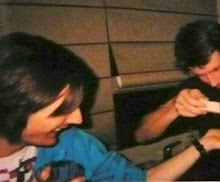
[The guy on the far left is me :D]


It's been a while since I last posted and although apologising for not posting more frequently smacks of disingenuousness (if you were really worried about it, you'd do something about it) I'm going to do so anyway. To anyone who cares, Sorry- but I've been busy writing my thesis.

Yes, that's right I'm actually up to the writing stage, despite the fact that I have 8 weeks and 3 days to go. Also I've just passed the rough 10,000 word mark which is pretty spiffy if I do say so myself, as it's a milestone on the way to completion and an order of magnitude larger than anything I've ever written on one subject before.

I would really like to share some parts of it with my readers, but I'm also aware that I maybe shouldn't, as potentially my final marker could end up reading it and getting the wrong impression. It will probably undergo some serious revision before it reaches its final incarnation.

Suffice to say, I've been writing about the games Guitar Hero, Audiosurf and Everyday Shooter which are all must-play games for people interested in what the future of music in videogames looks like. [Or could look like it everyone reads my thesis ;)]

So I'll leave it at that for a while and hope it satisfies the hunger of those desperately desiring an update on my work.

Cheerio!

Monday, 9 June 2008

An extract from my recent paper on VR and the 'first person perspective' videogame

I've been thinking about (and doing a bit of select reading of) the concept of 'New Games Journalism', which Kieron Gillen outlined in his 'New Games Journalism Manifesto'. The point that I thought was most important, was this:

New Games Journalism... argues that the worth of a videogame lies not in the game, but in the gamer. What a gamer feels and thinks as this alien construct takes over all their sensory inputs is what’s interesting here, not just the mechanics of how it got there...

This makes us Travel Journalists to Imaginary places. Our job is to describe what it’s like to visit a place that doesn’t exist outside of the gamer’s head...
The thing with travel journalism or reportage is that it’s interesting even if you have absolutely no inclination of going there.


The idea of dealing with the game and talking about it subjectively, as embodied, is extremely powerful, to my mind. And with this though, I wanted to share with my handful of readers, an extract from my own research discussion paper which will undoubtedly be somewhat adapted into a section of my thesis. I'll hopefully put the paper up in full in a few weeks, but until then, here's a little bit of my own attempt at injecting the aesthetic of 'New Games Journalism' into a bit of academic writing.

Any resemblance to Jim Rossignol's recent post on Rock, Paper, Shotgun from last week is purely coincidence. I started writing the paper only a few days before Jim wrote his and when he beat me to the punch, I was kinda miffed. But hey, it means I must be on the right track if someone as distinguished and insightful as Jim is talking about it.

________________________________________________________________

Oblivion, belonging loosely to the category of open world or sandbox type games, allows the player great freedom for exploration. At almost any point the player can leave the main narrative path and explore the world to discover and engage with its inhabitants, or simply venture into the countryside for its own sake. The game world stretches for many miles, across many different environments and is populated to varying degrees with ancient ruins and secluded settlements. The ability to go ‘off the beaten track’ is inscribed within the games rules, and is clearly accommodated for, even expected. For example, one of the many ‘skills’ that a play can employ within the game is Alchemy, which involves the brewing of potions from raw ingredients often gathered from the wild. At its most abstracted level, the game can be seen as rewarding players for exploring and discovering these useful reagents through the ability to brew useful, even potentially life saving potions. Somewhat humorously, the possibility is open to reading the game as encouraging the practice of stopping to smell the flowers.


A different aspect of the game that I wish to relate and demonstrate the power of procedural rhetoric is best told through my own subjective experience and reaction. At a point roughly 20 to 30 hours into the game, I found myself at a location called Cloud Ruler Temple high up in the Jerall Mountains. To the south of the temple is visible the towering spire at the heart of Imperial City, the largest city and one of the central places within which much of the game takes place. Behind the temple and to the north is a series of large, beautifully rendered snow covered mountains. There is no road leading up it and no perceptible reason to climb them. With no inclination towards advancing the plot and instead being possessed by a desire to explore the world, I began to enacting the role of ‘the explorer’ as classified in Richard Bartle’s taxonomy of MUD[1] game players[2]. Bartle describes four types of MUD players and their differing rationales for engaging with the game – in the case of the explorer, Bartle says

Players try to find out as much as they can about the virtual world. Although initially this means mapping its topology (i.e. exploring the MUD's breadth), later it advances to experimentation with its physics (i.e. exploring the MUD's depth).[3]


Knowing that my character possessed an exceptional level of the acrobatics skill, which directly modifies the height of a player’s jump, I attempted to climb the mountain through a combination of running and leaping. Thwarted by near vertical surfaces of snow and ice, I made my way across the face of the mountain (in my mind pretending that by rock climbing I was managing to traverse the similarly near-vertical cliff faces) to approach from the north, a much gentler gradient. At many points along the way I would get stuck, just below the crest of the mountain with the knowledge that it was just out of reach teasing me, making me want to get up there all the more. I would perhaps assert that this feeling in me was somewhat akin to that experienced by many serious mountain climbers who characterise their motivation for climbing mountains as doing so ‘just because it’s there’. Similarly, I wanted to climb to the peak of the Jerall Mountains because they were there; however, I also wanted to see what was on the other side.


When I finally did reach a section of the mountainside that permitted the kind of virtual ice climbing I was undertaking, I was rather excited. I had, after all, spent the last several minutes on the face of a mountain and had gone so far as to have crossed several sections of the map. The inability to reach the top so far had only made me more determined. I eventually reached what I believe to be the highest point in the game and the view was all the better for feeling as though I had actually accomplished something. Over the other side of the mountain ranges – and plainly within view of the massive draw distance[4] – was another set of mountain ranges, not snow covered like the ones I was standing on, but wooded and rolling and filled with possibility. Looking north-north-west, the woods continued on down to what appeared to be a large body of water, possibly a lake or the ocean (the ocean was certainly in that direction and reachable in other places) however there was one small barrier between me and those far away hills of promise, and it was a literal barrier. Upon reaching certain points of the world designated by the level designers as the ‘edge of the map’ and hence playable area, players encounter an impassable, invisible barrier and are told via onscreen lettering ‘You cannot go that way, turn back.’ I propose that, in effect, by not allowing the player to visit all the places one can see Oblivion, due in part to its emphasis on beautifully realistic visuals, heightens any feelings of wanderlust already present in the player, whether intentionally or not. The fact that the game intentionally sets itself up as a consistent world, as previously mentioned, and encourages exploration, only to so cruelly curb said exploration, is rhetorically strange, if not wilfully perverse.


[1] MUD stands for ‘Multi-User Dungeon’. These were generally text based online games, the precursors to modern ‘massively multiplayer online’ (MMO) games such as ‘World of Warcraft’ or ‘Everquest’. I am stretching his definition to include single player games that include large worlds much like MUD’s – such as Oblivion.

[2] Richard Bartle ‘Hearts, Clubs, Diamonds, Spades: Players Who Suit MUDs’ in Katie Salen and Eric Zimmerman, eds. The Game Design Reader: A Rules of Play Anthology, (Mass.: MIT Press, 2006), pp.754-786

[3] Ibid.

[4] Draw Distance is the technical term for how far the game engine renders the environment into the distance. The fact that the draw distance is so long is a bi-product of the games previously mentioned appropriation of FPS tropes such as technology pushing graphics.

Monday, 19 May 2008

Becoming Gamer; or "My last ever log out."

I hearthed to Shattrath, at the request of a very good friend of mine. She had something to show me, she said, and I had a good idea of what exactly that was. I had, after all, 'twinked' her with 1,000 gold a few weeks prior and, as it turned out, it was her snowy gryphon mount that she had purchased with my parting gift, that she wanted to share with me. I felt like a big brother to a little sister - I had never met her in the 'real 'world. She hugged me, made a *sniff emote and said with lots of exclamation marks that she'd miss me. I was going to miss her too.

Recently, after a particularly bad experience with an overly controlling and somewhat arrogant guild leader, I was left without a World of Warcraft guild that I called home. I wanted to 'progress' and to see (and beat) new content but finding a new raiding guild to start building relationships within was just not something I was prepared to do again. University was also starting to heat up, with an increasing amount of work having to go into assessment tasks and my major thesis, when my job, which that suited me and my study timetable perfectly, sadly dried up. Without a steady income, and having to still pay the bills (not many, but a few) I decided that, well, after a good run of a year and 6 months with the World of Warcaft, maybe it had become time to hang up the gauntlets and retire gracefully.

So I did. And it's probably one of the best things I could have done. Now, I'm not saying that wow is the devil or anything knee-jerkingly reactionist like that (although I *do* have some serious issues with some elements of it: the grind, only having one somewhat flawed model of guild leadership, etc, etc). But instead, much like Mr Brainy Gamer himself, Michael Abbott, said - it means that I can play other games again. I mean, in all honesty, how many people who play wow seriously do you think also play other games seriously and critically on a regular basis? I'd wager not many.

I make no secret of the fact that I want to work in the games industry. I am working towards that with my degree and with my thesis, and also, now, so with this. I can't just play WoW all the time and call myself a gamer. I honestly have no desire to work in any other field. I recognise that I probably will, but I hope that eventually I will be able to work for a living on what I am so most passionate about. My passion is for gaming, and that's really what this experience has been all about. I've left WoW and all of the amazing wonderful (and some horrible) people that I met on the Alliance side of the Dath'Remmar Oceanic Realm, and yeah, I'll miss them too. But I'm not a really a WoW-er. Not anymore. I'm a GAME-er.

Saturday, 15 March 2008

Project Update

HOLY HOLE IN THE GROUND, BATMAN! IT'S A VERBOSE UPDATE OF MY HONOURS PROJECT - POSSIBLY THE MOST IMPORTANT WORK ON VIDEOGAME MUSIC OF OUR TIMES! (Sorry Caps).

Follows:

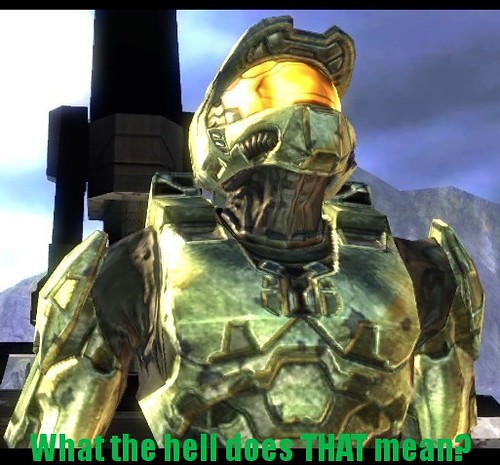
In my project I propose to examine the role that music plays in the genre of videogames known as First Person Shooters (FPS). Specifically I will examine in detail the score of the Xbox game Halo 2, published by Microsoft Game Studios, and the complex relationships with other elements of the game. The Halo series of games are the Videogame equivalent of the Hollywood Blockbuster – they have some of the highest production values of the current generation of games and spend more time under development than their filmic counterparts.


Videogame analysis and critique, being a burgeoning field, has been developing a vocabulary and methodology with which to approach Videogames and their methods of creating meaning and story. Most analyses and critiques can be placed in one of two camps; those that study a Videogames efforts at inscribing a narrative in a game, identified as ‘Narratology’, often drawing on methods of analysis for other media, such as films, literature and especially hypertext and new media. The alternative, calling their study of games as systems unrelated to story ‘Ludology’, is exactly that, to treat Videogames as systems and representations, examining the rules and laws that govern the simulation.


My analysis of Halo and the music of the series involves a number of key elements. I will apply traditional musical analysis techniques to the music of Halo 2, looking at the function played by musical devices such as ‘Leitmotif’, as well as examining the effect of style and genre connotations. I will also apply a method of analysis that quantifiably examines the music in terms of ‘what plays when’ and try to find some motivation as to ‘why’ it does so. I wish to also apply an examination of the evolution of the music across the series, including key musical motifs and pieces, and view it as not only a development of the composers ‘voice’ but also as a representation of the progression of the themes of the games.


In a non traditional vein, I wish to also attempt to identify important salient features of the relationship between the music and other non-musical aspects of the game. For example, I wish to analyse specific levels of the game by using concepts such as ‘level flow’, ‘progression’ and ‘optimal paths or strategies’, in an attempt to uncover meaningful relationships to the music. One tool I will use to do this is a world famous video recording of a ‘Speed Run’ in which the player, an American film student and Halo player, completes the game on the hardest difficulty setting (called ‘Legendary difficulty’) and never once dies, providing an insight into the importance of elements of the structure and layout of the levels, as well as combat techniques. The most reduced and implicit form of feedback that the player receives from the game is information about the player’s state; either the player is still alive and can continue on ‘progressing’ through the game to its conclusion, or the player is dead and must try again. This information reveals inarticulate or tacit aspects of the game that the designers intentionally and unintentionally included in the game, and which I believe are a vital aspect of the ‘meaning’ created by the game. The crux of the rationale for this approach is a belief that Halo 2 locates much of its created meaning (in a largely non-narrative sense) outside of traditional narrative structures and devices such as dialogue, narration and cinematic direction. In this way, I believe that I will see a parallel to meanings and ideas created by and revealed in the music.


I will also apply semi-filmic analyses, adapting concepts such as Mimesis and Diegesis, along with analyses of such things as the effects of geography, art direction and the Videogame equivalent of camera angles to specific levels and sections of the game. Throughout I will apply Ian Bogost’ theory of ‘unit operations’ as an approach to Videogame criticism, as well as his idea of ‘simulation fever’, especially in regards to the ideas of Mimesis and Diegesis in Videogames – whether videogames ‘tell’ the story to the player (Diegesis) or ‘show’ the story to the player by mimicking actions (Mimesis). To explain the relevance of this distinction, I quote Wikipedia’s entry on Diegesis:

When we come to a modern consideration of the cinema, it may appear that the medium is a straight-forward example of mimetic storytelling--but it is not. In terms of classical poetics, the cinema is an epic form that utilizes dramatic elements; this is determined by the technologies of the camera and editing. Even in a spatially and temporally continuous scene (mimicking the theatrical situation, as it were), the camera chooses where to look for us. In a similar way, editing causes us to jump from one place (and time sometimes) to another, whether it be somewhere else in the room, or across town. This jump is a form of narration; it is as if a narrator whispers to us: "meanwhile, on the other side of the forest".


By this definition it would seem at first glance that First Person Shooter games (and Halo in particular) are generally ‘Diegetic’ with only a short amount of ‘cut scenes’ at the beginning and end of levels determining what the player has to look at. However, if we consider Bogost’s notion of simulation fever, which says that, while we generally view simulations, and Halo could be considered as such, as ‘objective’ representations of what we are simulating, they are in actual fact necessarily ‘subjective’ by virtue of their nature as reductive. Even when a simulation renders every physical aspect of an environment or situation in detail, it still does not include such things as concepts of value, such as the value of human life, which Bogost says by referencing a military simulation of a sarin nerve gas cloud modelling simulation. While it arguable simulates accurately the progression of the gas on a University campus and how to evacuate quickest, it does not represent such things as who to prioritise for evacuation; the Nobel prize winning Professors or the students with years of possible contribution in their lives still left unrealised. In this way, by choosing what Halo includes and excludes in its ‘simulation’, Halo 2 could certainly be considered also Mimetic, and this seemingly contradictory state will be explored.


To sum up my project, I am looking at the music of Halo 2 and placing an emphasis on identifying other aspects of meaning creation in the non-musical elements of the game, applying current theories and concepts of videogame criticism as well as a number of adapted methods from other mediums. I wish to outline the relationships between the music and these other elements and hopefully persuade the reader that a Videogame about a super-human soldier in the future whose task it is to save the world is a work worthy of investigation and which locates its meaning and value in places non typical to media such as films and novels.


*******

Word! Did you read it all? If so, give yourself a pat on the back for getting through over 1,000 of the finest words on Teh Interwebs without exploding. Feel free to comment / flame / ignore this post.


Oh, and the thing about Heiddeger I mentioned last week? That's so last week. It's MIMESIS now.

- Ben.