Tuesday, 23 September 2008

Videogames will save the world!


And I don't mean that in a 'figurative sense' or as a playfully ironic commentary on the the over-abundance of superhero tropes and 'hero complex' tales. I mean it instead that I think videogames are teaching our kids and young adults to think through, what is to many older persons, potentially opaque and incomprehensible systems.

Let me explain.

I was watching the fantastic Michael Moore style documentary The Corporation. You've probably seen the promo's for it - it's the one where the film makers compare the corporation as a legal "person" to a psychopath. It makes sense, after all it has no conscience and it's main driving motivation is the bottom line.

One of the big things that I got out of the documentary was that whenever people saw through what was a patently exploitative system (as was the case in the Bolivian water riots and a number of other examples) people got up and did something about it.

Videogames, according to Ian Bogost, can speak to players through what he terms Procedural Rhetoric, and as games get more complicated and convoluted, gamers are only getting more and more used to the idea of procedures and systems. Gonzalo Frasca in his essay for The Videogame Theory Reader (which I have summarised elsewhere) likens simulation to the act of creating government legislation and I think he's quite right when he says that
"Video games imply an enormous paradigm shift for our culture because they represent the first complex simulational media for the masses".

Videogames can and are giving players the experiences necessary and the cognitive tools to be able to start to come to grips with large systems and procedures. In the film The Corporation, a company appearing 'socially responsible' becomes a market driven reaction to consumers being turned off by irresponsible plunderers of the environment. This is a product of the market, which in itself is a system. When more people are taught (by videogames) the ability to think through processes in general, it is my hope more people will start to take positive action and make themselves heard about a number of these inherently bad systems that have cropped up in society.

That's enough of my ranting. Go watch The Corporation on YouTube or DVD and get excited about the prospect of a gamer revolution! Viva La Gamer!

Monday, 15 September 2008

The 'Affect' Discussion


What affect does a videogame have on a player? A watcher? What about on wider society? These questions have yet to be satisfactorily answered, with critics lambasting games for being so-called 'murder simulators', much to the horror of gaming advocates, while the same advocates say that videogames are an emerging art form. The problem with this position is that Art does affect - and should affect. Are videogame advocates trying to have their cake and eat it too?

I'm definitely on the affirmitive side of the 'Art'/'Not-Art' divide - I think games are (if not in nature, certainly in content) quite like Films, Books, Television and other media. And I don't think that Grand Theft Auto is a 'murder simulator', but what affect is it really having on the players?


A good friend of mine, a second year psychology student who writes the blog Lexje's Insights, brought up the issue of videogame affect, particularly in regard to frustration and anger generated by games.


A game could be relaxing as it is a recreation etc... But also (especially as i have witnessed a lot of Halo Tantrums) people can get really stressed and angry about what they are playing. One relaxed the other stressed out; the same thing could have 2 different effects on people. Someone probably needs to create some kind of gaming perception scale.


I thought this idea of a 'perception scale' was interesting enough to warrant sharing with my readers. So, putting it out there - what do you think? Should games be ranked according to frustration generated in the player? Can games even be labelled in this way? Should perhaps we be categorising the players (ourselves) somewhere between 'easily frustrated' and 'cool calm and collected, instead?


I'll be the first to admit that a lot of what we get out of media like games and film is a reflection of what's already inside of us - like holding up a mirror to aspects of ourselves - but I also believe there's undoubtedly a part played by the media itself.


Extra Credit: Watch this video of a kid getting upset while playing Halo (Note: This video skirts the cruel/funny line at certain points, but it also illustrates a point about how affecting videogames can be.)

Wednesday, 10 September 2008

The peaks and perils of First Person Camera


Corvus Elrod and I have been going back and forth over twitter this week about camera's and camera choice in games, and he's written up a series of posts about 3rd person camera (yesterday) as well as 1st person view. And its gotten me thinking about first person perspective games a lot (mostly because they are the kind of game I tend to gravitate towards) and in particular why I think Assassins Creed was actually better for being rendered in third person and conversely why I think Mirrors Edge, while commendable for trying a whole slew of new ideas and daring to be different just generally, is possibly doomed to have some serious problems.

The essential point is the difference in camera angle - where Assassins Creed generally uses a 3rd person over the head view to depict Altair scrambling up the side of buildings, Mirrors Edge uses First Person perspective. So what's great about the first person perspective? Primarily, with a First Person Perspective you get a strong and direct connection with 'you' as the player inside the game. You're are looking out your own characters eyes, after all, and in my opinion this view (with certain caveats) seems natural and instantly relatable; it's closer to the 'normal' way that we view the world from our bodies. Additionally, it allows for very precise actions, most commonly used for aiming weapons such as guns, bows and other projectiles.

Unfortunately there are equally a number of negative aspects with the first person perspective game and which for the sake of brevity I will not attempt to list. However, one aspect I want to foreground in this discussion is highlighted once we start aiming for rather more complex control relationships with our player avatar and ourselves.

Basically I see the issue as one of embodiment in the game-space. As I hinted at in Corvus' original post I don't think that anyone has yet made a first person perspective game where the 'camera' - your embodied view of the world - is anywhere near as flexible as our real world bodily configuration.

We have a pair of eyes that move independently of our heads, and on top of that our heads can also move independently of our torso. The whole history to date of the First Person Perspective game (to the best of my knowledge) has been limited to an avatar that moves his or her eyes, head and torso as one. And this is actually fine... for certain things. It's fine particularly for (surprise, surprise) shooting games as when you aim down the sights of a real-world weapon, you don't move your head or even your eyes far from the target.

Additionally the first person perspective can only give the player so much information about their surroundings. For starters, our display screens for videogames are woefully too small to represent the whole field of vision of the average person, and as such, first person representations of games are going to lose information that the player would have in an identical real-world situation.

Take for example, your feet. Do you have to look down at your feet to know where they are? Of course not. So when Halo makes the player aim down at their feet we just know that some information about the environment is being lost. And you know, this is also fine. As Corvus says, many videogame protagonists are supposedly wearing bulky, vision impairing helmets after all. Except that when playing a game we also lose two (well three if you count taste) other senses that could be delivering information as well! We don't get to feel the world - the cool brush of a breeze on our skin or the crunch of gravel under our feet - or smell the scents in a space. So all this information which we would in reality be receiving about our surroundings, whether consciously or not, is further lost.

I was reading recently the Game Set Watch Column 'Diamond in the Rough - A body in the dark' about the healing system in the most recent Alone in the Dark. The article rightly discusses some of the innovative features of the game and how it encourages embodiment in the game-space, however when I came to this passage I had to stop, suppressing the urge to guffaw.
The effect of all of this is to ground you in the body of your protagonist. You must constantly check yourself for new cuts or bruises, sometimes eliciting a tired shrug from Edward when a visual check reveals no new blemishes.


Okay, am I the only person to think that having to visually check your body for cuts and bruises is actually dis-engaging you from your body? Since when have you ever had to stop and look yourself over only to realise that actually "Oh, I'm bleeding from the stomach".

Yes, granted there have been some times when I have experienced an adrenaline rush that has suppressed the pain of small injuries, and I have heard of people 'shrugging off' larger injuries as well, but if you've got the time to 'look yourself over' you've got the time to take a breather and start feeling the pain!

So, all this gets me to the point of saying, for all the benefits the FPS brings with it's embodied perspective, it comes with a bunch of detractors. And that's why I think Assassins Creed went the right way with 3rd person parkour action. I believe that the use of the third person perspective can partially make up for what we lose in the form of experienced, embodied information about the world.

Just one last quick quote - this time from Clint Hocking of Far Cry 2 talking about their own implementation of specific areas and even types of injury, Hocking responded saying

...a contextual animation [plays] based on the type of injury you received and the location of the injury. If you fell from a cliff, you might have a dislocated ankle that needs to be relocated. If you were shot in the leg, you might need to prise the bullet out with a knife, if you were hit by a grenade blast you might need to pull shrapnel our of your elbow… the idea is to hit the player with a visceral ‘punch’ right at the moment that the intensity is highest and his adrenalin is pumping. The combined effect is to create powerful psychosomatic bonds between the player, the avatar and consequently the world itself.


I think Hocking's got the right idea - whether it's first, third or some odd combination of the two (think Oblivion style interchanging) the aim has to be to convey enough information to the player and about the player so as to aid a sense of embodiment, which only aids in the never-ending quest for 'immersion'. If that's the goal (and the actually result) then I don't really mind which one they choose. Maybe I could even learn to love Mirrors Edge (God knows I really want to!).

Wednesday, 3 September 2008

What speaks to me the most


In Mitch Krpata's Taxonomy of Gamers I'm dead-set a Tourist. Indeed before Mr. Krpata's series there was Richard A. Bartles 'HEARTS, CLUBS, DIAMONDS, SPADES: PLAYERS WHO SUIT MUDS' which I think extends to offline games remarkably well also,and in which I am similarly an 'Explorer' type player. The point that I want to make is that when I'm being a tourist, I prefer to do so from a First Person Perspective.

Corvus Elrod posted a few weeks back a small, almost throw-away, theory that personality type might have an influence on what perspective videogame players prefer to play in, whether First or Third. He asked for a quick poll in the comments and it seemed to me to be a little bit inconclusive, but I think that he's probably actually onto something.

The issue seems to me to be 'what flavour do you like your story'? All story driven videogames in recent memory that have captivated me have (primarily) told the meat of their story through story and plot that I experience in the game from the first person perspective. I'm experiencing it as the character. Now, I don't want to pretend that this could become some kind of hard and fast rule - after all I have also previously passionately enjoyed third person games like The Baldur's Gate series, and even many FPS games like Halo use 3rd person cut-scenes for certain sections of exposition.

Still, if you know me and have been paying attention to my thesis updates, etc, you'll know my shtick is all about what things are unique about videogames, and that we should be trying our best to capitalise on them. It's just what gets me excited about the medium - the idea of the new and things that have genuinely not been tried.

So I'm now wondering why more games haven't gone the route of the Half-Life's and the Call of Duty's. Both games tell their story exclusively (with very few exceptions) through first person experiences. Obviously I don't want to advocate that all videogames should ever do is tell a story in First Person Perspective, but it does seem like the industry hasn't really pushed the envelope very far past the previously mentioned examples. When can I expect the FPS equivalent of, Apocalypse Now (I'm talking about in terms of mood, atmosphere and focus on the psychological experience rather than the setting - Vietnam has been almost been done to death as much as WWII)? Casablanca? Doctor Zhivago?

The obvious point is that FPS games like those great films would be impossible, granted. After all, there's really very little shooting in them - but that's actually OK with me. I'm a tourist after all - I've climbed the highest peaks in Oblivion before just to see it, not because it had any intrinsic reward. I don't think I'm alone in this, there is definitely space in the videogame market for more tourist appealing games.

So, on that note, I've been talking to Corvus about the issue of perspective and personality type and he's suggested we set up a more comprehensive poll and aim for a bigger survey of people - if anything comes of it, I'll let you know.

Sunday, 24 August 2008

Videogames and Digital Musicians


Before I proceed, I must confess that this is stepping on the toes of my thesis a tiny bit – but I think anything I’d write at this stage probably would anyway. Maybe bits of this will find their way into the thesis anyway, so that’ll make it worthwhile.


I’ve been meaning to write this blog post for night on three months now. Obviously I’ve been busy writing other things (I just completed a first draft for my thesis - quite an accomplishment in itself) but now that I’m taking a couple days to catch my breath I wanted to jot down some thoughts I've had which also might incidentally help explain how and/or why I, a Bachelor of Music student, came to be writing a thesis on music in videogames. Because there is a connection.


My major was ‘digital music’ a kind of catch-all subject for anything music related that was technical (nyquist frequency anyone?) or that used a computer. Suffice to say that I love the subject. I hadn’t actually realised until recently but most of my listening habits have arisen from the desire to find people making the kind of music that I felt that I could make. Primarily that is computer and effects based music, with artists like The Knife, Röyksopp, and Junior Boys inspiring me with their synth-tones and crisp TR-808 samples. Anyway, one of the bigger parts of the 'Digital Musics' subject stream was live electronic music performance and it's here that I want to make an observation – videogame designers could stand to learn a lot by looking at live electronic musicians.


Artists like those that perform at the NIME (New Interfaces for Musical Expression) Conference every year, not least of all my own honours supervisor, the brilliant Dr. Garth Paine, have been making interesting and engaging live music with computers for decades. And a central concern in these performances is often keeping the audience engaged and the performer looking like they’re doing more than just checking email. They accomplish this mainly through interesting and engaging performance interfaces like wacom tablets and by connecting swathes of transducers (anything that takes a real world input and converts it to an electronic signal) to their bodies.


So what the heck does that have to do with videogame music? Well as hardware gets more and more powerful, I believe, we are going to see more and more music generated ‘on the fly’ in videogames, and when we do, videogame developers would do extremely well to pay attention to those musicians that have already experimented with making music on the go to glean what they can; what works, what doesn’t, how to keep an audience engaged, and (most importantly for this discussion) how to meaningfully connect audio to visuals.


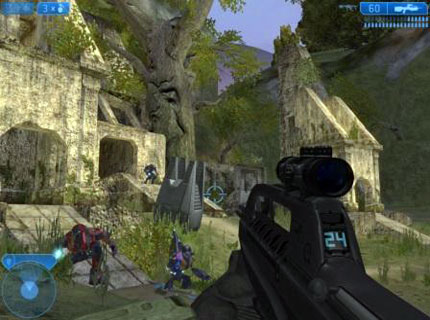
Significantly, videogames don’t have to worry about keeping an audience visually entertained – the games visuals should have that aspect covered. However, what if the videogame’s visuals much like the electronic musicians visual performance gestures were similarly connected? Can you see the potential? This is getting at the heart of what my thesis is about, so I don’t want to give it all away, but I am incredibly excited by the potential for music in games to be generated by game elements on a level that goes beyond those like what Tommy Tallarico recently depicted. In an interview with Tom Kim on the Gamasutra podcast he described the process of implementing music in videogames, saying:


You have to let them [the music programmers] know that you want this version to play when there are a hundred guys on horseback and this other version when there's only one.[1]

Seriously guys (and most composers are guys, by the way - an issues that’s also planned for the thesis), we’ve had the processing power of multi-core CPU’s since the start of this generation of videogame consoles and multiple gigabytes of RAM, but the very best we can come up with is “play this song now, and this other one later”? Because that’s essentially what it boils down to. Composer for games Phil Richard Jacques said in an interview on Gamasutra about his own ‘interactive’ scores that


the way I want to do [music] interactively is have a musical transition, or rise or whatever that sounds very musical... rather than hard-cutting two tracks, because I think it can be done better than that.[2]

Okay that’s great, but what about doing something a bit more than that? With all due respect to Mr Jacques, I think the scope for ‘interactivity’ is just a little bit broader than just making transitions sound smooth. He goes on to say later in the interview that the original Outrun game from way back in the 80’s, in a move that seems to pre-empt current videogame musical interactivity, had a faux interactive score in the sense that the music was composed so that roughly around the time that a player reached branching sections at the end of a track the song would change signifying this.


It was actually composed so the music would change where an average player would do the branching at the end.

I mean, it wasn't interactive, but they timed the music so that when you went down the end of one course and you branched into the next course, the music would go into a different chorus or something like that.[3]

So if Outrun twenty-odd years ago could do music that in a way reflected what was happening on screen (in it’s own pre-determined and constricted way) and affected the change in music on a structural level within the song – please explain how the best we can do today is make pleasant transitions between tracks?


My answer? I’ll have it for you in writing in, oh, say seven weeks. Actually, add a little bit longer to that for it to be marked as I don’t think they’d appreciate me putting it out there before the markers had a chance to read it. But I think I will have some answers. Also if any of the composers I mentioned end up reading this (hey it happened over on Cruise Elroy!) I’d love to hear their thoughts on the issue – although I have a sneaking suspicion I know what they’d say.


[1] “Video Game Music Strikes a Bigger Chord,” http://www.businessweek.com/globalbiz/content/jul2008/gb2008078_807637.htm

[2] “Gamasutra - Staying In Tune: Richard Jacques On Game Music's Past, Present, And Future,” http://www.gamasutra.com/view/feature/3695/staying_in_tune_richard_jacques_.php

[3] Ibid.

Thursday, 14 August 2008

Thesis Update

[The guy on the far left is me :D]


It's been a while since I last posted and although apologising for not posting more frequently smacks of disingenuousness (if you were really worried about it, you'd do something about it) I'm going to do so anyway. To anyone who cares, Sorry- but I've been busy writing my thesis.

Yes, that's right I'm actually up to the writing stage, despite the fact that I have 8 weeks and 3 days to go. Also I've just passed the rough 10,000 word mark which is pretty spiffy if I do say so myself, as it's a milestone on the way to completion and an order of magnitude larger than anything I've ever written on one subject before.

I would really like to share some parts of it with my readers, but I'm also aware that I maybe shouldn't, as potentially my final marker could end up reading it and getting the wrong impression. It will probably undergo some serious revision before it reaches its final incarnation.

Suffice to say, I've been writing about the games Guitar Hero, Audiosurf and Everyday Shooter which are all must-play games for people interested in what the future of music in videogames looks like. [Or could look like it everyone reads my thesis ;)]

So I'll leave it at that for a while and hope it satisfies the hunger of those desperately desiring an update on my work.

Cheerio!

Monday, 4 August 2008

Kountry Gentleman


This song has been in my head for the better part of four days and I just can't seem to get it out.

Maybe sharing it with you will help get it out. Pity about the compressed quality of the sound, oh well, that's YouTube for ya.

And if you didn't like that one, this one is possibly even better.


Too much? Naw...