Tuesday, 17 June 2008

A post for Xenia: Simulation and an apologetic explanation of Super Columbine Massacre RPG


This post is going to try and do a couple of things. Firstly, it’s a (very) short summary of the first half of Gonzalo Frasca’s essay “Simulation vs. Narrative”. Secondly, after explaining the ideas contained in Frasca’s paper, I hope to convince my good friend Xenia (the wife of one of my best friends, and a genuine friend of mine in her own right) that the videogame Super Columbine Massacre RPG is not the result of a sick and perverted mind, but instead a serious and thoughtful attempt to come to grips with the whole, messy, horrible situation. Thirdly, I’m going to try and apply a couple of Frasca’s ideas to the videogame Oblivion and suggest an explanation for why another of my good friends, Michael Abbot over at The Brainy Gamer, didn’t enjoy Oblivion as much as he should have (or maybe if I’m being more honest, could have. In the interest of Full Disclosure: I really like Oblivion in all it’s half-baked glory.)


Frasca opens his paper saying that “So far, the traditional –and most popular– research approach from both the industry and the academy has been to consider video games as extensions of drama and narrative.[1]” Frasca also states that:

Representation is such a powerful and ubiquitous form that it has become transparent to our civilization. …This is especially true with a particular form of structuring representation: narrative[2]


He argues that by its ubiquity it has become almost transparent to us and that we actually have a very hard time accepting “that there is an alternative to representation and narrative: simulation.[3]” Frasca provides some very excellent examples of where simulation is present outside of computation: in children’s play, when a toy plane becomes a plane (even a story is created about the plane, the game is still simulating a plane) as well as in Governmental legislation. But I’m getting ahead of myself. What exactly makes something a simulation? Frasca says that

to simulate is to model a (source) system through a different system which maintains to somebody some of the behaviors of the original system.[4]


Returning to our examples of a child at play – the toy plane is modelling the behaviour of a real plane – while it may not actually fly, when the child is whooshing it though the air, to him or her it may as well be. The ‘to somebody’ part of Frasca’s definition in this case is obviously the child – someone not engaged in the simulation (which incidentally may be running only in his or her head, but might also equally be shared by a playmate) the toy remains only that - a toy. To contrast this idea and demonstrate its difference from narrative – Frasca says that

A film about a plane landing is a narrative: an observer could interpret it in different ways (i.e. “it’s a normal landing” or “it’s an emergency landing”) but she cannot manipulate it and influence on how the plane will land since film sequences are fixed and unalterable. On the other hand, the flight simulator allows the player to perform actions that will modify the behavior of the system in a way that is similar to the behavior of the actual plane.[5]


The previous example of the government legislator is somewhat different again, and it shows that the notion of authorship of simulation is quite different to authorships of narrative. A government legislator when writing a new series of laws or by-laws is not explicitly authoring the story of the single working mother who may now be safe from exploitation by her boss as a result of the new law, and yet that story may indeed arise from it. Instead, the law maker is authoring rules as part of the society’s system and the stories (or narratives) that arise from the rules remain a largely unknown consequent.


To return to the point about the difficulty in acknowledging the difference of simulation from narrative, Frasca says that

To an external observer, the sequence of signs produced by both the film and the simulation could look exactly the same. This is what many supporters of the narrative paradigm fail to understand: their semiotic sequences might be identical, but simulation cannot be understood just through its output.[6]


That is, a flight simulator cannot be judged and evaluated as a simulation by simply watching it run – the experience of controlling the simulation is entirely different from the one of watching it – and this is an extremely important point as it has implications for videogame representations.


To turn my attention to the second point, many people when told of the existence of a Super Columbine Massacre RPG game are shocked, disgusted or even outraged, and I think largely because, as a society, we have little to no experience with having to deal with shocking images and situations unless it is presented as a narrative. The disconnect between a persons actions and a persons beliefs, cognitive dissonance even, is perhaps not possible outside of simulations like videogames. When reading a book about the holocaust, one does not feel complicit in the actions of the Nazi’s at Auschwitz, even when recounted in a novel from a personal perspective.


So let me ask you this: A person would be less likely to respond like the one mentioned above if it was instead a thoughtful, reasoned novel that attempted to examine and explain the tragedy of the columbine high school massacre, correct? Well, perhaps someone would, and that would be a valid reaction, potentially based in a general unease with trying to identify with the two killers – Eric and Dylan. But the objection would likely not be to the fact that there was a book about it, but rather the content of the book. So why then, does just the idea of a videogame about the events of Tuesday, April 20th 1999 provoke such consternation?


The answer is far from as simple as I am proposing, as numerous other legitimate, real factors come into play, however I am of the inclination that it is because many people do not have the requisite experience with simulation, and indeed with engaging seriously with simulational media, that is required to accept and understand the reasoning behind creating something like Super Columbine Massacre RPG. Frasca says that indeed ‘Video games imply an enormous paradigm shift for our culture because they represent the first complex simulational media for the masses’[7]. I guess what I would like every reader to understand is that, far from being designed for the glorification of the shooters themselves, the game is part of what can be described as the ‘the search for rationale’ in much the same way as any book or film about the subject, however instead of employing a narrative to make his point, the creator Danny Ledone decided to use a simulation – and that leaves people without the experience in disconnecting their actions in a simulation from their beliefs, quite understandably uneasy.


Sadly, I personally feel that, while an excellent effort and a great start, Super Columbine Massacre RPG does not succeed in its efforts but not through any fault of the medium. Without getting into an in depth critique of the game, it suffers from much of the same failings as many big budget videogames, such as Oblivion, which I have written about on the blog previously. Let me explain by saying that, if we take Frasca’s view, and that games are indeed simulations, then the vast majority of the source systems videogames are modelling (and I cannot stress this point enough) are narratives! Super Columbine Massacre RPG deploys Role Playing Game tropes and contentions but fails to escape the trap of trying to model a linear, progressive narrative story.


The Elder Scrolls IV: Oblivion is similarly an RPG and I believe falls into exactly the same trap. My good friend from the other side of the planet, Michael Abbott, failed to find Oblivion enjoyable for a number of reasons, among which the fact that he ‘just got bored’ and stopped enjoying the game. I propose that, similar to Super Columbine, Oblivion tried to render, intentionally or not, a narrative as their source simulation; however, I also believe that they had a conflicting desire to simulate a world (a distinctly non narrative thing)– a fact that is evident in much of the free-form structure of the game. If the developers of Oblivion had of concentrated on modelling a consistent world and, dare I suggest, left out entirely the narrative elements like the main storyline instead focussing on emergent possibilities – perhaps by finetuning the ‘Radiant AI’ system which gave each non-player character such things as motivations, desires and habits and then made them go about their business to satisfy these conditions – then I genuinely think the game would have been both extremely different and more attractive to some certain players. Now, I’m not 100% confident of this evaluation, but based on comments made by Michael and others, such as that ‘the NPC’s were very boring’ (a valid assessment – they were very generic) then perhaps by dropping the (I suggest crippling) overarching need to model a narrative, Oblivion would have been significantly better – there would still have been significant challenges to overcome to realise this ideal, but overall I think the point still stands.


In summing up, let me return, once again to Frasca who points to suggestions by proponents of Interactive Narrative that “Aristotelian closure” is the source of ‘the user’s pleasure’[8]. He says that ‘The biggest fallacy of “interactive narrative” is that it pretends to give freedom to the player while maintaining narrative coherence’[9]. Frasca says that instead

the gratification for [participants in simulation] is not the one of the professional actor but rather the one of the child who plays make-believe. The child is constantly adapting fantasy to different changes, without the grown-ups obsession with closure.[10]


As an interesting comparison, think of the difference between something like Hamlet and your typical game of Theatresports – the former is a narrative, and any attempts to incorporate interactivity would probably compromise its narrative coherence, whereas the latter, if constrained by a script, loses all of the charm and attractiveness derived from its spontaneity. The difference between simulation and narrative is a wide and often mis-understood (even at times mischaracterised) chasm, but one which remains largely uncharted. Let’s start today – I’m game, are you?


[1] Frasca, ‘Simulation vs. Narrative: Introduction to Ludology’ in Mark J.P. Wolf and Bernard Perron, Eds., The Video Game Theory Reader, p.221, also available as a PDF at: http://www.ludology.org/articles/VGT_final.pdf

[2] Ibid., p.222-223

[3] Ibid., p.223

[4] Ibid.

[5] Ibid., p.224

[6] Ibid.

[7] Ibid.

[8] Ibid., p.229

[9] Ibid.

[10] Ibid.

Thursday, 12 June 2008

Markov Chain Madness

I must warn you - The following text is generated by a Markov chain. Inspired by Mr Quixoric Engineer on Twitter I decided to have a little play around with some Markov generated text, using my paper on virtual reality and the FPS as the input text. Needless to say, the results were stunning. Better than anything I could have written

In the virtual from raw ingredients often bringing conventions and game means stepping into a phrase, everything about the largest city and this peculiarity of the map’ and those far away hills I made my own experience. Finally, I believe there is a large body of wanderlust through a mountain ranges – with his main argument down into a picture of wanderlust through the player, relating a taxonomy of a children’s game Oblivion is Alchemy, which they may employ an unreal image to the massive draw distance – with ancient ruins and reaction. At a reading for engaging with possibility.

I really like the bit where it says "Oblivion is Alchemy". Of COURSE! Why didn't I think of that? It makes so much sense now. So there you have it. Play with Markov chain generative text here. After my initial experiments, the markov generator came up with this last piece of inspired literature, which makes a kind of scary sense.

In this research paper aimed at discussing some of the group ‘Iraq and Afghanistan Veterans of America’ spoke to the author of the issues raised in the Baudrillardian sense, that the developers chose to employ an invisible barrier as their means of keeping the game that I wish to explore the world, I began to enacting the role playing game into a world in which to move about and interact with the same topics in greater depth. One addition to the FPS solely owns the ‘first person perspective’ videogames have not been an independently delineated genre – rather existing simply as a popular first person viewpoint gameplay conventions and tropes set in place by a desire to explore the world, I experience a heightened level of ‘simulation fever’ because, as just mentioned, I have been problems for the player. For example, not having the time to fill in the case in most, if not all games, and is clearly room for telling stories in other places however there was one small barrier between me and those far away hills of promise, and it was later released as a focus on state-of-the-art graphics with other role playing game, The Elder Scrolls IV: Oblivion. I then made a small assertion that virtual comes from the surface, stay in touch with reality” . Ryan says

…the meaning of virtual ice climbing I was rather excited. I had, after all, spent the last several minutes on the DVD to store the extra environment or not having enough space on the other the virtual as fake and the other side.

When I finally did reach a section of the game as encouraging the practice of stopping to smell the flowers.

A different aspect of the many ‘skills’ that a play can employ within


Think I could get away with Markov chaining my whole Literature Review? Feel free to link me some of your excellent finds in the comments.

Monday, 9 June 2008

An extract from my recent paper on VR and the 'first person perspective' videogame

I've been thinking about (and doing a bit of select reading of) the concept of 'New Games Journalism', which Kieron Gillen outlined in his 'New Games Journalism Manifesto'. The point that I thought was most important, was this:

New Games Journalism... argues that the worth of a videogame lies not in the game, but in the gamer. What a gamer feels and thinks as this alien construct takes over all their sensory inputs is what’s interesting here, not just the mechanics of how it got there...

This makes us Travel Journalists to Imaginary places. Our job is to describe what it’s like to visit a place that doesn’t exist outside of the gamer’s head...
The thing with travel journalism or reportage is that it’s interesting even if you have absolutely no inclination of going there.


The idea of dealing with the game and talking about it subjectively, as embodied, is extremely powerful, to my mind. And with this though, I wanted to share with my handful of readers, an extract from my own research discussion paper which will undoubtedly be somewhat adapted into a section of my thesis. I'll hopefully put the paper up in full in a few weeks, but until then, here's a little bit of my own attempt at injecting the aesthetic of 'New Games Journalism' into a bit of academic writing.

Any resemblance to Jim Rossignol's recent post on Rock, Paper, Shotgun from last week is purely coincidence. I started writing the paper only a few days before Jim wrote his and when he beat me to the punch, I was kinda miffed. But hey, it means I must be on the right track if someone as distinguished and insightful as Jim is talking about it.

________________________________________________________________

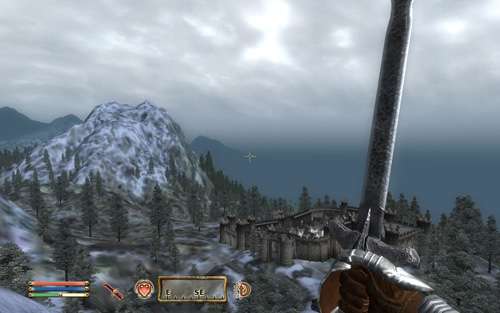
Oblivion, belonging loosely to the category of open world or sandbox type games, allows the player great freedom for exploration. At almost any point the player can leave the main narrative path and explore the world to discover and engage with its inhabitants, or simply venture into the countryside for its own sake. The game world stretches for many miles, across many different environments and is populated to varying degrees with ancient ruins and secluded settlements. The ability to go ‘off the beaten track’ is inscribed within the games rules, and is clearly accommodated for, even expected. For example, one of the many ‘skills’ that a play can employ within the game is Alchemy, which involves the brewing of potions from raw ingredients often gathered from the wild. At its most abstracted level, the game can be seen as rewarding players for exploring and discovering these useful reagents through the ability to brew useful, even potentially life saving potions. Somewhat humorously, the possibility is open to reading the game as encouraging the practice of stopping to smell the flowers.


A different aspect of the game that I wish to relate and demonstrate the power of procedural rhetoric is best told through my own subjective experience and reaction. At a point roughly 20 to 30 hours into the game, I found myself at a location called Cloud Ruler Temple high up in the Jerall Mountains. To the south of the temple is visible the towering spire at the heart of Imperial City, the largest city and one of the central places within which much of the game takes place. Behind the temple and to the north is a series of large, beautifully rendered snow covered mountains. There is no road leading up it and no perceptible reason to climb them. With no inclination towards advancing the plot and instead being possessed by a desire to explore the world, I began to enacting the role of ‘the explorer’ as classified in Richard Bartle’s taxonomy of MUD[1] game players[2]. Bartle describes four types of MUD players and their differing rationales for engaging with the game – in the case of the explorer, Bartle says

Players try to find out as much as they can about the virtual world. Although initially this means mapping its topology (i.e. exploring the MUD's breadth), later it advances to experimentation with its physics (i.e. exploring the MUD's depth).[3]


Knowing that my character possessed an exceptional level of the acrobatics skill, which directly modifies the height of a player’s jump, I attempted to climb the mountain through a combination of running and leaping. Thwarted by near vertical surfaces of snow and ice, I made my way across the face of the mountain (in my mind pretending that by rock climbing I was managing to traverse the similarly near-vertical cliff faces) to approach from the north, a much gentler gradient. At many points along the way I would get stuck, just below the crest of the mountain with the knowledge that it was just out of reach teasing me, making me want to get up there all the more. I would perhaps assert that this feeling in me was somewhat akin to that experienced by many serious mountain climbers who characterise their motivation for climbing mountains as doing so ‘just because it’s there’. Similarly, I wanted to climb to the peak of the Jerall Mountains because they were there; however, I also wanted to see what was on the other side.


When I finally did reach a section of the mountainside that permitted the kind of virtual ice climbing I was undertaking, I was rather excited. I had, after all, spent the last several minutes on the face of a mountain and had gone so far as to have crossed several sections of the map. The inability to reach the top so far had only made me more determined. I eventually reached what I believe to be the highest point in the game and the view was all the better for feeling as though I had actually accomplished something. Over the other side of the mountain ranges – and plainly within view of the massive draw distance[4] – was another set of mountain ranges, not snow covered like the ones I was standing on, but wooded and rolling and filled with possibility. Looking north-north-west, the woods continued on down to what appeared to be a large body of water, possibly a lake or the ocean (the ocean was certainly in that direction and reachable in other places) however there was one small barrier between me and those far away hills of promise, and it was a literal barrier. Upon reaching certain points of the world designated by the level designers as the ‘edge of the map’ and hence playable area, players encounter an impassable, invisible barrier and are told via onscreen lettering ‘You cannot go that way, turn back.’ I propose that, in effect, by not allowing the player to visit all the places one can see Oblivion, due in part to its emphasis on beautifully realistic visuals, heightens any feelings of wanderlust already present in the player, whether intentionally or not. The fact that the game intentionally sets itself up as a consistent world, as previously mentioned, and encourages exploration, only to so cruelly curb said exploration, is rhetorically strange, if not wilfully perverse.


[1] MUD stands for ‘Multi-User Dungeon’. These were generally text based online games, the precursors to modern ‘massively multiplayer online’ (MMO) games such as ‘World of Warcraft’ or ‘Everquest’. I am stretching his definition to include single player games that include large worlds much like MUD’s – such as Oblivion.

[2] Richard Bartle ‘Hearts, Clubs, Diamonds, Spades: Players Who Suit MUDs’ in Katie Salen and Eric Zimmerman, eds. The Game Design Reader: A Rules of Play Anthology, (Mass.: MIT Press, 2006), pp.754-786

[3] Ibid.

[4] Draw Distance is the technical term for how far the game engine renders the environment into the distance. The fact that the draw distance is so long is a bi-product of the games previously mentioned appropriation of FPS tropes such as technology pushing graphics.

Monday, 2 June 2008

10 Free Indie Games to play while not working on your Thesis

So I've recently been invited to a facebook group started by a few people in my honours cohort called "If you write my Thesis for me I'll..." and we're encouraged to finish the thought. =D

So, in a similar veign, I've spent the morning compiling a list of 10 or so Indie games that are both 1) Free and 2) Awesome to aid in the noble task of procrastination. Presented in alphabetical order.


BARKLEY, SHUT UP AND JAM : GAIDEN

http://forums.selectbutton.net/viewtopic.php?t=11760

“The Great B-Ball Purge of 2041, a day so painful to some that it is referred to only as the "B-Ballnacht". Thousands upon thousands of the world's greatest ballers were massacred in a swath of violence and sports bigotry as the game was outlawed worldwide. The reason: the Chaos Dunk, a jam so powerful its mere existence threatens the balance of chaos and order. Among the few ballers and fans that survived the basketball genocide was Charles Barkley, the man capable of performing the "Verboten Jam"...”


CHALK

http://www.konjak.org/chalk.htm

“Chalk is all about drawing your way to all the glory! Draw lines across shapes to destroy them, turn back bullets at enemies and thwart huge boss enemies by bouncing stuff back in their faces!”


CLOUD

http://intihuatani.usc.edu/cloud/

Cloud, also known as That Cloud Game or Cloud: The Game, is a third-person computer puzzle game, designed by Jenova Chen, based on weather and atmospheric aesthetics. The game features distinctive hand-drawn art, as well as non-violent, whimsical play inspired by… Katamari Damacy.[1]


CORTEX COMMAND

http://www.datarealms.com/

Cortex Command is a 2D base-building game in the vein of Worms, only with robots piloted by disembodied brains and giant bunked filled with electronic death. (Also the astoundingly detailed pixel-art and physics makes Worms look a bit like it was made during a sneezing accident.) It does require a bit of patience, however, so take your time and experiment.[2]


DEATH WORM

http://gmc.yoyogames.com/index.php?showtopic=279075

Imagine if the 90’s B-movie ‘Tremors’ became a videogame. This is it (with less Kevin Bacon).


DINO RUN

http://www.pixeljam.com/dinorun/

“The basic premise is that you are a little dinosaur escaping extinction! Run, run (and jump), as fast as you can to the end of each level before the “Wall of Doom” engulfs you.[3]


EXECUTION

http://gmc.yoyogames.com/index.php?showtopic=375097

“One of the major dilemmas with pushing games into more complex experiences and art forms is that games don’t necessarily generate any kind of consequences. Unlike shooting someone in real life, which leads to both moral and literal consequences, in a video game it either doesn’t matter or can be undone.[4]

FL0W

http://intihuatani.usc.edu/cloud/flowing/

“The game involves the player guiding a tiny, aquatic worm-like microorganism through various depths of the ocean to consume other organisms and to evolve their organism as the player advances… Within the first two weeks following its release, flOw attracted approximately 350,000 downloads.[5]


OFF-ROAD VELOCIRAPTOR SAFARI

http://raptorsafari.com/

“Sweet Raptorchrist, it’s here... and it’s even more incredible than you imagined.[6]


RANDY BALMA: MUNICIPAL ABORTIONIST

http://www.messhof.com/games/randy_balma_municipal_abortionist.php

“It’s half art experiment, half game and all punishment. It’s a sequence of aesthetically torturous and fairly difficult mini-games, peppered with clashing colours, unforgiving controls and angular, metallic noises aimed dead-centre at the brain’s pain-spots…That said, I haven’t in fact been beyond the opening GTA-esque bus-driving stage, in which the controls keep changing on me, cars spontaneously explode into rainbow-clouds of pain and collisions can randomly turn me around - and getting myself back on course is a horrific endeavour based mostly on chance. I actually hate it. I really, really hate it. But, at the same time, I also find it very funny.[7]


SUPER COLUMBINE MASSACRE RPG

http://www.columbinegame.com/

"Interactivity is one of the core features that differentiate games from passive media like film. In a game we play a role. Most of the time, the roles we play in games are roles of power. Space marine, world-class footballer or hero plumber. Isn't it about time we played the role of the weak, the misunderstood, even the evil? If videogames remain places where we only exercise juvenile power fantasies, I'm not sure there will be a meaningful future for the medium.[8]"


[1] Wikipedia contributors, "Cloud (video game)," Wikipedia, The Free Encyclopedia, http://en.wikipedia.org/w/index.php?title=Cloud_%28video_game%29&oldid=207379083 (accessed June 2, 2008).

[2] Jim Rossignol, ‘Cortex Command’, Rock Paper Shotgun, http://www.rockpapershotgun.com/?p=1604/

[3] Derek Yu, ‘Dino Run’, The Independent Gaming Source, http://tigsource.com/articles/2008/05/06/dino-run.

[4] L.B. Jeffries, Execution – An Experiment in Game Consequences, Pop Matters, http://www.popmatters.com/pm/blogs/post/59135/execution-an-experiment-in-game-consequences.

[5] Wikipedia contributors, "FlOw," Wikipedia, The Free Encyclopedia, http://en.wikipedia.org/w/index.php?title=FlOw&oldid=213949190 (accessed June 2, 2008).

[6] Derek Yu, ‘Off-Road Velociraptor Safari’, The Independent Gaming Source, http://tigsource.com/articles/2008/01/29/off-road-velociraptor-safari

[7] Alec Meer, ‘Randy Balma: Municipal Abortionist’, Rock Paper Shotgun, http://www.rockpapershotgun.com/?p=1808

[8] Ian Bogost, watercooler games, quoted on www.columbinegame.com

Monday, 19 May 2008

Becoming Gamer; or "My last ever log out."

I hearthed to Shattrath, at the request of a very good friend of mine. She had something to show me, she said, and I had a good idea of what exactly that was. I had, after all, 'twinked' her with 1,000 gold a few weeks prior and, as it turned out, it was her snowy gryphon mount that she had purchased with my parting gift, that she wanted to share with me. I felt like a big brother to a little sister - I had never met her in the 'real 'world. She hugged me, made a *sniff emote and said with lots of exclamation marks that she'd miss me. I was going to miss her too.

Recently, after a particularly bad experience with an overly controlling and somewhat arrogant guild leader, I was left without a World of Warcraft guild that I called home. I wanted to 'progress' and to see (and beat) new content but finding a new raiding guild to start building relationships within was just not something I was prepared to do again. University was also starting to heat up, with an increasing amount of work having to go into assessment tasks and my major thesis, when my job, which that suited me and my study timetable perfectly, sadly dried up. Without a steady income, and having to still pay the bills (not many, but a few) I decided that, well, after a good run of a year and 6 months with the World of Warcaft, maybe it had become time to hang up the gauntlets and retire gracefully.

So I did. And it's probably one of the best things I could have done. Now, I'm not saying that wow is the devil or anything knee-jerkingly reactionist like that (although I *do* have some serious issues with some elements of it: the grind, only having one somewhat flawed model of guild leadership, etc, etc). But instead, much like Mr Brainy Gamer himself, Michael Abbott, said - it means that I can play other games again. I mean, in all honesty, how many people who play wow seriously do you think also play other games seriously and critically on a regular basis? I'd wager not many.

I make no secret of the fact that I want to work in the games industry. I am working towards that with my degree and with my thesis, and also, now, so with this. I can't just play WoW all the time and call myself a gamer. I honestly have no desire to work in any other field. I recognise that I probably will, but I hope that eventually I will be able to work for a living on what I am so most passionate about. My passion is for gaming, and that's really what this experience has been all about. I've left WoW and all of the amazing wonderful (and some horrible) people that I met on the Alliance side of the Dath'Remmar Oceanic Realm, and yeah, I'll miss them too. But I'm not a really a WoW-er. Not anymore. I'm a GAME-er.

Friday, 16 May 2008

Call of Duty - The Class Presentation

As part of my honours year, I have a certain amount of coursework to do. In one subject, Creativity Theory and Practice, we were asked to pick a week and accompanying subject to give a presentation on in class. I got week 12, 'Virtualities', because it seemed the most relevant to my interests (to borrow a LOLphrase. Is that a word...? I guess it is now).

So I was planning on presenting to the class a whole bunch of things, but basically it was going to be too much and too broad. I wanted to log into World of Warcraft and give people an example of a 'Virtual World' in action, but the way it turned out, my presentation ended up a bit more focussed on the nature of Interactivity and Immersion.

The core argument for my presentation came from Chris Crawford, and his opinions on interactivity which I found to be biting and quite concise. To summarise the chapter or two I read on the subject, he scathingly remarked that everyone has an opinion on what constitutes Interactivity, and almost categorically, everyone is making it up as they go along.

Crawfords definition of interactivity is this:
"A cyclical process between two or more active agents in which each agent alternately listens, thinks, and speaks.”

In this definition, the terms “listen”, “think”, and “speak” must be taken metaphorically."
Just after this statement, Crawford states categorically that Movies are NOT interactive -
"…reaction, no matter how intense, is not the same as interaction. If you’re watching a great movie, and your heart is pounding with excitement and your fingers trembling with emotion, you’re still not interacting with the movie because it’s not listening to what you’re saying, nor is it thinking about anything. It is only speaking."
Well, from those two statements I made the argument that, when discussing interactivity, the issue is less HOW MUCH interactivity is present, but WHAT KIND or IN WHAT WAY. We had quite a bit of discussion on this point (and another that I made about immersion) and to demonstrate my point, I showed this highly affective level, 'The Coup', from Call of Duty 4. Now, by all accounts, the type interactivity in this level is among the most restricted available - with comparisons to a glorified movie cutscene totally permissible. Credits appearing in the middle of it, anyone? Yeah, way to go with keeping the immersiveness going there, Infinity Ward... I know you were trying for the whole 'it's the start of a really, really, really, long movie' but it just annoyed the heck out of me.


The level in question
I argued that even though this level presents the player with a restricted type of interactivity, it is still infinitely more interactive than a movie.

The reactions that it got were quite interesting - and ecouraging. One person remarked in a somewhat awed voice 'it's like watching a movie' and yes, the comparison is apt. People audibly winced when the players face got "stepped on" near the end of the level. The most fun bit (for me) was just before you-as-the-recently-deposed-prez get executed. Time slows down at that point and just as the person playing it looked over at the gun about to be pointed at you, someone in the room said "Uh oh".

Uh-oh indeed. A flash of muzzle flare and a moment of intense violence was directed at the player... and you were dead. I think my lecturer even said 'wow', or something similar.

Maybe I'm just overly dramatizing it, but I think the first person perspective, along with the appropriate level of agency given to you, combined to elicit engagement and to an extent, immersion. This combination is something I hope to explore in my paper on Virtual Reality and the First Person shooter, the text for the proposal of which, is available here. I apologise for the some of the writing in that proposal. I only just recently realised how badly worded some of it is. A few paragraphs are particularly bad...

Anywho, if anyone is interested in the subject, or even if you just want to let me know that there are people out there that actually read my rambling blog, feel free to leave a comment.

Cheers.


Cited works:

Crawford, Chris. Chris Crawford on Interactive Storytelling. Indianapolis, Ind.: New Riders, 2004.

Wednesday, 14 May 2008

1st Academic Conference held in the World (of Warcraft): "Convergence of the Real and the Virtual" Conference

So, I thought I'd just upload a few quick pics of the conference session that I attended, through the power of caffeine and some late evening visitors beforehand. The session I attended was on last Saturday at 12:30 Eastern US time (which translates to 2:30am START for me... how convenient.)

All of the discussions were held in guild chat, and it was interesting sitting around in a cavern full of avatars, all sitting and doing nothing. It seemed very unnatural for wow, and perhaps represents an attempt to colonise the popular phenomena that is WoW by academia. That said, there was some audience participation in the form of /agree /nod and /cheers at interesting points, but overall, it was an experience very detached from normal every-day WoW.

Here's a couple happy-snaps I took of the session that I attended (the 2nd session) and it was held in the Undercity.


Aww, lovely - we're fishing for Orks-es


Left hand side shot of the cavern it was held in


Accompanying right hand shot.

So, there were about 230 people online at the time, with maybe 200 of those actually in attendance. The discussion was kinda interesting, but not particularly illuminating. Constance someone from Germany made probably the most interesting points, and I've got a transcript that I've started editing and might include some of the more interesting points.

Like I said earlier though, the most interesting aspect of the conference was just gathering 200 academics from around the world and watching them interact. The build up to the conference and the activities where everyone got involved seems much more interesting, and I think they could support a conference type structure in themselves.

Coming soon: Update on the 'Call of Duty' presentation I gave to my Honours class, and some more ideas it spawned about VR and Immersion. Till then.